

Non-deterministic Calibration
195
0.00
0.02
0.04
0.06
m
0
1000
2000
3000
4000
Probability density
0
500
1000
g s [MPa]
0.00000
0.00025
0.00050
0.00075
0.00100
Probability density
100
120
140
g 0 [MPa]
0
2
4
6
Probability density
0
200
400
G 0 [MPa]
0.00
0.05
0.10
0.15
Probability density
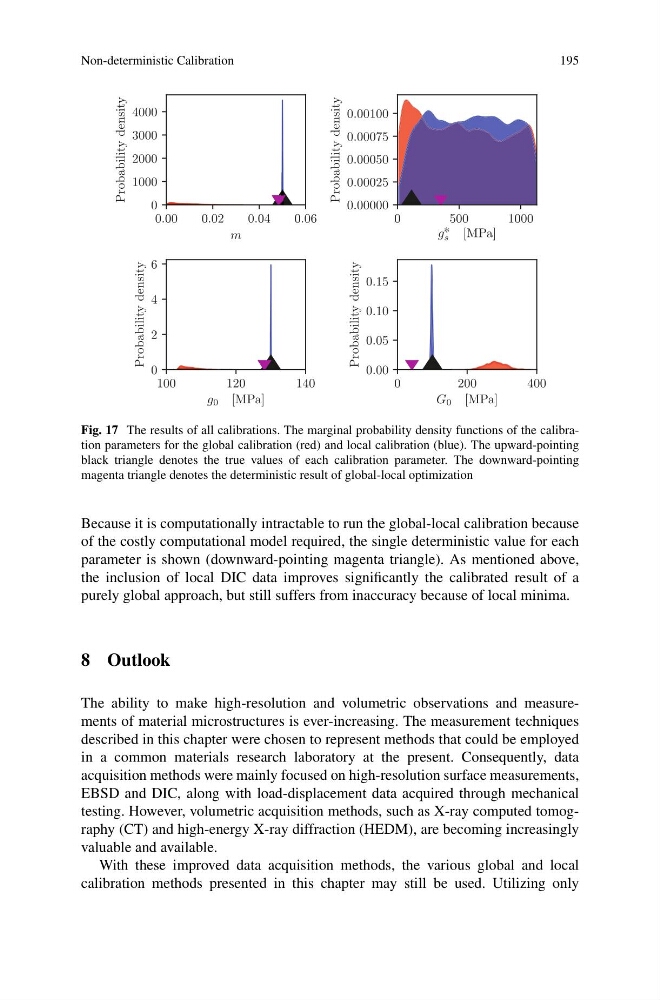
Fig. 17 The results of all calibrations. The marginal probability density functions of the calibration parameters for the global calibration (red) and local calibration (blue). The upward-pointing
black triangle denotes the true values of each calibration parameter. The downward-pointing
magenta triangle denotes the deterministic result of global-local optimization
Because it is computationally intractable to run the global-local calibration because
of the costly computational model required, the single deterministic value for each
parameter is shown (downward-pointing magenta triangle). As mentioned above,
the inclusion of local DIC data improves significantly the calibrated result of a
purely global approach, but still suffers from inaccuracy because of local minima.
8 Outlook
The ability to make high-resolution and volumetric observations and measurements of material microstructures is ever-increasing. The measurement techniques
described in this chapter were chosen to represent methods that could be employed
in a common materials research laboratory at the present. Consequently, data
acquisition methods were mainly focused on high-resolution surface measurements,
EBSD and DIC, along with load-displacement data acquired through mechanical
testing. However, volumetric acquisition methods, such as X-ray computed tomography (CT) and high-energy X-ray diffraction (HEDM), are becoming increasingly
valuable and available.
With these improved data acquisition methods, the various global and local
calibration methods presented in this chapter may still be used. Utilizing only
195
0.00
0.02
0.04
0.06
m
0
1000
2000
3000
4000
Probability density
0
500
1000
g s [MPa]
0.00000
0.00025
0.00050
0.00075
0.00100
Probability density
100
120
140
g 0 [MPa]
0
2
4
6
Probability density
0
200
400
G 0 [MPa]
0.00
0.05
0.10
0.15
Probability density
Fig. 17 The results of all calibrations. The marginal probability density functions of the calibration parameters for the global calibration (red) and local calibration (blue). The upward-pointing
black triangle denotes the true values of each calibration parameter. The downward-pointing
magenta triangle denotes the deterministic result of global-local optimization
Because it is computationally intractable to run the global-local calibration because
of the costly computational model required, the single deterministic value for each
parameter is shown (downward-pointing magenta triangle). As mentioned above,
the inclusion of local DIC data improves significantly the calibrated result of a
purely global approach, but still suffers from inaccuracy because of local minima.
8 Outlook
The ability to make high-resolution and volumetric observations and measurements of material microstructures is ever-increasing. The measurement techniques
described in this chapter were chosen to represent methods that could be employed
in a common materials research laboratory at the present. Consequently, data
acquisition methods were mainly focused on high-resolution surface measurements,
EBSD and DIC, along with load-displacement data acquired through mechanical
testing. However, volumetric acquisition methods, such as X-ray computed tomography (CT) and high-energy X-ray diffraction (HEDM), are becoming increasingly
valuable and available.
With these improved data acquisition methods, the various global and local
calibration methods presented in this chapter may still be used. Utilizing only