

170
J. Hochhalter et al.
A fundamental aspect of DIC is that the specimen surface must contain sufficient
features such that obtained images can be used to perform the correlation. While
there are examples of using natural surface variation for DIC in the literature, cf.
[19, 46], it is more common that a pattern must be applied to the specimen to make
up for sparse natural features. The applied surface pattern plays a large role in DIC,
namely, it affects the possible spatial resolution and accuracy of the measurements.
There are several patterning options available for measurements of deformations at
the grain scale, e.g., microstamping, lithography, and nanoparticle placement. For
a full review of available techniques, the reader is referred to the recent review
article of Dong and Pan [10]. Most importantly, the pattern needs to be visible
to the image capturing device; optical cameras and scanning electron microscopes
(SEM) are the two most common means of image capture for appropriately scaled
DIC of polycrystalline metals. Furthermore, those methods require different pattern
characteristics, e.g., pattern features must be opaque to electrons for optimal image
contrast in SEM and opaque to visible light with optical cameras.
2.2.2 High-Resolution EBSD
EBSD is a well-established scanning electron microscope-based diffraction technique that may be used to determine local crystallographic orientation on a specimen
surface. With respect to modeling, it may be used to determine the grain structure
of a specific specimen [47] or to acquire statistical data about grain texture and
morphology for a given material [8, 45]. HREBSD is a means of extracting the
elastic deformation gradient of one diffraction pattern compared to another via
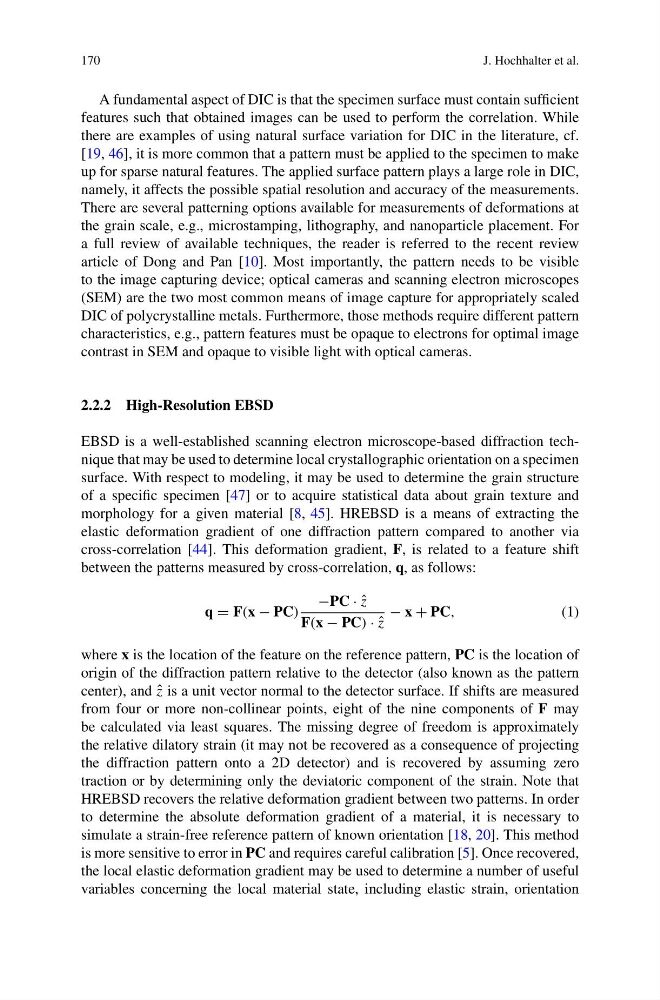
cross-correlation [44]. This deformation gradient, F, is related to a feature shift
between the patterns measured by cross-correlation, q, as follows:
q = F(x − PC)
−PC · ˆ
z
F(x − PC) · ˆ
z
− x + PC,
(1)
where x is the location of the feature on the reference pattern, PC is the location of
origin of the diffraction pattern relative to the detector (also known as the pattern
center), and ˆ
z is a unit vector normal to the detector surface. If shifts are measured
from four or more non-collinear points, eight of the nine components of F may
be calculated via least squares. The missing degree of freedom is approximately
the relative dilatory strain (it may not be recovered as a consequence of projecting
the diffraction pattern onto a 2D detector) and is recovered by assuming zero
traction or by determining only the deviatoric component of the strain. Note that
HREBSD recovers the relative deformation gradient between two patterns. In order
to determine the absolute deformation gradient of a material, it is necessary to
simulate a strain-free reference pattern of known orientation [18, 20]. This method
is more sensitive to error in PC and requires careful calibration [5]. Once recovered,
the local elastic deformation gradient may be used to determine a number of useful
variables concerning the local material state, including elastic strain, orientation
J. Hochhalter et al.
A fundamental aspect of DIC is that the specimen surface must contain sufficient
features such that obtained images can be used to perform the correlation. While
there are examples of using natural surface variation for DIC in the literature, cf.
[19, 46], it is more common that a pattern must be applied to the specimen to make
up for sparse natural features. The applied surface pattern plays a large role in DIC,
namely, it affects the possible spatial resolution and accuracy of the measurements.
There are several patterning options available for measurements of deformations at
the grain scale, e.g., microstamping, lithography, and nanoparticle placement. For
a full review of available techniques, the reader is referred to the recent review
article of Dong and Pan [10]. Most importantly, the pattern needs to be visible
to the image capturing device; optical cameras and scanning electron microscopes
(SEM) are the two most common means of image capture for appropriately scaled
DIC of polycrystalline metals. Furthermore, those methods require different pattern
characteristics, e.g., pattern features must be opaque to electrons for optimal image
contrast in SEM and opaque to visible light with optical cameras.
2.2.2 High-Resolution EBSD
EBSD is a well-established scanning electron microscope-based diffraction technique that may be used to determine local crystallographic orientation on a specimen
surface. With respect to modeling, it may be used to determine the grain structure
of a specific specimen [47] or to acquire statistical data about grain texture and
morphology for a given material [8, 45]. HREBSD is a means of extracting the
elastic deformation gradient of one diffraction pattern compared to another via
cross-correlation [44]. This deformation gradient, F, is related to a feature shift
between the patterns measured by cross-correlation, q, as follows:
q = F(x − PC)
−PC · ˆ
z
F(x − PC) · ˆ
z
− x + PC,
(1)
where x is the location of the feature on the reference pattern, PC is the location of
origin of the diffraction pattern relative to the detector (also known as the pattern
center), and ˆ
z is a unit vector normal to the detector surface. If shifts are measured
from four or more non-collinear points, eight of the nine components of F may
be calculated via least squares. The missing degree of freedom is approximately
the relative dilatory strain (it may not be recovered as a consequence of projecting
the diffraction pattern onto a 2D detector) and is recovered by assuming zero
traction or by determining only the deviatoric component of the strain. Note that
HREBSD recovers the relative deformation gradient between two patterns. In order
to determine the absolute deformation gradient of a material, it is necessary to
simulate a strain-free reference pattern of known orientation [18, 20]. This method
is more sensitive to error in PC and requires careful calibration [5]. Once recovered,
the local elastic deformation gradient may be used to determine a number of useful
variables concerning the local material state, including elastic strain, orientation