

Computational Micromechanics Modeling of Polycrystalline Superalloys. . .
159
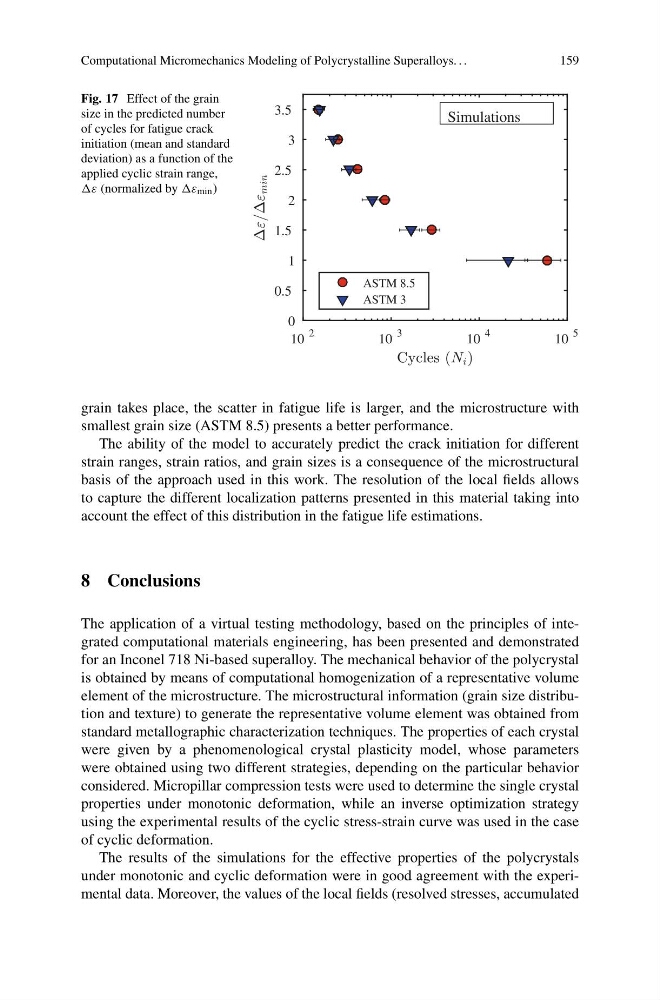
Fig. 17 Effect of the grain
size in the predicted number
of cycles for fatigue crack
initiation (mean and standard
deviation) as a function of the
applied cyclic strain range,
ε (normalized by ε min )
grain takes place, the scatter in fatigue life is larger, and the microstructure with
smallest grain size (ASTM 8.5) presents a better performance.
The ability of the model to accurately predict the crack initiation for different
strain ranges, strain ratios, and grain sizes is a consequence of the microstructural
basis of the approach used in this work. The resolution of the local fields allows
to capture the different localization patterns presented in this material taking into
account the effect of this distribution in the fatigue life estimations.
8 Conclusions
The application of a virtual testing methodology, based on the principles of integrated computational materials engineering, has been presented and demonstrated
for an Inconel 718 Ni-based superalloy. The mechanical behavior of the polycrystal
is obtained by means of computational homogenization of a representative volume
element of the microstructure. The microstructural information (grain size distribution and texture) to generate the representative volume element was obtained from
standard metallographic characterization techniques. The properties of each crystal
were given by a phenomenological crystal plasticity model, whose parameters
were obtained using two different strategies, depending on the particular behavior
considered. Micropillar compression tests were used to determine the single crystal
properties under monotonic deformation, while an inverse optimization strategy
using the experimental results of the cyclic stress-strain curve was used in the case
of cyclic deformation.
The results of the simulations for the effective properties of the polycrystals
under monotonic and cyclic deformation were in good agreement with the experimental data. Moreover, the values of the local fields (resolved stresses, accumulated
159
Fig. 17 Effect of the grain
size in the predicted number
of cycles for fatigue crack
initiation (mean and standard
deviation) as a function of the
applied cyclic strain range,
ε (normalized by ε min )
grain takes place, the scatter in fatigue life is larger, and the microstructure with
smallest grain size (ASTM 8.5) presents a better performance.
The ability of the model to accurately predict the crack initiation for different
strain ranges, strain ratios, and grain sizes is a consequence of the microstructural
basis of the approach used in this work. The resolution of the local fields allows
to capture the different localization patterns presented in this material taking into
account the effect of this distribution in the fatigue life estimations.
8 Conclusions
The application of a virtual testing methodology, based on the principles of integrated computational materials engineering, has been presented and demonstrated
for an Inconel 718 Ni-based superalloy. The mechanical behavior of the polycrystal
is obtained by means of computational homogenization of a representative volume
element of the microstructure. The microstructural information (grain size distribution and texture) to generate the representative volume element was obtained from
standard metallographic characterization techniques. The properties of each crystal
were given by a phenomenological crystal plasticity model, whose parameters
were obtained using two different strategies, depending on the particular behavior
considered. Micropillar compression tests were used to determine the single crystal
properties under monotonic deformation, while an inverse optimization strategy
using the experimental results of the cyclic stress-strain curve was used in the case
of cyclic deformation.
The results of the simulations for the effective properties of the polycrystals
under monotonic and cyclic deformation were in good agreement with the experimental data. Moreover, the values of the local fields (resolved stresses, accumulated