

152
A. Cruzado et al.
0
0.5
1
1.5
2
2.5
3
-1.5
-1
-0.5
0
0.5
1
1.5
(a)
(b)
(c)
(d)
0
1000 2000 3000 4000 5000 6000
-0.5
0
0.5
1
1.5
2
2.5
3
0
0.5
1
1.5
2
2.5
3
-1.5
-1
-0.5
0
0.5
1
1.5
0
100
200
300
400
-0.5
0
0.5
1
1.5
2
2.5
3
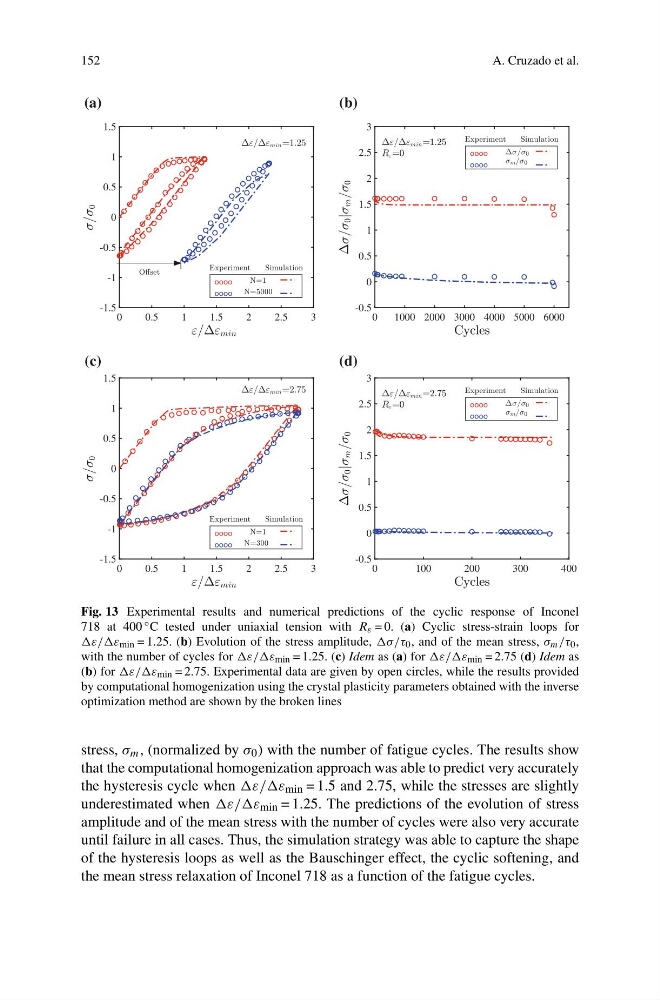
Fig. 13 Experimental results and numerical predictions of the cyclic response of Inconel
718 at 400 ◦ C tested under uniaxial tension with R ε = 0. (a) Cyclic stress-strain loops for
ε//ε min = 1.25. (b) Evolution of the stress amplitude, σ/τ 0 , and of the mean stress, σ m /τ 0 ,
with the number of cycles for ε//ε min = 1.25. (c) Idem as (a) for ε//ε min = 2.75 (d) Idem as
(b) for min = 2.75. Experimental data are given by open circles, while the results provided
by computational homogenization using the crystal plasticity parameters obtained with the inverse
optimization method are shown by the broken lines
stress, σ m , (normalized by σ 0 ) with the number of fatigue cycles. The results show
that the computational homogenization approach was able to predict very accurately
the hysteresis cycle when ε//ε min = 1.5 and 2.75, while the stresses are slightly
underestimated when ε//ε min = 1.25. The predictions of the evolution of stress
amplitude and of the mean stress with the number of cycles were also very accurate
until failure in all cases. Thus, the simulation strategy was able to capture the shape
of the hysteresis loops as well as the Bauschinger effect, the cyclic softening, and
the mean stress relaxation of Inconel 718 as a function of the fatigue cycles.
A. Cruzado et al.
0
0.5
1
1.5
2
2.5
3
-1.5
-1
-0.5
0
0.5
1
1.5
(a)
(b)
(c)
(d)
0
1000 2000 3000 4000 5000 6000
-0.5
0
0.5
1
1.5
2
2.5
3
0
0.5
1
1.5
2
2.5
3
-1.5
-1
-0.5
0
0.5
1
1.5
0
100
200
300
400
-0.5
0
0.5
1
1.5
2
2.5
3
Fig. 13 Experimental results and numerical predictions of the cyclic response of Inconel
718 at 400 ◦ C tested under uniaxial tension with R ε = 0. (a) Cyclic stress-strain loops for
ε//ε min = 1.25. (b) Evolution of the stress amplitude, σ/τ 0 , and of the mean stress, σ m /τ 0 ,
with the number of cycles for ε//ε min = 1.25. (c) Idem as (a) for ε//ε min = 2.75 (d) Idem as
(b) for min = 2.75. Experimental data are given by open circles, while the results provided
by computational homogenization using the crystal plasticity parameters obtained with the inverse
optimization method are shown by the broken lines
stress, σ m , (normalized by σ 0 ) with the number of fatigue cycles. The results show
that the computational homogenization approach was able to predict very accurately
the hysteresis cycle when ε//ε min = 1.5 and 2.75, while the stresses are slightly
underestimated when ε//ε min = 1.25. The predictions of the evolution of stress
amplitude and of the mean stress with the number of cycles were also very accurate
until failure in all cases. Thus, the simulation strategy was able to capture the shape
of the hysteresis loops as well as the Bauschinger effect, the cyclic softening, and
the mean stress relaxation of Inconel 718 as a function of the fatigue cycles.