

Computational Micromechanics Modeling of Polycrystalline Superalloys. . .
145
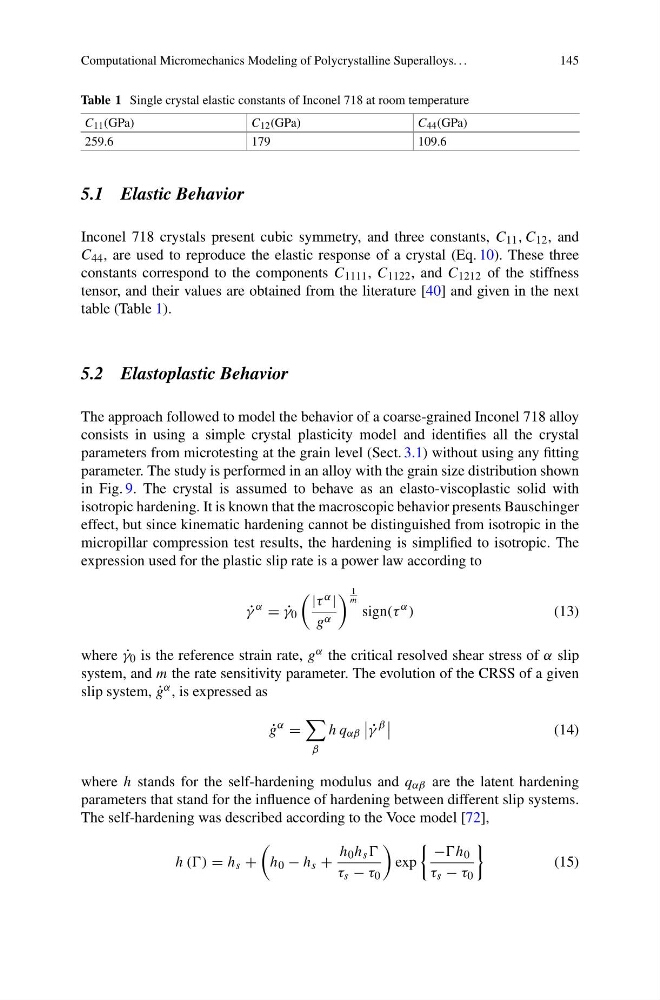
Table 1 Single crystal elastic constants of Inconel 718 at room temperature
C 11 (GPa)
C 12 (GPa)
C 44 (GPa)
259.6
179
109.6
5.1 Elastic Behavior
Inconel 718 crystals present cubic symmetry, and three constants, C 11 , C 12 , and
C 44 , are used to reproduce the elastic response of a crystal (Eq. 10). These three
constants correspond to the components C 1111 , C 1122 , and C 1212 of the stiffness
tensor, and their values are obtained from the literature [40] and given in the next
table (Table 1).
5.2 Elastoplastic Behavior
The approach followed to model the behavior of a coarse-grained Inconel 718 alloy
consists in using a simple crystal plasticity model and identifies all the crystal
parameters from microtesting at the grain level (Sect. 3.1) without using any fitting
parameter. The study is performed in an alloy with the grain size distribution shown
in Fig. 9. The crystal is assumed to behave as an elasto-viscoplastic solid with
isotropic hardening. It is known that the macroscopic behavior presents Bauschinger
effect, but since kinematic hardening cannot be distinguished from isotropic in the
micropillar compression test results, the hardening is simplified to isotropic. The
expression used for the plastic slip rate is a power law according to
˙
γ
α
= ˙
γ 0
|τ α |
g α
1
m
sign(τ
α )
(13)
where ˙
γ 0 is the reference strain rate, g α the critical resolved shear stress of α slip
system, and m the rate sensitivity parameter. The evolution of the CRSS of a given
slip system, ˙
g α , is expressed as
˙
g
α
=
β
h q αβ
˙
γ
β
(14)
where h stands for the self-hardening modulus and q αβ are the latent hardening
parameters that stand for the influence of hardening between different slip systems.
The self-hardening was described according to the Voce model [72],
h () = h s +
h 0 − h s +
h 0 h s
τ s − τ 0
exp
−h 0
τ s − τ 0
(15)
145
Table 1 Single crystal elastic constants of Inconel 718 at room temperature
C 11 (GPa)
C 12 (GPa)
C 44 (GPa)
259.6
179
109.6
5.1 Elastic Behavior
Inconel 718 crystals present cubic symmetry, and three constants, C 11 , C 12 , and
C 44 , are used to reproduce the elastic response of a crystal (Eq. 10). These three
constants correspond to the components C 1111 , C 1122 , and C 1212 of the stiffness
tensor, and their values are obtained from the literature [40] and given in the next
table (Table 1).
5.2 Elastoplastic Behavior
The approach followed to model the behavior of a coarse-grained Inconel 718 alloy
consists in using a simple crystal plasticity model and identifies all the crystal
parameters from microtesting at the grain level (Sect. 3.1) without using any fitting
parameter. The study is performed in an alloy with the grain size distribution shown
in Fig. 9. The crystal is assumed to behave as an elasto-viscoplastic solid with
isotropic hardening. It is known that the macroscopic behavior presents Bauschinger
effect, but since kinematic hardening cannot be distinguished from isotropic in the
micropillar compression test results, the hardening is simplified to isotropic. The
expression used for the plastic slip rate is a power law according to
˙
γ
α
= ˙
γ 0
|τ α |
g α
1
m
sign(τ
α )
(13)
where ˙
γ 0 is the reference strain rate, g α the critical resolved shear stress of α slip
system, and m the rate sensitivity parameter. The evolution of the CRSS of a given
slip system, ˙
g α , is expressed as
˙
g
α
=
β
h q αβ
˙
γ
β
(14)
where h stands for the self-hardening modulus and q αβ are the latent hardening
parameters that stand for the influence of hardening between different slip systems.
The self-hardening was described according to the Voce model [72],
h () = h s +
h 0 − h s +
h 0 h s
τ s − τ 0
exp
−h 0
τ s − τ 0
(15)