

138
A. Cruzado et al.
10
2
10
3
10
4
10
5
10
6
10
-4
10
-3
10
-2
10
-1
10
0
10
1
ASTM 8.5
ASTM 3
10
2
10
3
10
4
10
5
10 -2
10 -1
10 0
(a)
(b)
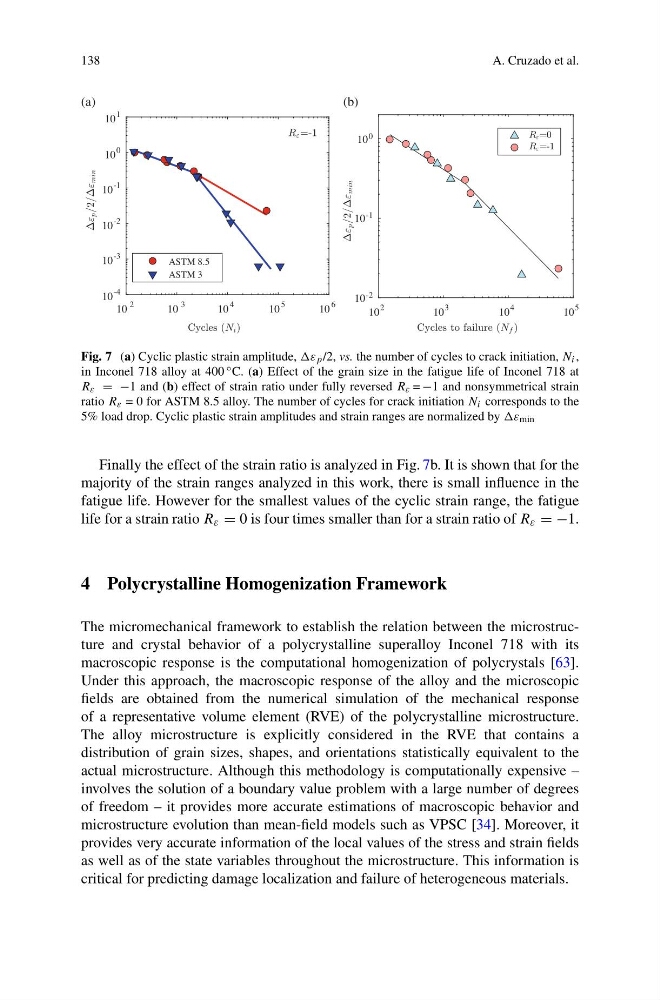
Fig. 7 (a) Cyclic plastic strain amplitude, ε p /2, vs. the number of cycles to crack initiation, N i ,
in Inconel 718 alloy at 400 ◦ C. (a) Effect of the grain size in the fatigue life of Inconel 718 at
R ε = −1 and (b) effect of strain ratio under fully reversed R ε = −1 and nonsymmetrical strain
ratio R ε = 0 for ASTM 8.5 alloy. The number of cycles for crack initiation N i corresponds to the
5% load drop. Cyclic plastic strain amplitudes and strain ranges are normalized by ε min
Finally the effect of the strain ratio is analyzed in Fig. 7b. It is shown that for the
majority of the strain ranges analyzed in this work, there is small influence in the
fatigue life. However for the smallest values of the cyclic strain range, the fatigue
life for a strain ratio R ε = 0 is four times smaller than for a strain ratio of R ε = −1.
4 Polycrystalline Homogenization Framework
The micromechanical framework to establish the relation between the microstructure and crystal behavior of a polycrystalline superalloy Inconel 718 with its
macroscopic response is the computational homogenization of polycrystals [63].
Under this approach, the macroscopic response of the alloy and the microscopic
fields are obtained from the numerical simulation of the mechanical response
of a representative volume element (RVE) of the polycrystalline microstructure.
The alloy microstructure is explicitly considered in the RVE that contains a
distribution of grain sizes, shapes, and orientations statistically equivalent to the
actual microstructure. Although this methodology is computationally expensive –
involves the solution of a boundary value problem with a large number of degrees
of freedom – it provides more accurate estimations of macroscopic behavior and
microstructure evolution than mean-field models such as VPSC [34]. Moreover, it
provides very accurate information of the local values of the stress and strain fields
as well as of the state variables throughout the microstructure. This information is
critical for predicting damage localization and failure of heterogeneous materials.
A. Cruzado et al.
10
2
10
3
10
4
10
5
10
6
10
-4
10
-3
10
-2
10
-1
10
0
10
1
ASTM 8.5
ASTM 3
10
2
10
3
10
4
10
5
10 -2
10 -1
10 0
(a)
(b)
Fig. 7 (a) Cyclic plastic strain amplitude, ε p /2, vs. the number of cycles to crack initiation, N i ,
in Inconel 718 alloy at 400 ◦ C. (a) Effect of the grain size in the fatigue life of Inconel 718 at
R ε = −1 and (b) effect of strain ratio under fully reversed R ε = −1 and nonsymmetrical strain
ratio R ε = 0 for ASTM 8.5 alloy. The number of cycles for crack initiation N i corresponds to the
5% load drop. Cyclic plastic strain amplitudes and strain ranges are normalized by ε min
Finally the effect of the strain ratio is analyzed in Fig. 7b. It is shown that for the
majority of the strain ranges analyzed in this work, there is small influence in the
fatigue life. However for the smallest values of the cyclic strain range, the fatigue
life for a strain ratio R ε = 0 is four times smaller than for a strain ratio of R ε = −1.
4 Polycrystalline Homogenization Framework
The micromechanical framework to establish the relation between the microstructure and crystal behavior of a polycrystalline superalloy Inconel 718 with its
macroscopic response is the computational homogenization of polycrystals [63].
Under this approach, the macroscopic response of the alloy and the microscopic
fields are obtained from the numerical simulation of the mechanical response
of a representative volume element (RVE) of the polycrystalline microstructure.
The alloy microstructure is explicitly considered in the RVE that contains a
distribution of grain sizes, shapes, and orientations statistically equivalent to the
actual microstructure. Although this methodology is computationally expensive –
involves the solution of a boundary value problem with a large number of degrees
of freedom – it provides more accurate estimations of macroscopic behavior and
microstructure evolution than mean-field models such as VPSC [34]. Moreover, it
provides very accurate information of the local values of the stress and strain fields
as well as of the state variables throughout the microstructure. This information is
critical for predicting damage localization and failure of heterogeneous materials.