

136
A. Cruzado et al.
Experimental
Pure kinematic
Pure isotropic
0
500
1000
Cycles
0
0.04 1
0.08 1
0.12 1
m
0
500
1000
Cycles
- 1
-0.5 1
0
0.5 1
1
Max/Min Stress
(c)
(a)
(d)
(b)
0
1
2
3
0
0.2
0.4
0.6
0.8
1
1.2
1.4
ASTM 8.5
ASTM3
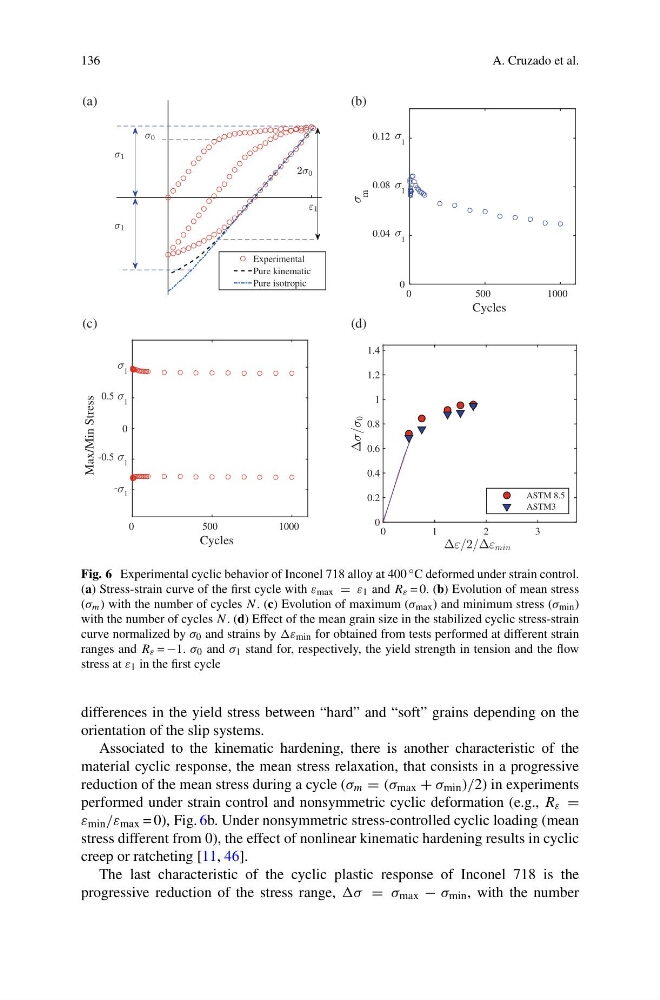
Fig. 6 Experimental cyclic behavior of Inconel 718 alloy at 400 ◦ C deformed under strain control.
(a) Stress-strain curve of the first cycle with ε max = ε 1 and R ε = 0. (b) Evolution of mean stress
(σ m ) with the number of cycles N . (c) Evolution of maximum (σ max ) and minimum stress (σ min )
with the number of cycles N . (d) Effect of the mean grain size in the stabilized cyclic stress-strain
curve normalized by σ 0 and strains by ε min for obtained from tests performed at different strain
ranges and R ε = −1. σ 0 and σ 1 stand for, respectively, the yield strength in tension and the flow
stress at ε 1 in the first cycle
differences in the yield stress between “hard” and “soft” grains depending on the
orientation of the slip systems.
Associated to the kinematic hardening, there is another characteristic of the
material cyclic response, the mean stress relaxation, that consists in a progressive
reduction of the mean stress during a cycle (σ m = (σ max + σ min )/2) in experiments
performed under strain control and nonsymmetric cyclic deformation (e.g., R ε =
ε min /ε max = 0), Fig. 6b. Under nonsymmetric stress-controlled cyclic loading (mean
stress different from 0), the effect of nonlinear kinematic hardening results in cyclic
creep or ratcheting [11, 46].
The last characteristic of the cyclic plastic response of Inconel 718 is the
progressive reduction of the stress range, σ = σ max − σ min , with the number
A. Cruzado et al.
Experimental
Pure kinematic
Pure isotropic
0
500
1000
Cycles
0
0.04 1
0.08 1
0.12 1
m
0
500
1000
Cycles
- 1
-0.5 1
0
0.5 1
1
Max/Min Stress
(c)
(a)
(d)
(b)
0
1
2
3
0
0.2
0.4
0.6
0.8
1
1.2
1.4
ASTM 8.5
ASTM3
Fig. 6 Experimental cyclic behavior of Inconel 718 alloy at 400 ◦ C deformed under strain control.
(a) Stress-strain curve of the first cycle with ε max = ε 1 and R ε = 0. (b) Evolution of mean stress
(σ m ) with the number of cycles N . (c) Evolution of maximum (σ max ) and minimum stress (σ min )
with the number of cycles N . (d) Effect of the mean grain size in the stabilized cyclic stress-strain
curve normalized by σ 0 and strains by ε min for obtained from tests performed at different strain
ranges and R ε = −1. σ 0 and σ 1 stand for, respectively, the yield strength in tension and the flow
stress at ε 1 in the first cycle
differences in the yield stress between “hard” and “soft” grains depending on the
orientation of the slip systems.
Associated to the kinematic hardening, there is another characteristic of the
material cyclic response, the mean stress relaxation, that consists in a progressive
reduction of the mean stress during a cycle (σ m = (σ max + σ min )/2) in experiments
performed under strain control and nonsymmetric cyclic deformation (e.g., R ε =
ε min /ε max = 0), Fig. 6b. Under nonsymmetric stress-controlled cyclic loading (mean
stress different from 0), the effect of nonlinear kinematic hardening results in cyclic
creep or ratcheting [11, 46].
The last characteristic of the cyclic plastic response of Inconel 718 is the
progressive reduction of the stress range, σ = σ max − σ min , with the number