

Computational Micromechanics Modeling of Polycrystalline Superalloys. . .
131
0
0.02 0.04 0.06 0.08
0.1
0.12
0
200
400
600
800
1000
0
0.02 0.04 0.06 0.08
0.12
0
200
400
600
800
1000
(a)
(b)
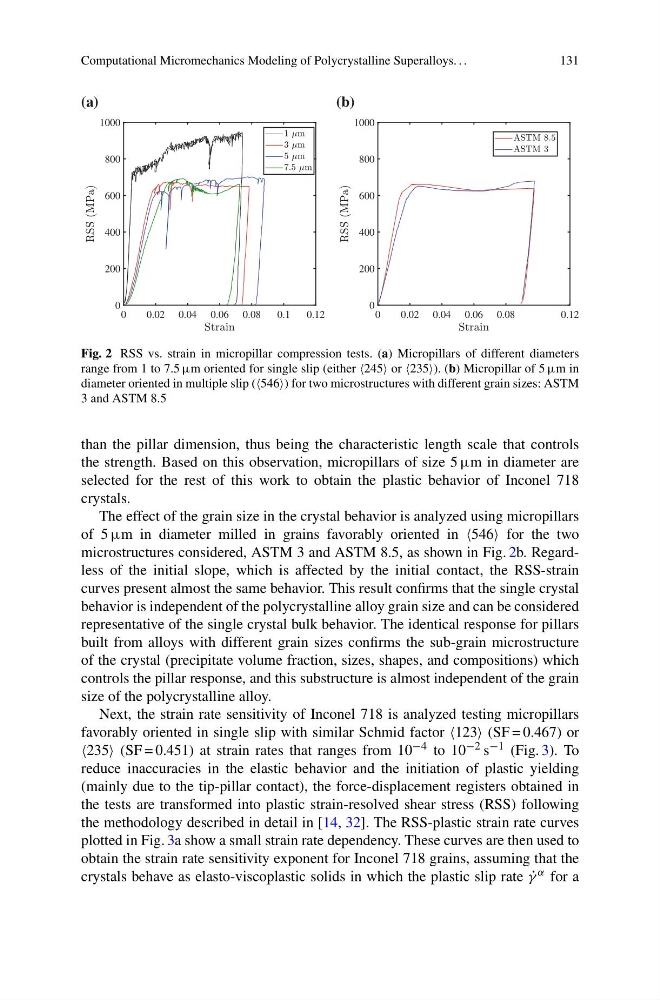
Fig. 2 RSS vs. strain in micropillar compression tests. (a) Micropillars of different diameters
range from 1 to 7.5 μm oriented for single slip (either 245 or 235). (b) Micropillar of 5 μm in
diameter oriented in multiple slip (546) for two microstructures with different grain sizes: ASTM
3 and ASTM 8.5
than the pillar dimension, thus being the characteristic length scale that controls
the strength. Based on this observation, micropillars of size 5 μm in diameter are
selected for the rest of this work to obtain the plastic behavior of Inconel 718
crystals.
The effect of the grain size in the crystal behavior is analyzed using micropillars
of 5 μm in diameter milled in grains favorably oriented in 546 for the two
microstructures considered, ASTM 3 and ASTM 8.5, as shown in Fig. 2b. Regardless of the initial slope, which is affected by the initial contact, the RSS-strain
curves present almost the same behavior. This result confirms that the single crystal
behavior is independent of the polycrystalline alloy grain size and can be considered
representative of the single crystal bulk behavior. The identical response for pillars
built from alloys with different grain sizes confirms the sub-grain microstructure
of the crystal (precipitate volume fraction, sizes, shapes, and compositions) which
controls the pillar response, and this substructure is almost independent of the grain
size of the polycrystalline alloy.
Next, the strain rate sensitivity of Inconel 718 is analyzed testing micropillars
favorably oriented in single slip with similar Schmid factor 123 (SF = 0.467) or
235 (SF = 0.451) at strain rates that ranges from 10 −4 to 10 −2 s −1 (Fig. 3). To
reduce inaccuracies in the elastic behavior and the initiation of plastic yielding
(mainly due to the tip-pillar contact), the force-displacement registers obtained in
the tests are transformed into plastic strain-resolved shear stress (RSS) following
the methodology described in detail in [14, 32]. The RSS-plastic strain rate curves
plotted in Fig. 3a show a small strain rate dependency. These curves are then used to
obtain the strain rate sensitivity exponent for Inconel 718 grains, assuming that the
crystals behave as elasto-viscoplastic solids in which the plastic slip rate ˙
γ α for a
131
0
0.02 0.04 0.06 0.08
0.1
0.12
0
200
400
600
800
1000
0
0.02 0.04 0.06 0.08
0.12
0
200
400
600
800
1000
(a)
(b)
Fig. 2 RSS vs. strain in micropillar compression tests. (a) Micropillars of different diameters
range from 1 to 7.5 μm oriented for single slip (either 245 or 235). (b) Micropillar of 5 μm in
diameter oriented in multiple slip (546) for two microstructures with different grain sizes: ASTM
3 and ASTM 8.5
than the pillar dimension, thus being the characteristic length scale that controls
the strength. Based on this observation, micropillars of size 5 μm in diameter are
selected for the rest of this work to obtain the plastic behavior of Inconel 718
crystals.
The effect of the grain size in the crystal behavior is analyzed using micropillars
of 5 μm in diameter milled in grains favorably oriented in 546 for the two
microstructures considered, ASTM 3 and ASTM 8.5, as shown in Fig. 2b. Regardless of the initial slope, which is affected by the initial contact, the RSS-strain
curves present almost the same behavior. This result confirms that the single crystal
behavior is independent of the polycrystalline alloy grain size and can be considered
representative of the single crystal bulk behavior. The identical response for pillars
built from alloys with different grain sizes confirms the sub-grain microstructure
of the crystal (precipitate volume fraction, sizes, shapes, and compositions) which
controls the pillar response, and this substructure is almost independent of the grain
size of the polycrystalline alloy.
Next, the strain rate sensitivity of Inconel 718 is analyzed testing micropillars
favorably oriented in single slip with similar Schmid factor 123 (SF = 0.467) or
235 (SF = 0.451) at strain rates that ranges from 10 −4 to 10 −2 s −1 (Fig. 3). To
reduce inaccuracies in the elastic behavior and the initiation of plastic yielding
(mainly due to the tip-pillar contact), the force-displacement registers obtained in
the tests are transformed into plastic strain-resolved shear stress (RSS) following
the methodology described in detail in [14, 32]. The RSS-plastic strain rate curves
plotted in Fig. 3a show a small strain rate dependency. These curves are then used to
obtain the strain rate sensitivity exponent for Inconel 718 grains, assuming that the
crystals behave as elasto-viscoplastic solids in which the plastic slip rate ˙
γ α for a