

Computational Micromechanics Modeling of Polycrystalline Superalloys. . .
129
Carbides
phase
' phase
'' phase
50 mm
20 nm
(b)
(a)
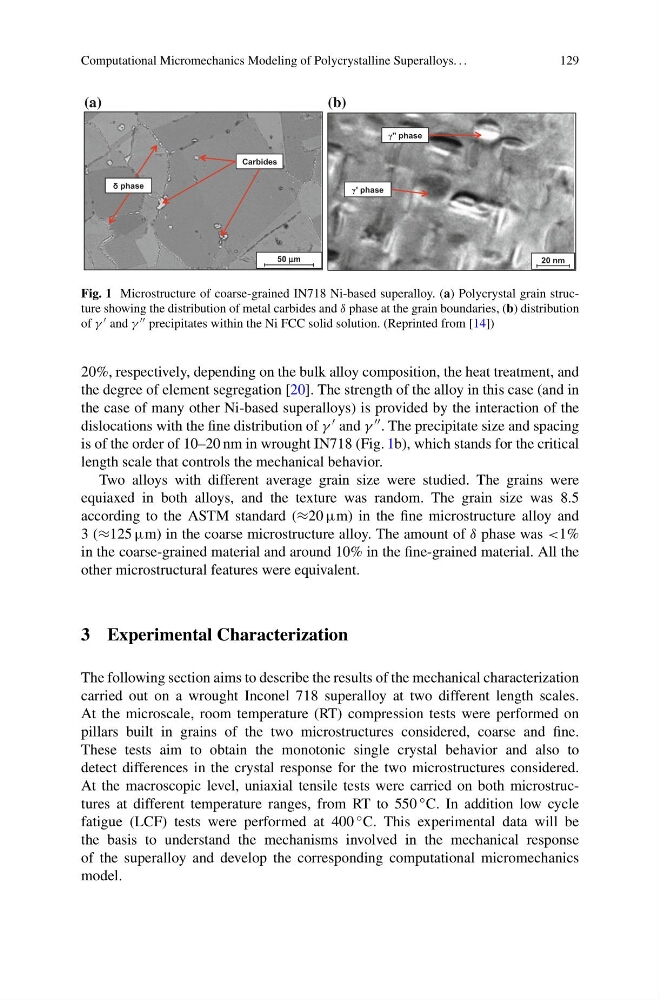
Fig. 1 Microstructure of coarse-grained IN718 Ni-based superalloy. (a) Polycrystal grain structure showing the distribution of metal carbides and δ phase at the grain boundaries, (b) distribution
of γ and γ precipitates within the Ni FCC solid solution. (Reprinted from [14])
20%, respectively, depending on the bulk alloy composition, the heat treatment, and
the degree of element segregation [20]. The strength of the alloy in this case (and in
the case of many other Ni-based superalloys) is provided by the interaction of the
dislocations with the fine distribution of γ and γ . The precipitate size and spacing
is of the order of 10–20 nm in wrought IN718 (Fig. 1b), which stands for the critical
length scale that controls the mechanical behavior.
Two alloys with different average grain size were studied. The grains were
equiaxed in both alloys, and the texture was random. The grain size was 8.5
according to the ASTM standard (≈20 μm) in the fine microstructure alloy and
3 (≈125 μm) in the coarse microstructure alloy. The amount of δ phase was <1%
in the coarse-grained material and around 10% in the fine-grained material. All the
other microstructural features were equivalent.
3 Experimental Characterization
The following section aims to describe the results of the mechanical characterization
carried out on a wrought Inconel 718 superalloy at two different length scales.
At the microscale, room temperature (RT) compression tests were performed on
pillars built in grains of the two microstructures considered, coarse and fine.
These tests aim to obtain the monotonic single crystal behavior and also to
detect differences in the crystal response for the two microstructures considered.
At the macroscopic level, uniaxial tensile tests were carried on both microstructures at different temperature ranges, from RT to 550 ◦ C. In addition low cycle
fatigue (LCF) tests were performed at 400 ◦ C. This experimental data will be
the basis to understand the mechanisms involved in the mechanical response
of the superalloy and develop the corresponding computational micromechanics
model.
129
Carbides
phase
' phase
'' phase
50 mm
20 nm
(b)
(a)
Fig. 1 Microstructure of coarse-grained IN718 Ni-based superalloy. (a) Polycrystal grain structure showing the distribution of metal carbides and δ phase at the grain boundaries, (b) distribution
of γ and γ precipitates within the Ni FCC solid solution. (Reprinted from [14])
20%, respectively, depending on the bulk alloy composition, the heat treatment, and
the degree of element segregation [20]. The strength of the alloy in this case (and in
the case of many other Ni-based superalloys) is provided by the interaction of the
dislocations with the fine distribution of γ and γ . The precipitate size and spacing
is of the order of 10–20 nm in wrought IN718 (Fig. 1b), which stands for the critical
length scale that controls the mechanical behavior.
Two alloys with different average grain size were studied. The grains were
equiaxed in both alloys, and the texture was random. The grain size was 8.5
according to the ASTM standard (≈20 μm) in the fine microstructure alloy and
3 (≈125 μm) in the coarse microstructure alloy. The amount of δ phase was <1%
in the coarse-grained material and around 10% in the fine-grained material. All the
other microstructural features were equivalent.
3 Experimental Characterization
The following section aims to describe the results of the mechanical characterization
carried out on a wrought Inconel 718 superalloy at two different length scales.
At the microscale, room temperature (RT) compression tests were performed on
pillars built in grains of the two microstructures considered, coarse and fine.
These tests aim to obtain the monotonic single crystal behavior and also to
detect differences in the crystal response for the two microstructures considered.
At the macroscopic level, uniaxial tensile tests were carried on both microstructures at different temperature ranges, from RT to 550 ◦ C. In addition low cycle
fatigue (LCF) tests were performed at 400 ◦ C. This experimental data will be
the basis to understand the mechanisms involved in the mechanical response
of the superalloy and develop the corresponding computational micromechanics
model.