

108
D. W. Eastman et al.
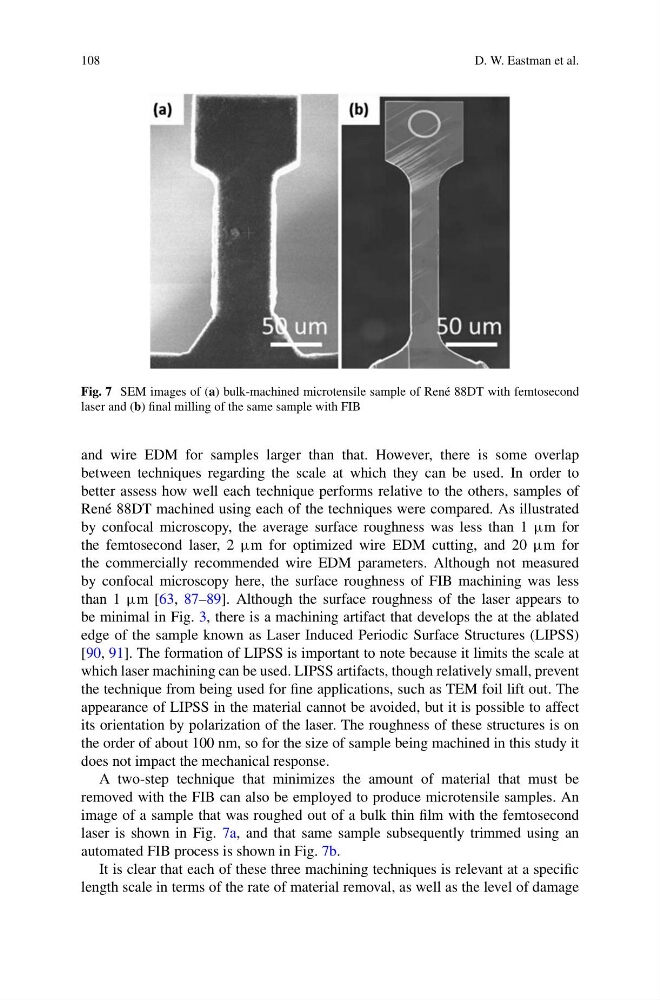
Fig. 7 SEM images of (a) bulk-machined microtensile sample of René 88DT with femtosecond
laser and (b) final milling of the same sample with FIB
and wire EDM for samples larger than that. However, there is some overlap
between techniques regarding the scale at which they can be used. In order to
better assess how well each technique performs relative to the others, samples of
René 88DT machined using each of the techniques were compared. As illustrated
by confocal microscopy, the average surface roughness was less than 1 μm for
the femtosecond laser, 2 μm for optimized wire EDM cutting, and 20 μm for
the commercially recommended wire EDM parameters. Although not measured
by confocal microscopy here, the surface roughness of FIB machining was less
than 1 μm [63, 87–89]. Although the surface roughness of the laser appears to
be minimal in Fig. 3, there is a machining artifact that develops the at the ablated
edge of the sample known as Laser Induced Periodic Surface Structures (LIPSS)
[90, 91]. The formation of LIPSS is important to note because it limits the scale at
which laser machining can be used. LIPSS artifacts, though relatively small, prevent
the technique from being used for fine applications, such as TEM foil lift out. The
appearance of LIPSS in the material cannot be avoided, but it is possible to affect
its orientation by polarization of the laser. The roughness of these structures is on
the order of about 100 nm, so for the size of sample being machined in this study it
does not impact the mechanical response.
A two-step technique that minimizes the amount of material that must be
removed with the FIB can also be employed to produce microtensile samples. An
image of a sample that was roughed out of a bulk thin film with the femtosecond
laser is shown in Fig. 7a, and that same sample subsequently trimmed using an
automated FIB process is shown in Fig. 7b.
It is clear that each of these three machining techniques is relevant at a specific
length scale in terms of the rate of material removal, as well as the level of damage
D. W. Eastman et al.
Fig. 7 SEM images of (a) bulk-machined microtensile sample of René 88DT with femtosecond
laser and (b) final milling of the same sample with FIB
and wire EDM for samples larger than that. However, there is some overlap
between techniques regarding the scale at which they can be used. In order to
better assess how well each technique performs relative to the others, samples of
René 88DT machined using each of the techniques were compared. As illustrated
by confocal microscopy, the average surface roughness was less than 1 μm for
the femtosecond laser, 2 μm for optimized wire EDM cutting, and 20 μm for
the commercially recommended wire EDM parameters. Although not measured
by confocal microscopy here, the surface roughness of FIB machining was less
than 1 μm [63, 87–89]. Although the surface roughness of the laser appears to
be minimal in Fig. 3, there is a machining artifact that develops the at the ablated
edge of the sample known as Laser Induced Periodic Surface Structures (LIPSS)
[90, 91]. The formation of LIPSS is important to note because it limits the scale at
which laser machining can be used. LIPSS artifacts, though relatively small, prevent
the technique from being used for fine applications, such as TEM foil lift out. The
appearance of LIPSS in the material cannot be avoided, but it is possible to affect
its orientation by polarization of the laser. The roughness of these structures is on
the order of about 100 nm, so for the size of sample being machined in this study it
does not impact the mechanical response.
A two-step technique that minimizes the amount of material that must be
removed with the FIB can also be employed to produce microtensile samples. An
image of a sample that was roughed out of a bulk thin film with the femtosecond
laser is shown in Fig. 7a, and that same sample subsequently trimmed using an
automated FIB process is shown in Fig. 7b.
It is clear that each of these three machining techniques is relevant at a specific
length scale in terms of the rate of material removal, as well as the level of damage