

78
Chapter 6. Modelling asymmetric relationships with multiple types
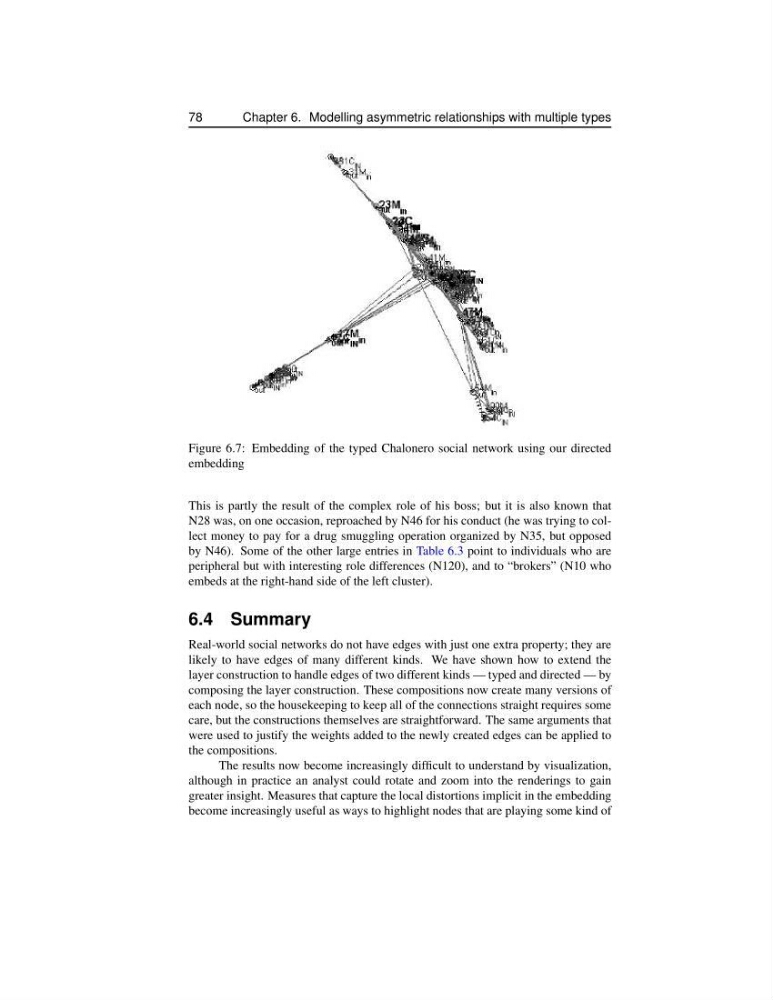
Figure 6.7: Embedding of the typed Chalonero social network using our directed
embedding
This is partly the result of the complex role of his boss; but it is also known that
N28 was, on one occasion, reproached by N46 for his conduct (he was trying to collect money to pay for a drug smuggling operation organized by N35, but opposed
by N46). Some of the other large entries in Table 6.3 point to individuals who are
peripheral but with interesting role differences (N120), and to “brokers” (N10 who
embeds at the right-hand side of the left cluster).
6.4 Summary
Real-world social networks do not have edges with just one extra property; they are
likely to have edges of many different kinds. We have shown how to extend the
layer construction to handle edges of two different kinds — typed and directed — by
composing the layer construction. These compositions now create many versions of
each node, so the housekeeping to keep all of the connections straight requires some
care, but the constructions themselves are straightforward. The same arguments that
were used to justify the weights added to the newly created edges can be applied to
the compositions.
The results now become increasingly difficult to understand by visualization,
although in practice an analyst could rotate and zoom into the renderings to gain
greater insight. Measures that capture the local distortions implicit in the embedding
become increasingly useful as ways to highlight nodes that are playing some kind of
Chapter 6. Modelling asymmetric relationships with multiple types
Figure 6.7: Embedding of the typed Chalonero social network using our directed
embedding
This is partly the result of the complex role of his boss; but it is also known that
N28 was, on one occasion, reproached by N46 for his conduct (he was trying to collect money to pay for a drug smuggling operation organized by N35, but opposed
by N46). Some of the other large entries in Table 6.3 point to individuals who are
peripheral but with interesting role differences (N120), and to “brokers” (N10 who
embeds at the right-hand side of the left cluster).
6.4 Summary
Real-world social networks do not have edges with just one extra property; they are
likely to have edges of many different kinds. We have shown how to extend the
layer construction to handle edges of two different kinds — typed and directed — by
composing the layer construction. These compositions now create many versions of
each node, so the housekeeping to keep all of the connections straight requires some
care, but the constructions themselves are straightforward. The same arguments that
were used to justify the weights added to the newly created edges can be applied to
the compositions.
The results now become increasingly difficult to understand by visualization,
although in practice an analyst could rotate and zoom into the renderings to gain
greater insight. Measures that capture the local distortions implicit in the embedding
become increasingly useful as ways to highlight nodes that are playing some kind of