

70
Chapter 6. Modelling asymmetric relationships with multiple types
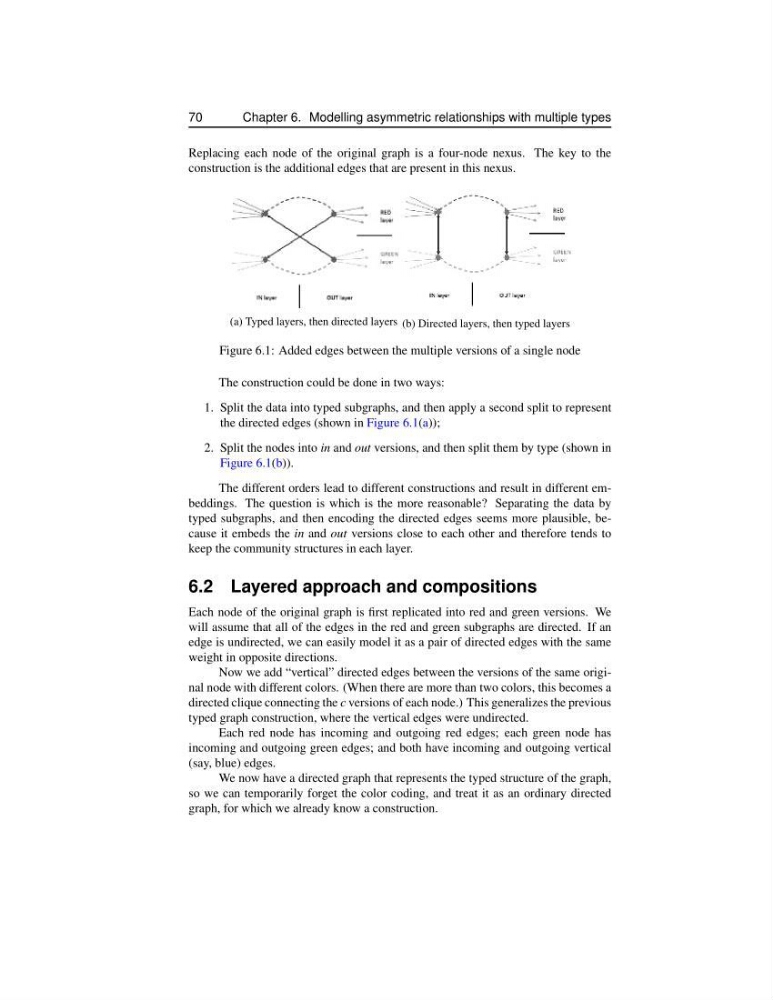
Replacing each node of the original graph is a four-node nexus. The key to the
construction is the additional edges that are present in this nexus.
(a) Typed layers, then directed layers (b) Directed layers, then typed layers
Figure 6.1: Added edges between the multiple versions of a single node
The construction could be done in two ways:
1. Split the data into typed subgraphs, and then apply a second split to represent
the directed edges (shown in Figure 6.1(a));
2. Split the nodes into in and out versions, and then split them by type (shown in
Figure 6.1(b)).
The different orders lead to different constructions and result in different embeddings. The question is which is the more reasonable? Separating the data by
typed subgraphs, and then encoding the directed edges seems more plausible, because it embeds the in and out versions close to each other and therefore tends to
keep the community structures in each layer.
6.2 Layered approach and compositions
Each node of the original graph is first replicated into red and green versions. We
will assume that all of the edges in the red and green subgraphs are directed. If an
edge is undirected, we can easily model it as a pair of directed edges with the same
weight in opposite directions.
Now we add “vertical” directed edges between the versions of the same original node with different colors. (When there are more than two colors, this becomes a
directed clique connecting the c versions of each node.) This generalizes the previous
typed graph construction, where the vertical edges were undirected.
Each red node has incoming and outgoing red edges; each green node has
incoming and outgoing green edges; and both have incoming and outgoing vertical
(say, blue) edges.
We now have a directed graph that represents the typed structure of the graph,
so we can temporarily forget the color coding, and treat it as an ordinary directed
graph, for which we already know a construction.
Chapter 6. Modelling asymmetric relationships with multiple types
Replacing each node of the original graph is a four-node nexus. The key to the
construction is the additional edges that are present in this nexus.
(a) Typed layers, then directed layers (b) Directed layers, then typed layers
Figure 6.1: Added edges between the multiple versions of a single node
The construction could be done in two ways:
1. Split the data into typed subgraphs, and then apply a second split to represent
the directed edges (shown in Figure 6.1(a));
2. Split the nodes into in and out versions, and then split them by type (shown in
Figure 6.1(b)).
The different orders lead to different constructions and result in different embeddings. The question is which is the more reasonable? Separating the data by
typed subgraphs, and then encoding the directed edges seems more plausible, because it embeds the in and out versions close to each other and therefore tends to
keep the community structures in each layer.
6.2 Layered approach and compositions
Each node of the original graph is first replicated into red and green versions. We
will assume that all of the edges in the red and green subgraphs are directed. If an
edge is undirected, we can easily model it as a pair of directed edges with the same
weight in opposite directions.
Now we add “vertical” directed edges between the versions of the same original node with different colors. (When there are more than two colors, this becomes a
directed clique connecting the c versions of each node.) This generalizes the previous
typed graph construction, where the vertical edges were undirected.
Each red node has incoming and outgoing red edges; each green node has
incoming and outgoing green edges; and both have incoming and outgoing vertical
(say, blue) edges.
We now have a directed graph that represents the typed structure of the graph,
so we can temporarily forget the color coding, and treat it as an ordinary directed
graph, for which we already know a construction.