

4.4. Summary
39
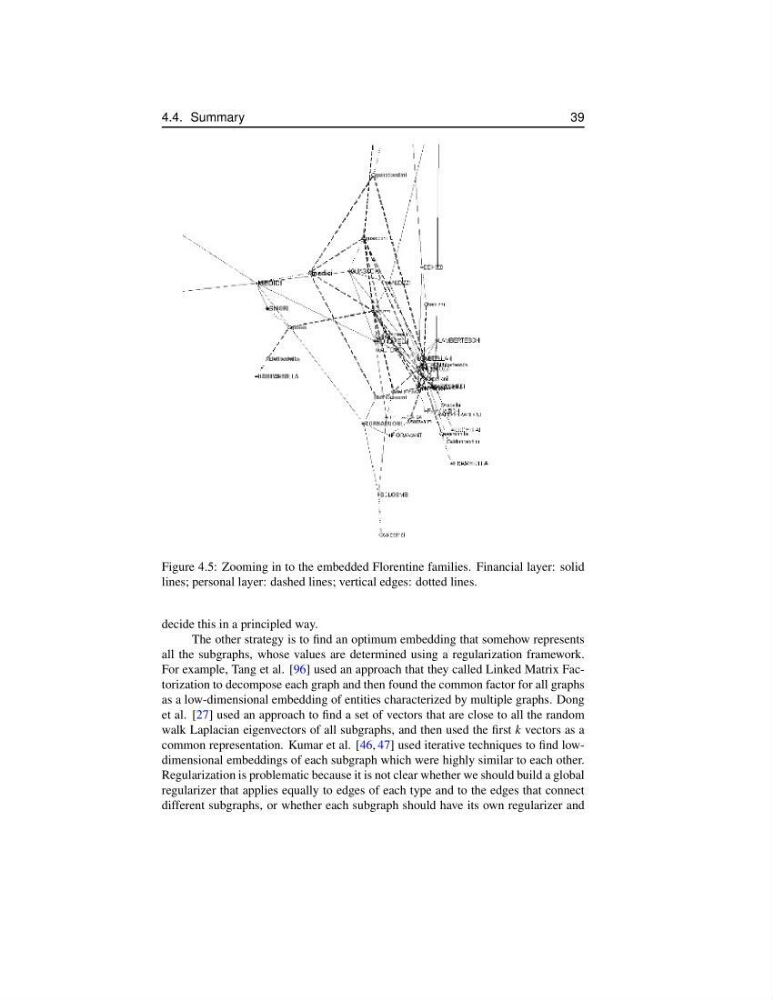
Figure 4.5: Zooming in to the embedded Florentine families. Financial layer: solid
lines; personal layer: dashed lines; vertical edges: dotted lines.
decide this in a principled way.
The other strategy is to find an optimum embedding that somehow represents
all the subgraphs, whose values are determined using a regularization framework.
For example, Tang et al. [96] used an approach that they called Linked Matrix Factorization to decompose each graph and then found the common factor for all graphs
as a low-dimensional embedding of entities characterized by multiple graphs. Dong
et al. [27] used an approach to find a set of vectors that are close to all the random
walk Laplacian eigenvectors of all subgraphs, and then used the first k vectors as a
common representation. Kumar et al. [46, 47] used iterative techniques to find lowdimensional embeddings of each subgraph which were highly similar to each other.
Regularization is problematic because it is not clear whether we should build a global
regularizer that applies equally to edges of each type and to the edges that connect
different subgraphs, or whether each subgraph should have its own regularizer and
39
Figure 4.5: Zooming in to the embedded Florentine families. Financial layer: solid
lines; personal layer: dashed lines; vertical edges: dotted lines.
decide this in a principled way.
The other strategy is to find an optimum embedding that somehow represents
all the subgraphs, whose values are determined using a regularization framework.
For example, Tang et al. [96] used an approach that they called Linked Matrix Factorization to decompose each graph and then found the common factor for all graphs
as a low-dimensional embedding of entities characterized by multiple graphs. Dong
et al. [27] used an approach to find a set of vectors that are close to all the random
walk Laplacian eigenvectors of all subgraphs, and then used the first k vectors as a
common representation. Kumar et al. [46, 47] used iterative techniques to find lowdimensional embeddings of each subgraph which were highly similar to each other.
Regularization is problematic because it is not clear whether we should build a global
regularizer that applies equally to edges of each type and to the edges that connect
different subgraphs, or whether each subgraph should have its own regularizer and