

4.4. Summary
37
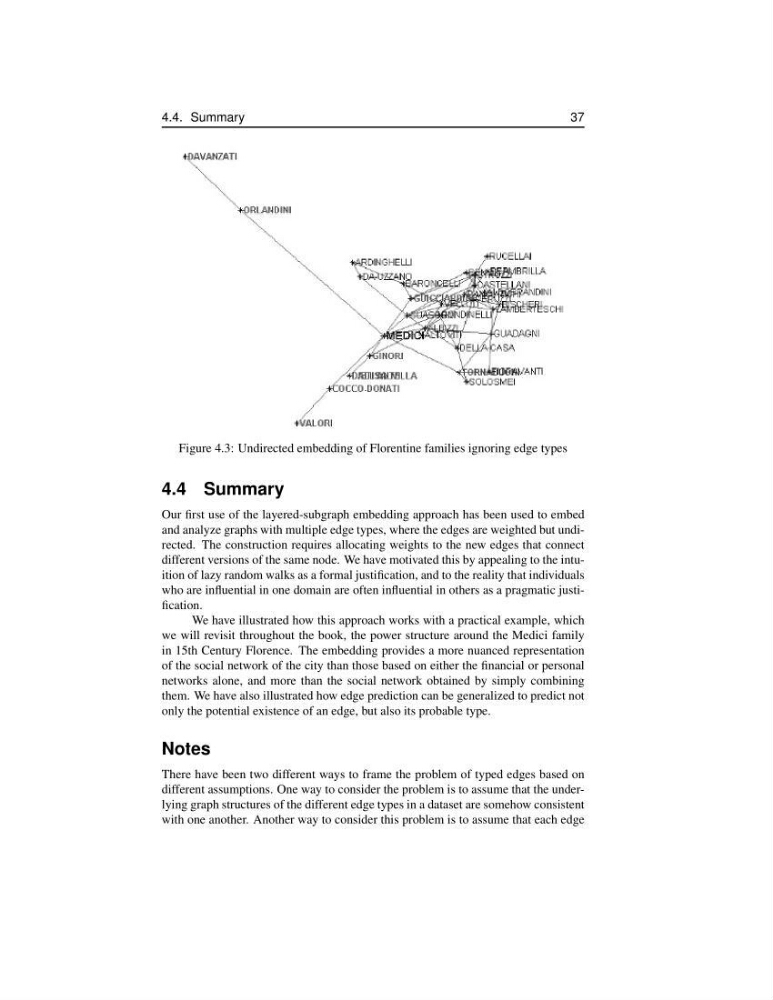
Figure 4.3: Undirected embedding of Florentine families ignoring edge types
4.4 Summary
Our first use of the layered-subgraph embedding approach has been used to embed
and analyze graphs with multiple edge types, where the edges are weighted but undirected. The construction requires allocating weights to the new edges that connect
different versions of the same node. We have motivated this by appealing to the intuition of lazy random walks as a formal justification, and to the reality that individuals
who are influential in one domain are often influential in others as a pragmatic justification.
We have illustrated how this approach works with a practical example, which
we will revisit throughout the book, the power structure around the Medici family
in 15th Century Florence. The embedding provides a more nuanced representation
of the social network of the city than those based on either the financial or personal
networks alone, and more than the social network obtained by simply combining
them. We have also illustrated how edge prediction can be generalized to predict not
only the potential existence of an edge, but also its probable type.
Notes
There have been two different ways to frame the problem of typed edges based on
different assumptions. One way to consider the problem is to assume that the underlying graph structures of the different edge types in a dataset are somehow consistent
with one another. Another way to consider this problem is to assume that each edge
37
Figure 4.3: Undirected embedding of Florentine families ignoring edge types
4.4 Summary
Our first use of the layered-subgraph embedding approach has been used to embed
and analyze graphs with multiple edge types, where the edges are weighted but undirected. The construction requires allocating weights to the new edges that connect
different versions of the same node. We have motivated this by appealing to the intuition of lazy random walks as a formal justification, and to the reality that individuals
who are influential in one domain are often influential in others as a pragmatic justification.
We have illustrated how this approach works with a practical example, which
we will revisit throughout the book, the power structure around the Medici family
in 15th Century Florence. The embedding provides a more nuanced representation
of the social network of the city than those based on either the financial or personal
networks alone, and more than the social network obtained by simply combining
them. We have also illustrated how edge prediction can be generalized to predict not
only the potential existence of an edge, but also its probable type.
Notes
There have been two different ways to frame the problem of typed edges based on
different assumptions. One way to consider the problem is to assume that the underlying graph structures of the different edge types in a dataset are somehow consistent
with one another. Another way to consider this problem is to assume that each edge