

41
Review of Basic Device Physics
p no = 1 × 10 5 cm –3 . Here, n no and p no define the equilibrium concentrations
of electrons and holes, respectively, in an n-type material. Now, we shine
light on the sample so that 1 × 10 13 cm –3 electron–hole pairs are generated
in the material. Then using Equation 2.47, the total number of electrons
n n = n no = 1 × 10 15 cm –3 and p n = 1 × 10 13 cm –3 . Thus, the majority carrier concentration n n remains unchanged, whereas the minority carrier concentration
p n is increased significantly. This is an example of low-level injection. On the
other hand, if 1 × 10 17 cm –3 electron–hole pairs are generated by incident
light, then from Equation 2.47, we get n n ≅ 1 × 10 17 cm –3 and p n = 1 × 10 17 cm –3
changing both the electron and hole concentrations in the semiconductor,
resulting in a high-level injection. The mathematics for high-level injection are
complex, and therefore, we will consider only low-level injection.
2.2.6.2 Recombination Processes
The semiconductor material returns to equilibrium through recombination
of injected minority carriers with the majority carriers in the case of carrier
injection or through generation of electron–hole pairs in the case of extraction of carriers.
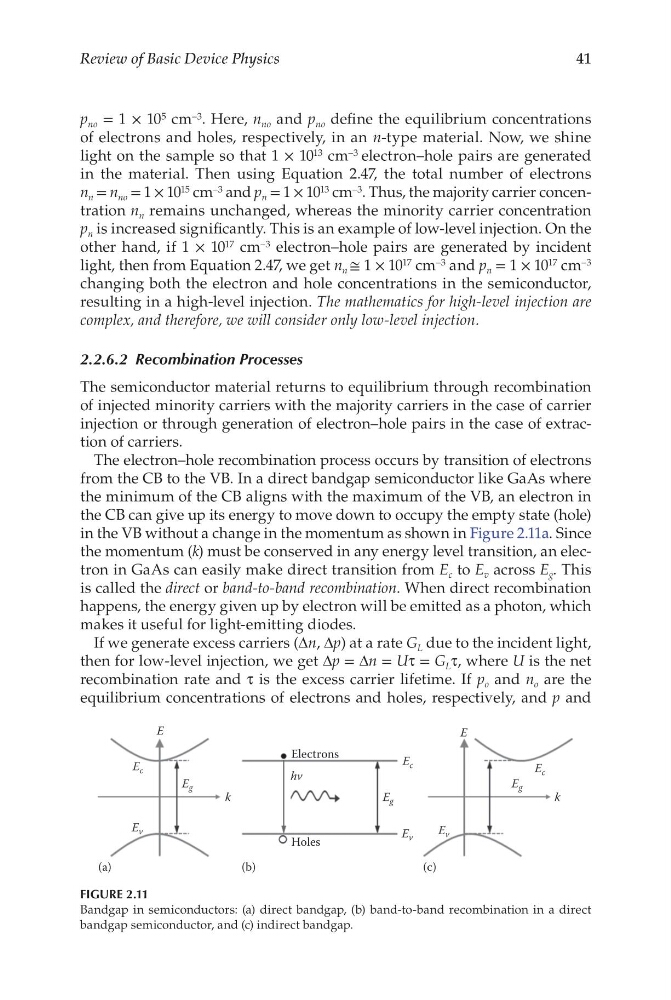
The electron–hole recombination process occurs by transition of electrons
from the CB to the VB. In a direct bandgap semiconductor like GaAs where
the minimum of the CB aligns with the maximum of the VB, an electron in
the CB can give up its energy to move down to occupy the empty state (hole)
in the VB without a change in the momentum as shown in Figure 2.11a. Since
the momentum (k) must be conserved in any energy level transition, an electron in GaAs can easily make direct transition from E c to E v across E g . This
is called the direct or band-to-band recombination. When direct recombination
happens, the energy given up by electron will be emitted as a photon, which
makes it useful for light-emitting diodes.
If we generate excess carriers (Δn, Δp) at a rate G L due to the incident light,
then for low-level injection, we get Δp = Δn = Uτ = G L τ, where U is the net
recombination rate and τ is the excess carrier lifetime. If p o and n o are the
equilibrium concentrations of electrons and holes, respectively, and p and
E
Electrons
Holes
E c
E v
E g
E g
E c
E v
E v
E g
E c
k
E
k
hv
(a)
(b)
(c)
FIGURE 2.11
Bandgap in semiconductors: (a) direct bandgap, (b) band-to-band recombination in a direct
bandgap semiconductor, and (c) indirect bandgap.
Review of Basic Device Physics
p no = 1 × 10 5 cm –3 . Here, n no and p no define the equilibrium concentrations
of electrons and holes, respectively, in an n-type material. Now, we shine
light on the sample so that 1 × 10 13 cm –3 electron–hole pairs are generated
in the material. Then using Equation 2.47, the total number of electrons
n n = n no = 1 × 10 15 cm –3 and p n = 1 × 10 13 cm –3 . Thus, the majority carrier concentration n n remains unchanged, whereas the minority carrier concentration
p n is increased significantly. This is an example of low-level injection. On the
other hand, if 1 × 10 17 cm –3 electron–hole pairs are generated by incident
light, then from Equation 2.47, we get n n ≅ 1 × 10 17 cm –3 and p n = 1 × 10 17 cm –3
changing both the electron and hole concentrations in the semiconductor,
resulting in a high-level injection. The mathematics for high-level injection are
complex, and therefore, we will consider only low-level injection.
2.2.6.2 Recombination Processes
The semiconductor material returns to equilibrium through recombination
of injected minority carriers with the majority carriers in the case of carrier
injection or through generation of electron–hole pairs in the case of extraction of carriers.
The electron–hole recombination process occurs by transition of electrons
from the CB to the VB. In a direct bandgap semiconductor like GaAs where
the minimum of the CB aligns with the maximum of the VB, an electron in
the CB can give up its energy to move down to occupy the empty state (hole)
in the VB without a change in the momentum as shown in Figure 2.11a. Since
the momentum (k) must be conserved in any energy level transition, an electron in GaAs can easily make direct transition from E c to E v across E g . This
is called the direct or band-to-band recombination. When direct recombination
happens, the energy given up by electron will be emitted as a photon, which
makes it useful for light-emitting diodes.
If we generate excess carriers (Δn, Δp) at a rate G L due to the incident light,
then for low-level injection, we get Δp = Δn = Uτ = G L τ, where U is the net
recombination rate and τ is the excess carrier lifetime. If p o and n o are the
equilibrium concentrations of electrons and holes, respectively, and p and
E
Electrons
Holes
E c
E v
E g
E g
E c
E v
E v
E g
E c
k
E
k
hv
(a)
(b)
(c)
FIGURE 2.11
Bandgap in semiconductors: (a) direct bandgap, (b) band-to-band recombination in a direct
bandgap semiconductor, and (c) indirect bandgap.