

36
Compact Models for Integrated Circuit Design
velocity increases linearly with the electric field indicating constant mobility. When the field exceeds about 2 × 10 4 V cm –1 , carriers begin to lose energy
by scattering with optical phonons and their velocity saturates. As the
field exceeds 100 KV cm –1 , carriers gain more energy from the field than
what they can lose by scattering. Consequently, their energy with respect
to the bottom of the CB (for electrons) or top of the VB (for holes) begins
to increase. The carriers are no longer at thermal equilibrium with the lattice. Since they acquire energy higher than the thermal energy (kT) they are
called hot carriers.
It is these hot carriers that are responsible for reducing the mobility at
high fields. For a more heavily doped material, the low-field mobility is
lower because of the impurity scattering. However, v sat remains the same,
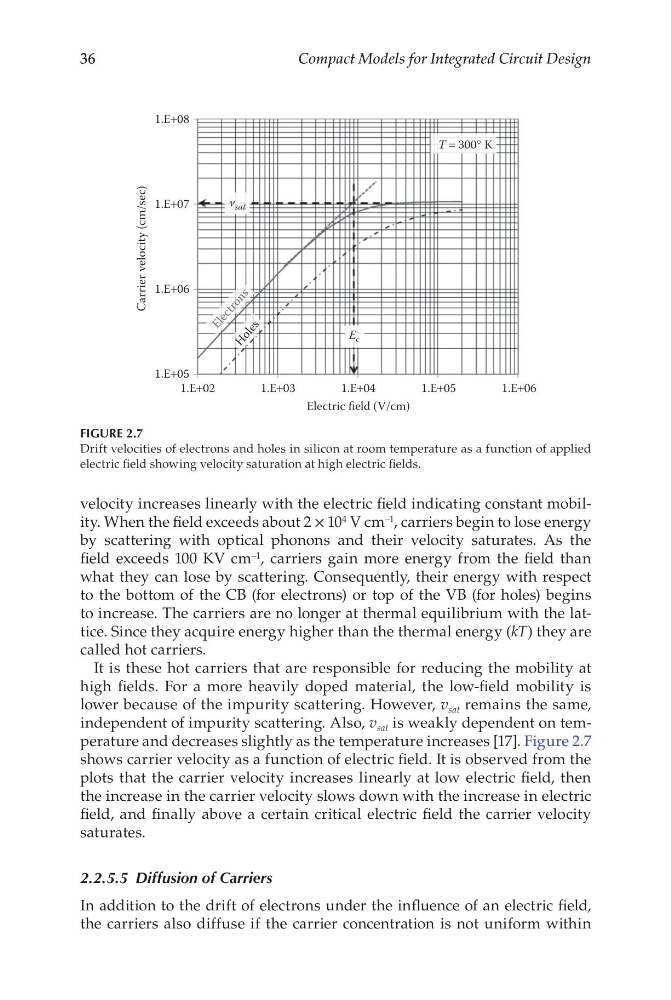
independent of impurity scattering. Also, v sat is weakly dependent on temperature and decreases slightly as the temperature increases [17]. Figure 2.7
shows carrier velocity as a function of electric field. It is observed from the
plots that the carrier velocity increases linearly at low electric field, then
the increase in the carrier velocity slows down with the increase in electric
field, and finally above a certain critical electric field the carrier velocity
saturates.
2.2.5.5 Diffusion of Carriers
In addition to the drift of electrons under the influence of an electric field,
the carriers also diffuse if the carrier concentration is not uniform within
1.E+02
1.E+05
1.E+06
1.E+07
T = 300° K
1.E+08
1.E+03
H
o l e s
E l e c t r o n s
1.E+04
Electric field (V/cm)
Carrier velocity (cm/sec)
E c
v sat
1.E+05
1.E+06
FIGURE 2.7
Drift velocities of electrons and holes in silicon at room temperature as a function of applied
electric field showing velocity saturation at high electric fields.
Compact Models for Integrated Circuit Design
velocity increases linearly with the electric field indicating constant mobility. When the field exceeds about 2 × 10 4 V cm –1 , carriers begin to lose energy
by scattering with optical phonons and their velocity saturates. As the
field exceeds 100 KV cm –1 , carriers gain more energy from the field than
what they can lose by scattering. Consequently, their energy with respect
to the bottom of the CB (for electrons) or top of the VB (for holes) begins
to increase. The carriers are no longer at thermal equilibrium with the lattice. Since they acquire energy higher than the thermal energy (kT) they are
called hot carriers.
It is these hot carriers that are responsible for reducing the mobility at
high fields. For a more heavily doped material, the low-field mobility is
lower because of the impurity scattering. However, v sat remains the same,
independent of impurity scattering. Also, v sat is weakly dependent on temperature and decreases slightly as the temperature increases [17]. Figure 2.7
shows carrier velocity as a function of electric field. It is observed from the
plots that the carrier velocity increases linearly at low electric field, then
the increase in the carrier velocity slows down with the increase in electric
field, and finally above a certain critical electric field the carrier velocity
saturates.
2.2.5.5 Diffusion of Carriers
In addition to the drift of electrons under the influence of an electric field,
the carriers also diffuse if the carrier concentration is not uniform within
1.E+02
1.E+05
1.E+06
1.E+07
T = 300° K
1.E+08
1.E+03
H
o l e s
E l e c t r o n s
1.E+04
Electric field (V/cm)
Carrier velocity (cm/sec)
E c
v sat
1.E+05
1.E+06
FIGURE 2.7
Drift velocities of electrons and holes in silicon at room temperature as a function of applied
electric field showing velocity saturation at high electric fields.