

32
Compact Models for Integrated Circuit Design
The mobility is proportional to the time interval between collisions and
inversely proportional to the effective mass of the carriers. The total mobility is
determined by combining the mobilities for different scattering mechanisms
such as mobility due to lattice scattering μ L and mobility due to ionized impurity
scattering μ I . Assuming different scattering mechanisms are independent, we
can write the expression for total mobility using Mathiessen’s rule
1
1
1
µ µ
µ
=
+
+
L
I
(2.29)
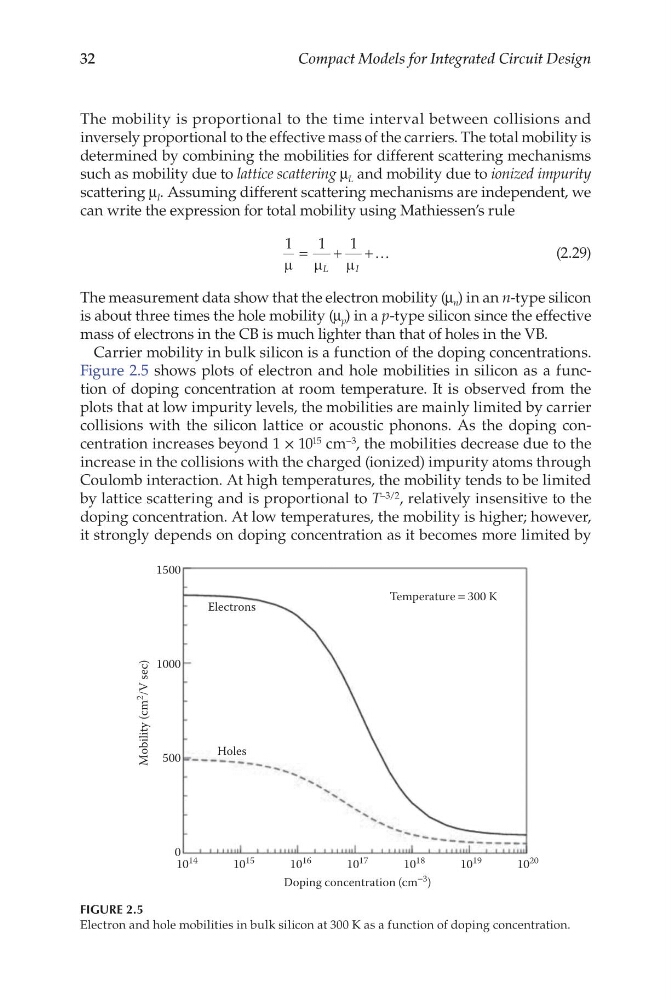
The measurement data show that the electron mobility (μ n ) in an n-type silicon
is about three times the hole mobility (μ p ) in a p-type silicon since the effective
mass of electrons in the CB is much lighter than that of holes in the VB.
Carrier mobility in bulk silicon is a function of the doping concentrations.
Figure 2.5 shows plots of electron and hole mobilities in silicon as a function of doping concentration at room temperature. It is observed from the
plots that at low impurity levels, the mobilities are mainly limited by carrier
collisions with the silicon lattice or acoustic phonons. As the doping concentration increases beyond 1 × 10 15 cm –3 , the mobilities decrease due to the
increase in the collisions with the charged (ionized) impurity atoms through
Coulomb interaction. At high temperatures, the mobility tends to be limited
by lattice scattering and is proportional to T –3/2 , relatively insensitive to the
doping concentration. At low temperatures, the mobility is higher; however,
it strongly depends on doping concentration as it becomes more limited by
10
14
10
15
Holes
Electrons
Temperature = 300 K
10
16
10
17
Doping concentration (cm
−3 )
1500
1000
500
Mobility (cm
2
/V sec)
0
10
18
10
19
10
20
FIGURE 2.5
Electron and hole mobilities in bulk silicon at 300 K as a function of doping concentration.
Compact Models for Integrated Circuit Design
The mobility is proportional to the time interval between collisions and
inversely proportional to the effective mass of the carriers. The total mobility is
determined by combining the mobilities for different scattering mechanisms
such as mobility due to lattice scattering μ L and mobility due to ionized impurity
scattering μ I . Assuming different scattering mechanisms are independent, we
can write the expression for total mobility using Mathiessen’s rule
1
1
1
µ µ
µ
=
+
+
L
I
(2.29)
The measurement data show that the electron mobility (μ n ) in an n-type silicon
is about three times the hole mobility (μ p ) in a p-type silicon since the effective
mass of electrons in the CB is much lighter than that of holes in the VB.
Carrier mobility in bulk silicon is a function of the doping concentrations.
Figure 2.5 shows plots of electron and hole mobilities in silicon as a function of doping concentration at room temperature. It is observed from the
plots that at low impurity levels, the mobilities are mainly limited by carrier
collisions with the silicon lattice or acoustic phonons. As the doping concentration increases beyond 1 × 10 15 cm –3 , the mobilities decrease due to the
increase in the collisions with the charged (ionized) impurity atoms through
Coulomb interaction. At high temperatures, the mobility tends to be limited
by lattice scattering and is proportional to T –3/2 , relatively insensitive to the
doping concentration. At low temperatures, the mobility is higher; however,
it strongly depends on doping concentration as it becomes more limited by
10
14
10
15
Holes
Electrons
Temperature = 300 K
10
16
10
17
Doping concentration (cm
−3 )
1500
1000
500
Mobility (cm
2
/V sec)
0
10
18
10
19
10
20
FIGURE 2.5
Electron and hole mobilities in bulk silicon at 300 K as a function of doping concentration.