

403
Bipolar Junction Transistor Compact Models
From Equation 11.68, the total majority carrier charge in the base consists of
equilibrium charge due to N a and excess components due to p′(x) and is given by
Q qA
p x dx
q A N x dx
q A
B
E
x
x V
E a
x
x V
E
E VBE
C BC
E VBE
C BC
=
=
+
′
∫
∫
( )
( )
(
)
(
)
(
)
(
)
p p x x dx
x
x V
E VBE
C BC
( )( )
(
)
(
)
∫
(11.72)
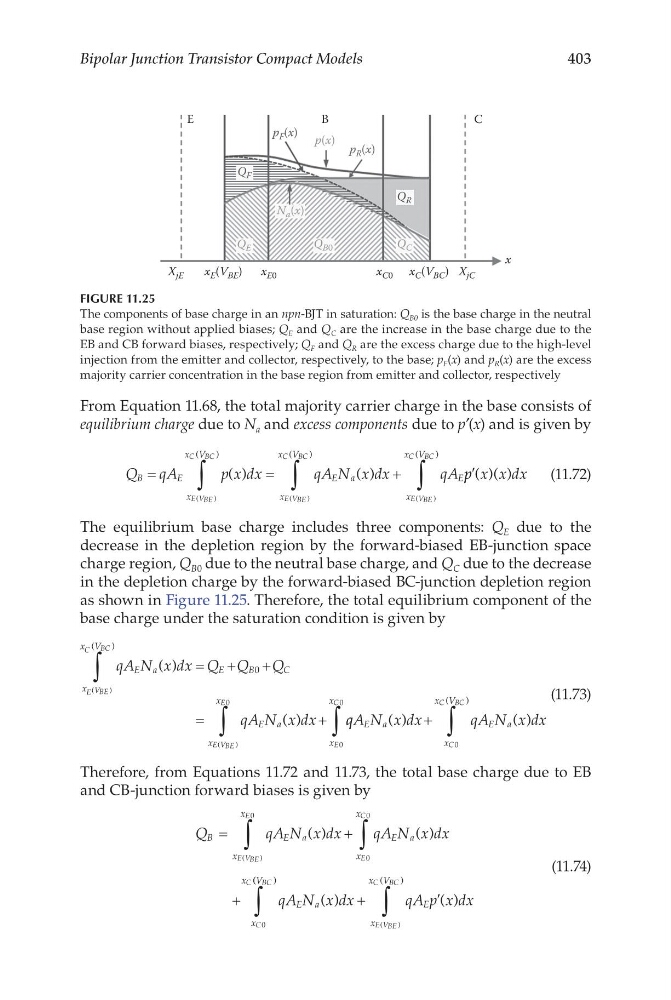
The equilibrium base charge includes three components: Q E due to the
decrease in the depletion region by the forward-biased EB-junction space
charge region, Q B0 due to the neutral base charge, and Q C due to the decrease
in the depletion charge by the forward-biased BC-junction depletion region
as shown in Figure 11.25. Therefore, the total equilibrium component of the
base charge under the saturation condition is given by
qA N x dx Q Q
Q
qA N x dx
E a
x
x V
E
B
C
E a
x
x
E VBE
C BC
E VBE
E
( )
( )
(
)
(
)
(
)
∫
∫
=
+
+
=
+
0
0
q qA N x dx
qA N x dx
E a
x
x
E a
x
x V
E
C
C
C BC
( )
( )
(
)
0
0
0
∫
∫
+
(11.73)
Therefore, from Equations 11.72 and 11.73, the total base charge due to EB
and CB-junction forward biases is given by
Q
q A N x dx
qA N x dx
qA N x dx
B
E a
x
x
E a
x
x
E a
x
x
E VBE
E
E
C
C
C
=
+
+
∫
∫
( )
( )
( )
(
)
0
0
0
0
( (
)
(
)
( )
(
)
V
E
x
x V
BC
E VBE
C BC
qA p x dx
∫
∫
+
′
(11.74)
E
B
C
X jE
X jC
x E0
x C0
Q F
Q B0
Q R
Q C
Q E
p(x)
p F (x)
p R (x)
N a (x)
x E (V BE )
x C (V BC )
x
FIGURE 11.25
The components of base charge in an npn-BJT in saturation: Q B0 is the base charge in the neutral
base region without applied biases; Q E and Q C are the increase in the base charge due to the
EB and CB forward biases, respectively; Q F and Q R are the excess charge due to the high-level
injection from the emitter and collector, respectively, to the base; p F (x) and p R (x) are the excess
majority carrier concentration in the base region from emitter and collector, respectively
Bipolar Junction Transistor Compact Models
From Equation 11.68, the total majority carrier charge in the base consists of
equilibrium charge due to N a and excess components due to p′(x) and is given by
Q qA
p x dx
q A N x dx
q A
B
E
x
x V
E a
x
x V
E
E VBE
C BC
E VBE
C BC
=
=
+
′
∫
∫
( )
( )
(
)
(
)
(
)
(
)
p p x x dx
x
x V
E VBE
C BC
( )( )
(
)
(
)
∫
(11.72)
The equilibrium base charge includes three components: Q E due to the
decrease in the depletion region by the forward-biased EB-junction space
charge region, Q B0 due to the neutral base charge, and Q C due to the decrease
in the depletion charge by the forward-biased BC-junction depletion region
as shown in Figure 11.25. Therefore, the total equilibrium component of the
base charge under the saturation condition is given by
qA N x dx Q Q
Q
qA N x dx
E a
x
x V
E
B
C
E a
x
x
E VBE
C BC
E VBE
E
( )
( )
(
)
(
)
(
)
∫
∫
=
+
+
=
+
0
0
q qA N x dx
qA N x dx
E a
x
x
E a
x
x V
E
C
C
C BC
( )
( )
(
)
0
0
0
∫
∫
+
(11.73)
Therefore, from Equations 11.72 and 11.73, the total base charge due to EB
and CB-junction forward biases is given by
Q
q A N x dx
qA N x dx
qA N x dx
B
E a
x
x
E a
x
x
E a
x
x
E VBE
E
E
C
C
C
=
+
+
∫
∫
( )
( )
( )
(
)
0
0
0
0
( (
)
(
)
( )
(
)
V
E
x
x V
BC
E VBE
C BC
qA p x dx
∫
∫
+
′
(11.74)
E
B
C
X jE
X jC
x E0
x C0
Q F
Q B0
Q R
Q C
Q E
p(x)
p F (x)
p R (x)
N a (x)
x E (V BE )
x C (V BC )
x
FIGURE 11.25
The components of base charge in an npn-BJT in saturation: Q B0 is the base charge in the neutral
base region without applied biases; Q E and Q C are the increase in the base charge due to the
EB and CB forward biases, respectively; Q F and Q R are the excess charge due to the high-level
injection from the emitter and collector, respectively, to the base; p F (x) and p R (x) are the excess
majority carrier concentration in the base region from emitter and collector, respectively