

163
Large Geometry MOSFET Compact Models
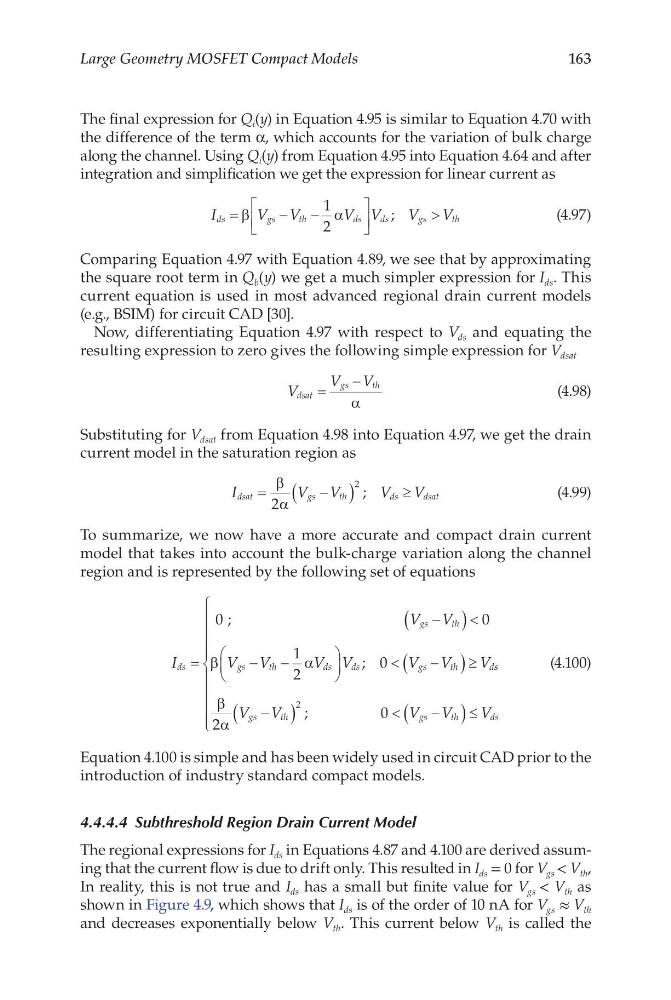
The final expression for Q i (y) in Equation 4.95 is similar to Equation 4.70 with
the difference of the term α, which accounts for the variation of bulk charge
along the channel. Using Q i (y) from Equation 4.95 into Equation 4.64 and after
integration and simplification we get the expression for linear current as
I
V V
V V
V
V
ds
gs
th
ds
ds
gs
th
=
−
−
>
β
α
1
2
;
(4.97)
Comparing Equation 4.97 with Equation 4.89, we see that by approximating
the square root term in Q b (y) we get a much simpler expression for I ds . This
current equation is used in most advanced regional drain current models
(e.g., BSIM) for circuit CAD [30].
Now, differentiating Equation 4.97 with respect to V ds and equating the
resulting expression to zero gives the following simple expression for V dsat
V
V V
dsat
gs
th
=
−
α
(4.98)
Substituting for V dsat from Equation 4.98 into Equation 4.97, we get the drain
current model in the saturation region as
I
V V
V V
dsat
gs
th
ds
dsat
=
−
(
)
≥
β
α
2
2 ;
(4.99)
To summarize, we now have a more accurate and compact drain current
model that takes into account the bulk-charge variation along the channel
region and is represented by the following set of equations
I
V V
V V
V V
V V
V
ds
gs
th
gs
th
ds
ds
gs
th
d
=
−
(
) <
−
−
<
−
(
) ≥
;
0
0
1
2
0
β
α
;
s s
gs
th
gs
th
ds
V V
V V
V
β
α
2
0
2
−
(
)
<
−
(
) ≤
;
(4.100)
Equation 4.100 is simple and has been widely used in circuit CAD prior to the
introduction of industry standard compact models.
4.4.4.4 Subthreshold Region Drain Current Model
The regional expressions for I ds in Equations 4.87 and 4.100 are derived assuming that the current flow is due to drift only. This resulted in I ds = 0 for V gs < V th ,
In reality, this is not true and I ds has a small but finite value for V gs < V th as
shown in Figure 4.9, which shows that I ds is of the order of 10 nA for V gs ≈ V th
and decreases exponentially below V th . This current below V th is called the
Large Geometry MOSFET Compact Models
The final expression for Q i (y) in Equation 4.95 is similar to Equation 4.70 with
the difference of the term α, which accounts for the variation of bulk charge
along the channel. Using Q i (y) from Equation 4.95 into Equation 4.64 and after
integration and simplification we get the expression for linear current as
I
V V
V V
V
V
ds
gs
th
ds
ds
gs
th
=
−
−
>
β
α
1
2
;
(4.97)
Comparing Equation 4.97 with Equation 4.89, we see that by approximating
the square root term in Q b (y) we get a much simpler expression for I ds . This
current equation is used in most advanced regional drain current models
(e.g., BSIM) for circuit CAD [30].
Now, differentiating Equation 4.97 with respect to V ds and equating the
resulting expression to zero gives the following simple expression for V dsat
V
V V
dsat
gs
th
=
−
α
(4.98)
Substituting for V dsat from Equation 4.98 into Equation 4.97, we get the drain
current model in the saturation region as
I
V V
V V
dsat
gs
th
ds
dsat
=
−
(
)
≥
β
α
2
2 ;
(4.99)
To summarize, we now have a more accurate and compact drain current
model that takes into account the bulk-charge variation along the channel
region and is represented by the following set of equations
I
V V
V V
V V
V V
V
ds
gs
th
gs
th
ds
ds
gs
th
d
=
−
(
) <
−
−
<
−
(
) ≥
;
0
0
1
2
0
β
α
;
s s
gs
th
gs
th
ds
V V
V V
V
β
α
2
0
2
−
(
)
<
−
(
) ≤
;
(4.100)
Equation 4.100 is simple and has been widely used in circuit CAD prior to the
introduction of industry standard compact models.
4.4.4.4 Subthreshold Region Drain Current Model
The regional expressions for I ds in Equations 4.87 and 4.100 are derived assuming that the current flow is due to drift only. This resulted in I ds = 0 for V gs < V th ,
In reality, this is not true and I ds has a small but finite value for V gs < V th as
shown in Figure 4.9, which shows that I ds is of the order of 10 nA for V gs ≈ V th
and decreases exponentially below V th . This current below V th is called the