

b
/
/
/
/
/
/
/
f
t
≤ k
u
≤t
≤t
/
/
/
/
/
/
/
/
≤ k
f
t
/
/
/
/
/
/
/
/
u
� �
� �
16
Mathematical Aspects of Logic Programming Semantics
_ _
_ _
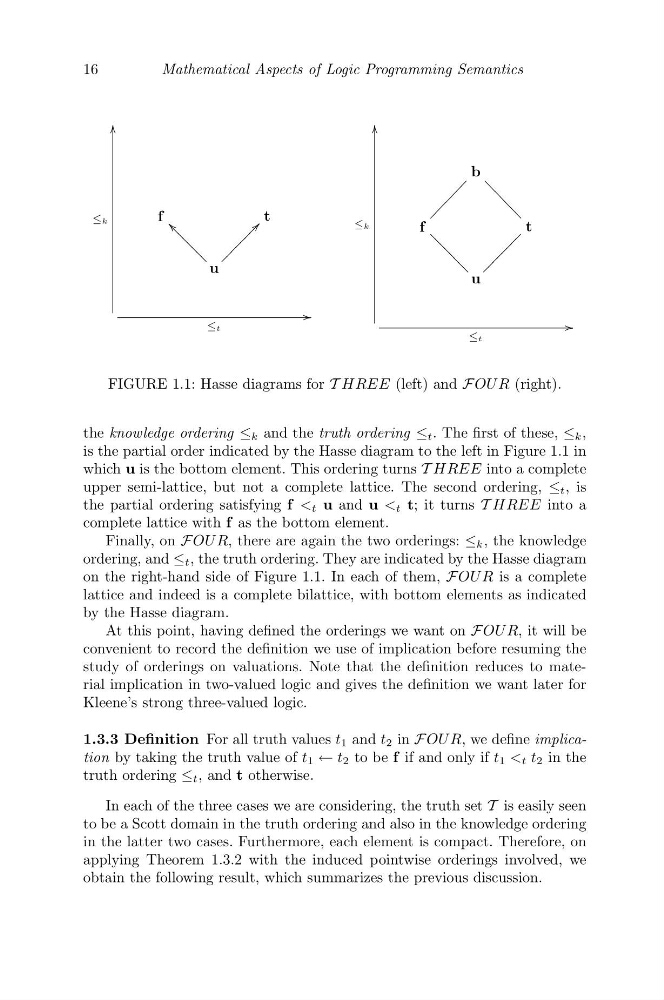
FIGURE 1.1: Hasse diagrams for T HREE (left) and FOU R (right).
the knowledge ordering ≤ k and the truth ordering ≤ t . The first of these, ≤ k ,
is the partial order indicated by the Hasse diagram to the left in Figure 1.1 in
which u is the bottom element. This ordering turns T HREE into a complete
upper semi-lattice, but not a complete lattice. The second ordering, ≤ t , is
the partial ordering satisfying f < t u and u < t t; it turns T HREE into a
complete lattice with f as the bottom element.
Finally, on FOU R, there are again the two orderings: ≤ k , the knowledge
ordering, and ≤ t , the truth ordering. They are indicated by the Hasse diagram
on the right-hand side of Figure 1.1. In each of them, FOU R is a complete
lattice and indeed is a complete bilattice, with bottom elements as indicated
by the Hasse diagram.
At this point, having defined the orderings we want on FOU R, it will be
convenient to record the definition we use of implication before resuming the
study of orderings on valuations. Note that the definition reduces to material implication in two-valued logic and gives the definition we want later for
Kleene’s strong three-valued logic.
1.3.3 Definition For all truth values t 1 and t 2 in FOU R, we define implication by taking the truth value of t 1 ← t 2 to be f if and only if t 1 < t t 2 in the
truth ordering ≤ t , and t otherwise.
In each of the three cases we are considering, the truth set T is easily seen
to be a Scott domain in the truth ordering and also in the knowledge ordering
in the latter two cases. Furthermore, each element is compact. Therefore, on
applying Theorem 1.3.2 with the induced pointwise orderings involved, we
obtain the following result, which summarizes the previous discussion.
/
/
/
/
/
/
/
f
t
≤ k
u
≤t
≤t
/
/
/
/
/
/
/
/
≤ k
f
t
/
/
/
/
/
/
/
/
u
� �
� �
16
Mathematical Aspects of Logic Programming Semantics
_ _
_ _
FIGURE 1.1: Hasse diagrams for T HREE (left) and FOU R (right).
the knowledge ordering ≤ k and the truth ordering ≤ t . The first of these, ≤ k ,
is the partial order indicated by the Hasse diagram to the left in Figure 1.1 in
which u is the bottom element. This ordering turns T HREE into a complete
upper semi-lattice, but not a complete lattice. The second ordering, ≤ t , is
the partial ordering satisfying f < t u and u < t t; it turns T HREE into a
complete lattice with f as the bottom element.
Finally, on FOU R, there are again the two orderings: ≤ k , the knowledge
ordering, and ≤ t , the truth ordering. They are indicated by the Hasse diagram
on the right-hand side of Figure 1.1. In each of them, FOU R is a complete
lattice and indeed is a complete bilattice, with bottom elements as indicated
by the Hasse diagram.
At this point, having defined the orderings we want on FOU R, it will be
convenient to record the definition we use of implication before resuming the
study of orderings on valuations. Note that the definition reduces to material implication in two-valued logic and gives the definition we want later for
Kleene’s strong three-valued logic.
1.3.3 Definition For all truth values t 1 and t 2 in FOU R, we define implication by taking the truth value of t 1 ← t 2 to be f if and only if t 1 < t t 2 in the
truth ordering ≤ t , and t otherwise.
In each of the three cases we are considering, the truth set T is easily seen
to be a Scott domain in the truth ordering and also in the knowledge ordering
in the latter two cases. Furthermore, each element is compact. Therefore, on
applying Theorem 1.3.2 with the induced pointwise orderings involved, we
obtain the following result, which summarizes the previous discussion.