

11
Order and Logic
TABLE 1.1: Belnap’s
p q ¬p
u u u
u f u
p
four
∧ q
u
f
-valued
p ∨ q
u
u
logic.
u t u
u b u
f u t
f f
t
f t t
f b t
t u f
t f
f
t t f
t b f
b u b
b f b
b t b
b b b
u
f
f
f
f
f
u
f
t
b
f
f
b
b
t
t
u
f
t
b
t
t
t
t
t
b
t
b
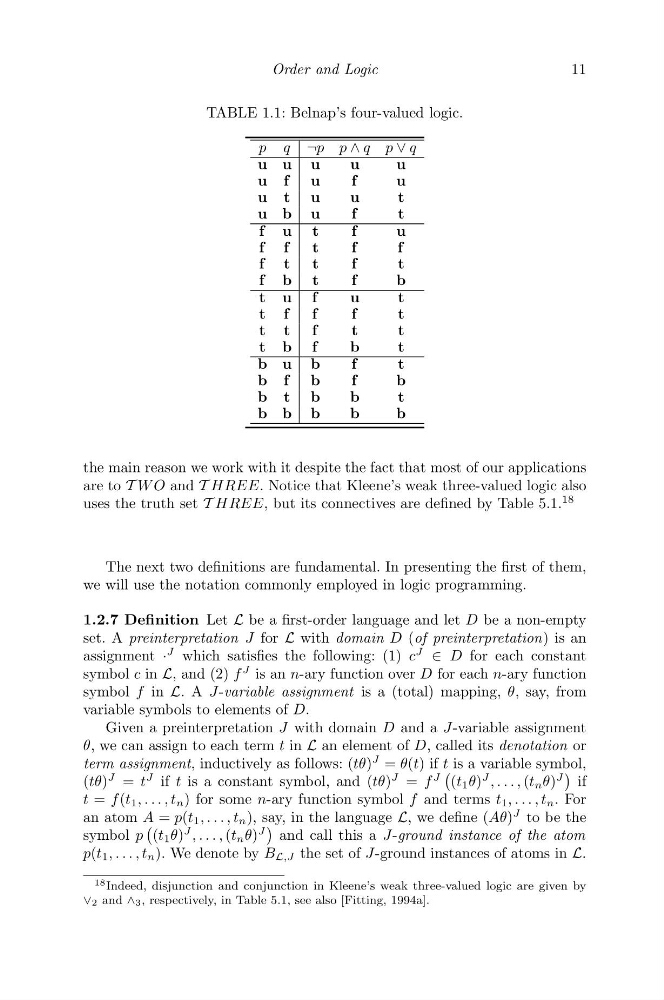
the main reason we work with it despite the fact that most of our applications
are to T W O and T HREE. Notice that Kleene’s weak three-valued logic also
uses the truth set T HREE, but its connectives are defined by Table 5.1.
18
The next two definitions are fundamental. In presenting the first of them,
we will use the notation commonly employed in logic programming.
1.2.7 Definition Let L be a first-order language and let D be a non-empty
set. A preinterpretation J for L with domain D (of preinterpretation) is an
assignment ·
J which satisfies the following: (1) c
J ∈ D for each constant
symbol c in L, and (2) f
J is an n-ary function over D for each n-ary function
symbol f in L. A J-variable assignment is a (total) mapping, θ, say, from
variable symbols to elements of D.
Given a preinterpretation J with domain D and a J-variable assignment
θ, we can assign to each term t in L an element of D, called its denotation or
term assignment, inductively as follows: (tθ)
J = θ(t) if t is a variable symb ol,
(tθ)
J = t
J if t is a constant symbol, and (tθ)
J = f
J (t θ)
J
J
1
, . . . , (t n θ) if
t = f (t 1 , . . . , t n ) for some n-ary function symbol f and terms t 1 , . . . , t n . For
an atom A
A = p(t 1 , . . . , t n ), say, in the language L, we define
A
(Aθ)
J to be
b
the
symbol p (t 1 θ)
J , . . . , (t n θ)
J and call this a J-ground instance of the atom
p(t 1 , . . . , t n ). We denote by B
b
,J the set of J-ground instances of atoms in
L
L.
18 Indeed, disjunction and conjunction in Kleene’s weak three-valued logic are given by
∨ 2 and ∧ 3 , respectively, in Table 5.1, see also [Fitting, 1994a].
Order and Logic
TABLE 1.1: Belnap’s
p q ¬p
u u u
u f u
p
four
∧ q
u
f
-valued
p ∨ q
u
u
logic.
u t u
u b u
f u t
f f
t
f t t
f b t
t u f
t f
f
t t f
t b f
b u b
b f b
b t b
b b b
u
f
f
f
f
f
u
f
t
b
f
f
b
b
t
t
u
f
t
b
t
t
t
t
t
b
t
b
the main reason we work with it despite the fact that most of our applications
are to T W O and T HREE. Notice that Kleene’s weak three-valued logic also
uses the truth set T HREE, but its connectives are defined by Table 5.1.
18
The next two definitions are fundamental. In presenting the first of them,
we will use the notation commonly employed in logic programming.
1.2.7 Definition Let L be a first-order language and let D be a non-empty
set. A preinterpretation J for L with domain D (of preinterpretation) is an
assignment ·
J which satisfies the following: (1) c
J ∈ D for each constant
symbol c in L, and (2) f
J is an n-ary function over D for each n-ary function
symbol f in L. A J-variable assignment is a (total) mapping, θ, say, from
variable symbols to elements of D.
Given a preinterpretation J with domain D and a J-variable assignment
θ, we can assign to each term t in L an element of D, called its denotation or
term assignment, inductively as follows: (tθ)
J = θ(t) if t is a variable symb ol,
(tθ)
J = t
J if t is a constant symbol, and (tθ)
J = f
J (t θ)
J
J
1
, . . . , (t n θ) if
t = f (t 1 , . . . , t n ) for some n-ary function symbol f and terms t 1 , . . . , t n . For
an atom A
A = p(t 1 , . . . , t n ), say, in the language L, we define
A
(Aθ)
J to be
b
the
symbol p (t 1 θ)
J , . . . , (t n θ)
J and call this a J-ground instance of the atom
p(t 1 , . . . , t n ). We denote by B
b
,J the set of J-ground instances of atoms in
L
L.
18 Indeed, disjunction and conjunction in Kleene’s weak three-valued logic are given by
∨ 2 and ∧ 3 , respectively, in Table 5.1, see also [Fitting, 1994a].