

� �
� �
� �
� �
216
Mathematical Aspects of Logic Programming Semantics
u
0.5
u
l − 0.5
/
/
f
0.5
t
0.5
/
/
/
/
/
/
/
/
/
/
t
f
l − 0.5
l − 0.5
b
0.5
/
/
b
l − 0.5
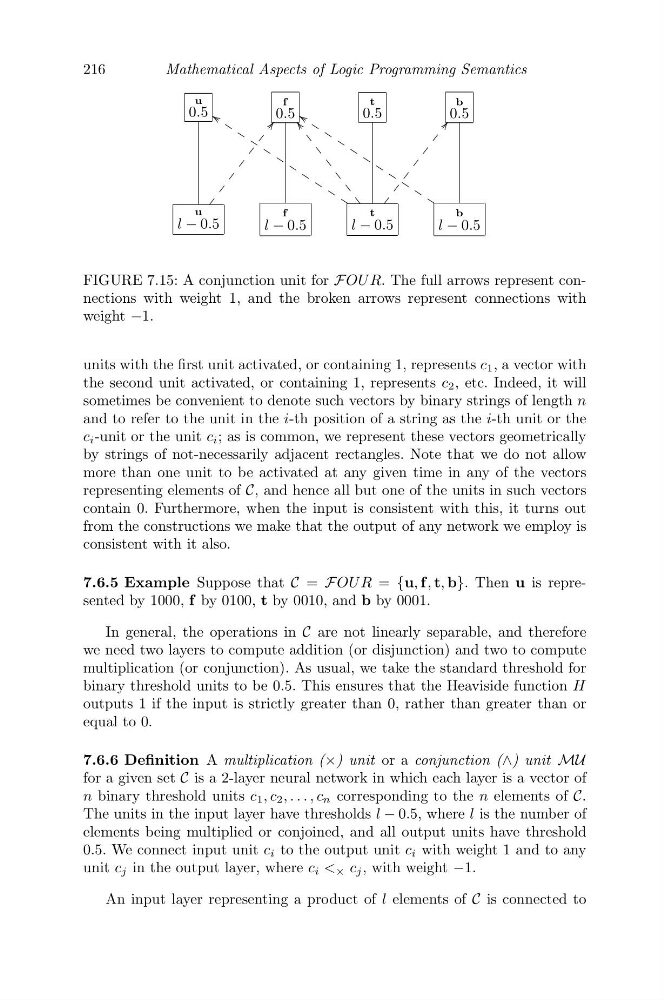
FIGURE 7.15: A conjunction unit for FOU R. The full arrows represent connections with weight 1, and the broken arrows represent connections with
weight −1.
units with the first unit activated, or containing 1, represents c 1 , a vector with
the second unit activated, or containing 1, represents c 2 , etc. Indeed, it will
sometimes be convenient to denote such vectors by binary strings of length n
and to refer to the unit in the i-th position of a string as the i-th unit or the
c i -unit or the unit c i ; as is common, we represent these vectors geometrically
by strings of not-necessarily adjacent rectangles. Note that we do not allow
more than one unit to be activated at any given time in any of the vectors
representing elements of C, and hence all but one of the units in such vectors
contain 0. Furthermore, when the input is consistent with this, it turns out
from the constructions we make that the output of any network we employ is
consistent with it also.
7.6.5 Example Suppose that C = FOU R = {u, f , t, b}. Then u is represented by 1000, f by 0100, t by 0010, and b by 0001.
In general, the operations in C are not linearly separable, and therefore
we need two layers to compute addition (or disjunction) and two to compute
multiplication (or conjunction). As usual, we take the standard threshold for
binary threshold units to be 0.5. This ensures that the Heaviside function H
outputs 1 if the input is strictly greater than 0, rather than greater than or
equal to 0.
7.6.6 Definition A multiplication (×) unit or a conjunction (∧) unit MU
for a given set C is a 2-layer neural network in which each layer is a vector of
n binary threshold units c 1 , c 2 , . . . , c n corresponding to the n elements of C.
The units in the input layer have thresholds l − 0.5, where l is the number of
elements being multiplied or conjoined, and all output units have threshold
0.5. We connect input unit c i to the output unit c i with weight 1 and to any
unit c j in the output layer, where c i < × c j , with weight −1.
An input layer representing a product of l elements of C is connected to
� �
� �
� �
216
Mathematical Aspects of Logic Programming Semantics
u
0.5
u
l − 0.5
/
/
f
0.5
t
0.5
/
/
/
/
/
/
/
/
/
/
t
f
l − 0.5
l − 0.5
b
0.5
/
/
b
l − 0.5
FIGURE 7.15: A conjunction unit for FOU R. The full arrows represent connections with weight 1, and the broken arrows represent connections with
weight −1.
units with the first unit activated, or containing 1, represents c 1 , a vector with
the second unit activated, or containing 1, represents c 2 , etc. Indeed, it will
sometimes be convenient to denote such vectors by binary strings of length n
and to refer to the unit in the i-th position of a string as the i-th unit or the
c i -unit or the unit c i ; as is common, we represent these vectors geometrically
by strings of not-necessarily adjacent rectangles. Note that we do not allow
more than one unit to be activated at any given time in any of the vectors
representing elements of C, and hence all but one of the units in such vectors
contain 0. Furthermore, when the input is consistent with this, it turns out
from the constructions we make that the output of any network we employ is
consistent with it also.
7.6.5 Example Suppose that C = FOU R = {u, f , t, b}. Then u is represented by 1000, f by 0100, t by 0010, and b by 0001.
In general, the operations in C are not linearly separable, and therefore
we need two layers to compute addition (or disjunction) and two to compute
multiplication (or conjunction). As usual, we take the standard threshold for
binary threshold units to be 0.5. This ensures that the Heaviside function H
outputs 1 if the input is strictly greater than 0, rather than greater than or
equal to 0.
7.6.6 Definition A multiplication (×) unit or a conjunction (∧) unit MU
for a given set C is a 2-layer neural network in which each layer is a vector of
n binary threshold units c 1 , c 2 , . . . , c n corresponding to the n elements of C.
The units in the input layer have thresholds l − 0.5, where l is the number of
elements being multiplied or conjoined, and all output units have threshold
0.5. We connect input unit c i to the output unit c i with weight 1 and to any
unit c j in the output layer, where c i < × c j , with weight −1.
An input layer representing a product of l elements of C is connected to