

103
Fixed-Point Theory for Generalized Metric Spaces
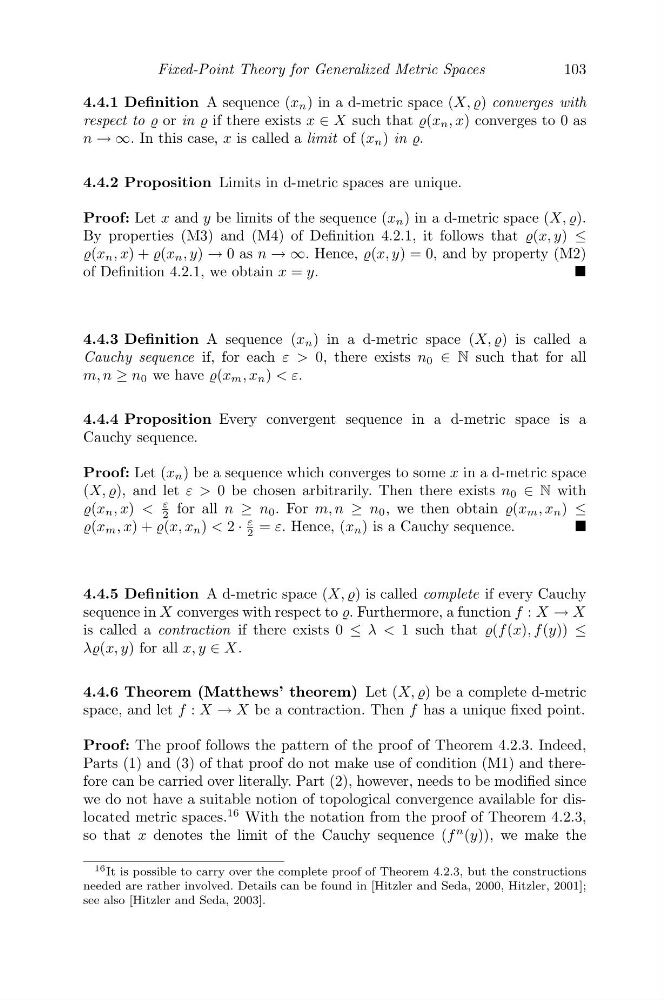
4.4.1 Definition A sequence (x n ) in a d-metric space (X, �) converges with
respect to � or in � if there exists x ∈ X such that �(x n , x) converges to 0 as
n → ∞. In this case, x is called a limit of (x n ) in �.
4.4.2 Proposition Limits in d-metric spaces are unique.
Proof: Let x and y be limits of the sequence (x n ) in a d-metric space (X, �).
By properties (M3) and (M4) of Definition 4.2.1, it follows that �(x, y) ≤
�(x n , x) + �(x n , y) → 0 as n → ∞. Hence, �(x, y) = 0, and by property (M2)
of Definition 4.2.1, we obtain x = y.
•
4.4.3 Definition A sequence (x n ) in a d-metric space (X, �) is called a
Cauchy sequence if, for each ε > 0, there exists n 0 ∈ N such that for all
m, n ≥ n 0 we have �(x m , x n ) < ε.
4.4.4 Proposition Every convergent sequence in a d-metric space is a
Cauchy sequence.
Proof: Let (x n ) be a sequence which converges to some x in a d-metric space
(X, �), and let ε > 0 be chosen arbitrarily. Then there exists n 0 ∈ N with
ε
�(x n , x) <
for all n ≥ n 0 . For m, n ≥ n 0 , we then obtain �(x m , x n ) ≤
2
ε
�(x m , x) + �(x, x n ) < 2 · 2 = ε. Hence, (x n ) is a Cauchy sequence.
•
4.4.5 Definition A d-metric space (X, �) is called complete if every Cauchy
sequence in X converges with respect to �. Furthermore, a function f : X → X
is called a contraction if there exists 0 ≤ λ < 1 such that �(f (x), f (y)) ≤
λ�(x, y) for all x, y ∈ X.
4.4.6 Theorem (Matthews’ theorem) Let (X, �) be a complete d-metric
space, and let f : X → X be a contraction. Then f has a unique fixed point.
Proof: The proof follows the pattern of the proof of Theorem 4.2.3. Indeed,
Parts (1) and (3) of that proof do not make use of condition (M1) and therefore can be carried over literally. Part (2), however, needs to be modified since
we do not have a suitable notion of topological convergence available for dislocated metric spaces.
16 With the notation from the proof of Theorem 4.2.3,
so that x denotes the limit of the Cauchy sequence (f
n (y)), we make the
16 It is possible to carry over the complete proof of Theorem 4.2.3, but the constructions
needed are rather involved. Details can be found in [Hitzler and Seda, 2000, Hitzler, 2001];
see also [Hitzler and Seda, 2003].
Fixed-Point Theory for Generalized Metric Spaces
4.4.1 Definition A sequence (x n ) in a d-metric space (X, �) converges with
respect to � or in � if there exists x ∈ X such that �(x n , x) converges to 0 as
n → ∞. In this case, x is called a limit of (x n ) in �.
4.4.2 Proposition Limits in d-metric spaces are unique.
Proof: Let x and y be limits of the sequence (x n ) in a d-metric space (X, �).
By properties (M3) and (M4) of Definition 4.2.1, it follows that �(x, y) ≤
�(x n , x) + �(x n , y) → 0 as n → ∞. Hence, �(x, y) = 0, and by property (M2)
of Definition 4.2.1, we obtain x = y.
•
4.4.3 Definition A sequence (x n ) in a d-metric space (X, �) is called a
Cauchy sequence if, for each ε > 0, there exists n 0 ∈ N such that for all
m, n ≥ n 0 we have �(x m , x n ) < ε.
4.4.4 Proposition Every convergent sequence in a d-metric space is a
Cauchy sequence.
Proof: Let (x n ) be a sequence which converges to some x in a d-metric space
(X, �), and let ε > 0 be chosen arbitrarily. Then there exists n 0 ∈ N with
ε
�(x n , x) <
for all n ≥ n 0 . For m, n ≥ n 0 , we then obtain �(x m , x n ) ≤
2
ε
�(x m , x) + �(x, x n ) < 2 · 2 = ε. Hence, (x n ) is a Cauchy sequence.
•
4.4.5 Definition A d-metric space (X, �) is called complete if every Cauchy
sequence in X converges with respect to �. Furthermore, a function f : X → X
is called a contraction if there exists 0 ≤ λ < 1 such that �(f (x), f (y)) ≤
λ�(x, y) for all x, y ∈ X.
4.4.6 Theorem (Matthews’ theorem) Let (X, �) be a complete d-metric
space, and let f : X → X be a contraction. Then f has a unique fixed point.
Proof: The proof follows the pattern of the proof of Theorem 4.2.3. Indeed,
Parts (1) and (3) of that proof do not make use of condition (M1) and therefore can be carried over literally. Part (2), however, needs to be modified since
we do not have a suitable notion of topological convergence available for dislocated metric spaces.
16 With the notation from the proof of Theorem 4.2.3,
so that x denotes the limit of the Cauchy sequence (f
n (y)), we make the
16 It is possible to carry over the complete proof of Theorem 4.2.3, but the constructions
needed are rather involved. Details can be found in [Hitzler and Seda, 2000, Hitzler, 2001];
see also [Hitzler and Seda, 2003].