

93
Fixed-Point Theory for Generalized Metric Spaces
mappings and is intended to help the reader to remember the nature of the
distance function under consideration at any given time. The one exception to
this occurs in Section 4.8.4, where we encounter two generalized ultrametrics
the second of which is derived from the first. In this instance, we retain the
notation � for the first of these generalized ultrametrics and d for the second;
essentially, the same comment applies to Section 5.1, where the results of
Section 4.8.4 are applied.
The most widely used of the distance functions just defined is that of
metric, and to that extent we regard metric distance functions as basic and
think of departures from them as variants.
The following well-known theorem, usually referred to as the Banach contraction mapping theorem, is fundamental in many areas of mathematics. It
is prototypical of a large number of extensions and refinements, including all
those we discuss in this chapter. We give the well-known proof in detail for
later reference.
4.2.3 Theorem (Banach) Let (X, d) be a complete metric space, let 0 ≤
λ < 1, and let f : X → X be a contraction with contractivity factor λ, that
is, f is a (single-valued) function satisfying d(f (x), f (y)) ≤ λd(x, y) for all
x, y ∈ X with x = y. Then f has a unique fixed point, which can be obtained
as the limit of the sequence (f
n (y)) for any y ∈ X.
Proof: The proof consists of the following three steps. It is shown that (1)
(f
n (y))
is a Cauchy sequence for all y ∈ X, (2) the limit of this Cauchy
n≥0
sequence is a fixed point of f , and (3) this fixed point is unique.
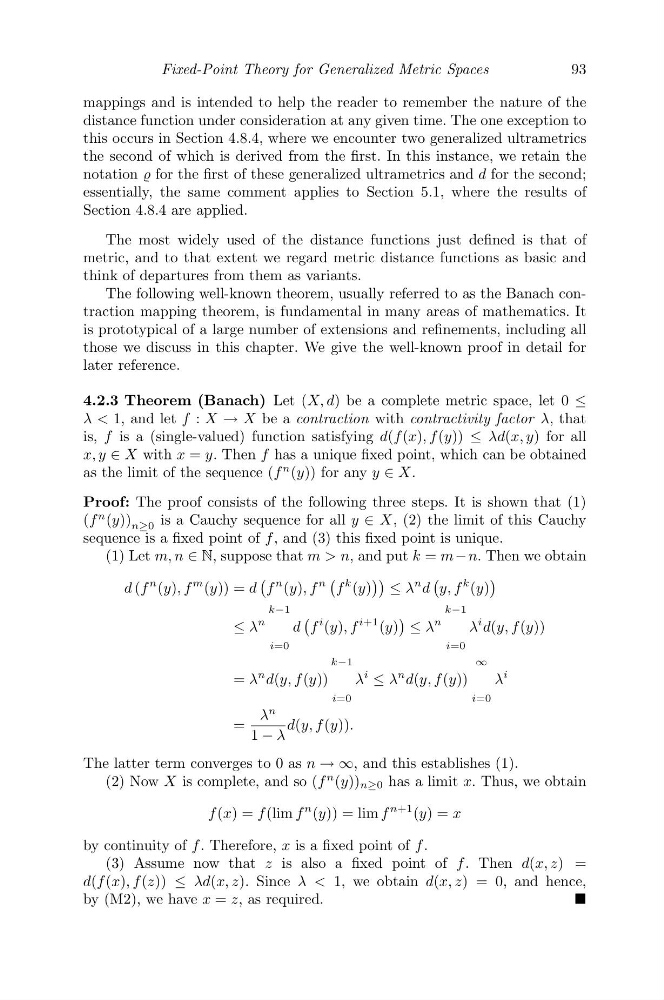
(1) Let m, n ∈ N, suppose that m > n, and put k = m − n. Then we obtain
A
A
bb
A
b
d (f
n (y), f
m (y)) = d f
n (y), f
n f
k (y) ≤ λ
n d y, f
k (y)
k−1
k−1
A
b
≤ λ
n
d f
i (y), f
i+1 (y) ≤ λ
n
λ
i d(y, f (y))
i=0
i=0
k−1
∞
= λ
n d(y, f (y))
λ
i ≤ λ
n d(y, f (y))
λ
i
i=0
i=0
λ
n
=
d(y, f (y)).
1 − λ
The latter term converges to 0 as n → ∞, and this establishes (1).
(2) Now X is complete, and so (f
n (y)) n≥0 has a limit x. Thus, we obtain
f (x) = f (lim f
n (y)) = lim f
n+1 (y) = x
by continuity of f . Therefore, x is a fixed point of f .
(3) Assume now that z is also a fixed point of f . Then d(x, z) =
d(f (x), f (z)) ≤ λd(x, z). Since λ < 1, we obtain d(x, z) = 0, and hence,
by (M2), we have x = z, as required.
•
Fixed-Point Theory for Generalized Metric Spaces
mappings and is intended to help the reader to remember the nature of the
distance function under consideration at any given time. The one exception to
this occurs in Section 4.8.4, where we encounter two generalized ultrametrics
the second of which is derived from the first. In this instance, we retain the
notation � for the first of these generalized ultrametrics and d for the second;
essentially, the same comment applies to Section 5.1, where the results of
Section 4.8.4 are applied.
The most widely used of the distance functions just defined is that of
metric, and to that extent we regard metric distance functions as basic and
think of departures from them as variants.
The following well-known theorem, usually referred to as the Banach contraction mapping theorem, is fundamental in many areas of mathematics. It
is prototypical of a large number of extensions and refinements, including all
those we discuss in this chapter. We give the well-known proof in detail for
later reference.
4.2.3 Theorem (Banach) Let (X, d) be a complete metric space, let 0 ≤
λ < 1, and let f : X → X be a contraction with contractivity factor λ, that
is, f is a (single-valued) function satisfying d(f (x), f (y)) ≤ λd(x, y) for all
x, y ∈ X with x = y. Then f has a unique fixed point, which can be obtained
as the limit of the sequence (f
n (y)) for any y ∈ X.
Proof: The proof consists of the following three steps. It is shown that (1)
(f
n (y))
is a Cauchy sequence for all y ∈ X, (2) the limit of this Cauchy
n≥0
sequence is a fixed point of f , and (3) this fixed point is unique.
(1) Let m, n ∈ N, suppose that m > n, and put k = m − n. Then we obtain
A
A
bb
A
b
d (f
n (y), f
m (y)) = d f
n (y), f
n f
k (y) ≤ λ
n d y, f
k (y)
k−1
k−1
A
b
≤ λ
n
d f
i (y), f
i+1 (y) ≤ λ
n
λ
i d(y, f (y))
i=0
i=0
k−1
∞
= λ
n d(y, f (y))
λ
i ≤ λ
n d(y, f (y))
λ
i
i=0
i=0
λ
n
=
d(y, f (y)).
1 − λ
The latter term converges to 0 as n → ∞, and this establishes (1).
(2) Now X is complete, and so (f
n (y)) n≥0 has a limit x. Thus, we obtain
f (x) = f (lim f
n (y)) = lim f
n+1 (y) = x
by continuity of f . Therefore, x is a fixed point of f .
(3) Assume now that z is also a fixed point of f . Then d(x, z) =
d(f (x), f (z)) ≤ λd(x, z). Since λ < 1, we obtain d(x, z) = 0, and hence,
by (M2), we have x = z, as required.
•