

82
Mathematical Aspects of Logic Programming Semantics
and so I n → I in the metric d. Thus, d generates Q, as claimed.
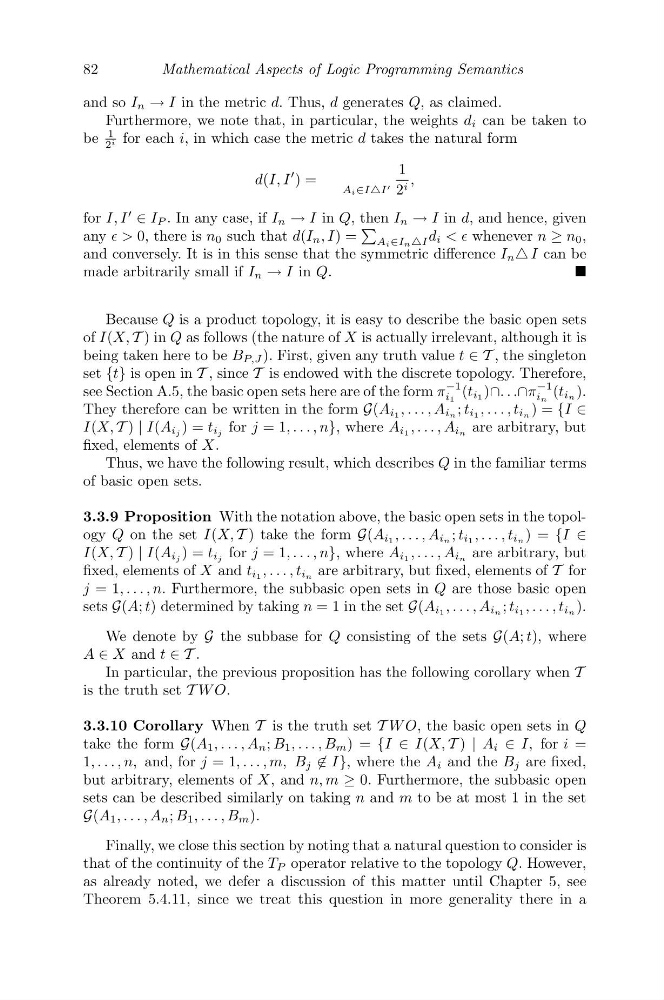
Furthermore, we note that, in particular, the weights d i can be taken to
1
be 2 i for each i, in which case the metric d takes the natural form
1
d(I, I
' ) =
,
Ai∈IfI / 2 i
'
for I, I ∈ I P . In any case, if I n → I in Q, then I n → I in d, and hence, given
o
any E > 0, there is n 0 such that d(I n , I) =
d i < E whenever n ≥ n 0 ,
Ai∈InfI
and conversely. It is in this sense that the symmetric difference I n D I can be
made arbitrarily small if I n → I in Q.
•
Because Q is a product topology, it is easy to describe the basic open sets
of I(X, T ) in Q as follows (the nature of X is actually irrelevant, although it is
being taken here to be B P,J ). First, given any truth value t ∈ T , the singleton
set {t} is open in T , since T is endowed with the discrete topology. Therefore,
see Section A.5, the basic open sets here are of the form π
−1 (t i1 )∩. . .∩π
−1 (t in ).
i1
in
They therefore can be written in the form G(A i1 , . . . , A in ; t i1 , . . . , t in ) = {I ∈
I(X, T ) | I(A ij ) = t ij for j = 1, . . . , n}, where A i1 , . . . , A in are arbitrary, but
fixed, elements of X.
Thus, we have the following result, which describes Q in the familiar terms
of basic open sets.
3.3.9 Proposition With the notation above, the basic open sets in the topology Q on the set I(X, T ) take the form G(A i1 , . . . , A in ; t i1 , . . . , t in ) = {I ∈
I(X, T ) | I(A ij ) = t ij for j = 1, . . . , n}, where A i1 , . . . , A in are arbitrary, but
fixed, elements of X and t i1 , . . . , t in are arbitrary, but fixed, elements of T for
j = 1, . . . , n. Furthermore, the subbasic open sets in Q are those basic open
sets G(A; t) determined by taking n = 1 in the set G(A i1 , . . . , A in ; t i1 , . . . , t in ).
We denote by G the subbase for Q consisting of the sets G(A; t), where
A ∈ X and t ∈ T .
In particular, the previous proposition has the following corollary when T
is the truth set T W O.
3.3.10 Corollary When T is the truth set T W O, the basic open sets in Q
take the form G(A 1 , . . . , A n ; B 1 , . . . , B m ) = {I ∈ I(X, T ) | A i ∈ I, for i =
1, . . . , n, and, for j = 1, . . . , m, B j ∈ I}, where the A i and the B j are fixed,
but arbitrary, elements of X, and n, m ≥ 0. Furthermore, the subbasic open
sets can be described similarly on taking n and m to be at most 1 in the set
G(A 1 , . . . , A n ; B 1 , . . . , B m ).
Finally, we close this section by noting that a natural question to consider is
that of the continuity of the T P operator relative to the topology Q. However,
as already noted, we defer a discussion of this matter until Chapter 5, see
Theorem 5.4.11, since we treat this question in more generality there in a
Mathematical Aspects of Logic Programming Semantics
and so I n → I in the metric d. Thus, d generates Q, as claimed.
Furthermore, we note that, in particular, the weights d i can be taken to
1
be 2 i for each i, in which case the metric d takes the natural form
1
d(I, I
' ) =
,
Ai∈IfI / 2 i
'
for I, I ∈ I P . In any case, if I n → I in Q, then I n → I in d, and hence, given
o
any E > 0, there is n 0 such that d(I n , I) =
d i < E whenever n ≥ n 0 ,
Ai∈InfI
and conversely. It is in this sense that the symmetric difference I n D I can be
made arbitrarily small if I n → I in Q.
•
Because Q is a product topology, it is easy to describe the basic open sets
of I(X, T ) in Q as follows (the nature of X is actually irrelevant, although it is
being taken here to be B P,J ). First, given any truth value t ∈ T , the singleton
set {t} is open in T , since T is endowed with the discrete topology. Therefore,
see Section A.5, the basic open sets here are of the form π
−1 (t i1 )∩. . .∩π
−1 (t in ).
i1
in
They therefore can be written in the form G(A i1 , . . . , A in ; t i1 , . . . , t in ) = {I ∈
I(X, T ) | I(A ij ) = t ij for j = 1, . . . , n}, where A i1 , . . . , A in are arbitrary, but
fixed, elements of X.
Thus, we have the following result, which describes Q in the familiar terms
of basic open sets.
3.3.9 Proposition With the notation above, the basic open sets in the topology Q on the set I(X, T ) take the form G(A i1 , . . . , A in ; t i1 , . . . , t in ) = {I ∈
I(X, T ) | I(A ij ) = t ij for j = 1, . . . , n}, where A i1 , . . . , A in are arbitrary, but
fixed, elements of X and t i1 , . . . , t in are arbitrary, but fixed, elements of T for
j = 1, . . . , n. Furthermore, the subbasic open sets in Q are those basic open
sets G(A; t) determined by taking n = 1 in the set G(A i1 , . . . , A in ; t i1 , . . . , t in ).
We denote by G the subbase for Q consisting of the sets G(A; t), where
A ∈ X and t ∈ T .
In particular, the previous proposition has the following corollary when T
is the truth set T W O.
3.3.10 Corollary When T is the truth set T W O, the basic open sets in Q
take the form G(A 1 , . . . , A n ; B 1 , . . . , B m ) = {I ∈ I(X, T ) | A i ∈ I, for i =
1, . . . , n, and, for j = 1, . . . , m, B j ∈ I}, where the A i and the B j are fixed,
but arbitrary, elements of X, and n, m ≥ 0. Furthermore, the subbasic open
sets can be described similarly on taking n and m to be at most 1 in the set
G(A 1 , . . . , A n ; B 1 , . . . , B m ).
Finally, we close this section by noting that a natural question to consider is
that of the continuity of the T P operator relative to the topology Q. However,
as already noted, we defer a discussion of this matter until Chapter 5, see
Theorem 5.4.11, since we treat this question in more generality there in a