

Chapter 2: Mathematical Preliminaries ~ 47
2.2 GRAPHS AND TREES
The theory of graphs is widely applied in many areas of computer scienceformal languages, compiler writing, artificial intelligence (AI), to mention only
a few. Also. the problems in computer science can be phrased as problems in
graphs. Our interest lies mainly in trees (special types of graphs) and their
properties.
2.2.1 GRAPHS
Defmition 2.11 A graph (or undirected graph) consists of (i) a nonempty set
V c...lled the set of vertices. (ii) a set E called the set of edges, and (iii) a map
which assigns to every edge a unique unordered pair of vertices.
Representation of a Graph
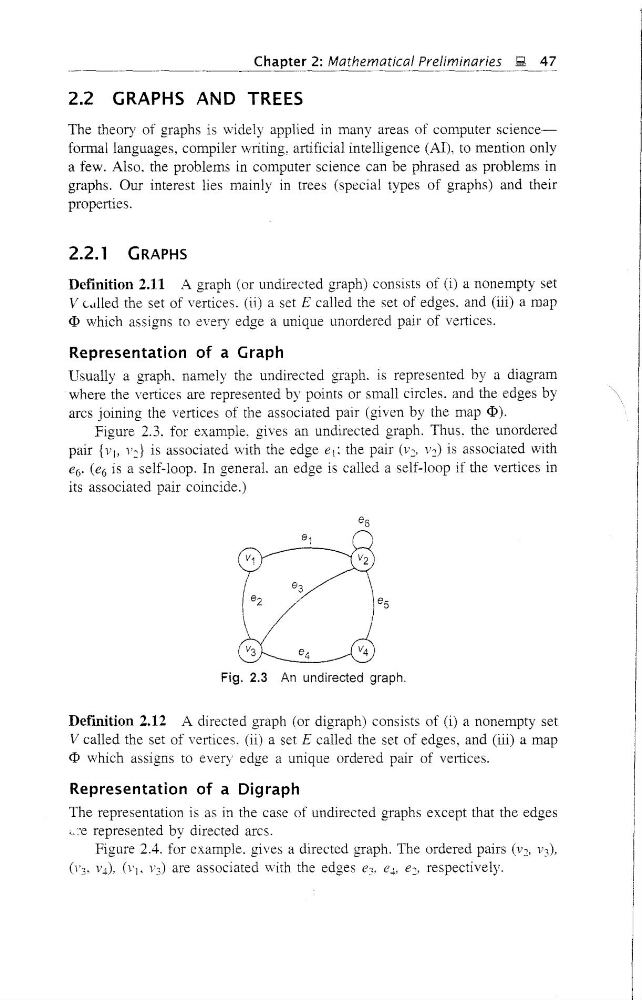
Usually a graph. namely the undirected graph. is represented by a diagram
where the vertices are represented by points or small circles, and the edges by
arcs joining the vertices of the associated pair (given by the map
pair {VI, v:} is associated with the edge el: the pair (v:' v:) is associated with
e6' (e6 is a self-loop. In generaL an edge is called a self-loop if the vertices in
its associated pair coincide.)
Fig. 2.3 An undirected graph.
Defmition 2.12 A directed graph (or digraph) consists of (i) a nonempty set
V called the set of vertices, (ii) a set E called the set of edges, and (iii) a map
which assigns to every edge a unique ordered pair of vertices.
Representation of a Digraph
The representation is as in the case of undirected graphs except that the edges
; ...:'e represented by directed arcs.
Figure 2.4. for example. gives a directed graph. The ordered pairs (v:, 1'3),
(1'3, 1'4), (VI. 1'3) are associated with the edges e3' e4, e:, respectively.
2.2 GRAPHS AND TREES
The theory of graphs is widely applied in many areas of computer scienceformal languages, compiler writing, artificial intelligence (AI), to mention only
a few. Also. the problems in computer science can be phrased as problems in
graphs. Our interest lies mainly in trees (special types of graphs) and their
properties.
2.2.1 GRAPHS
Defmition 2.11 A graph (or undirected graph) consists of (i) a nonempty set
V c...lled the set of vertices. (ii) a set E called the set of edges, and (iii) a map
which assigns to every edge a unique unordered pair of vertices.
Representation of a Graph
Usually a graph. namely the undirected graph. is represented by a diagram
where the vertices are represented by points or small circles, and the edges by
arcs joining the vertices of the associated pair (given by the map
pair {VI, v:} is associated with the edge el: the pair (v:' v:) is associated with
e6' (e6 is a self-loop. In generaL an edge is called a self-loop if the vertices in
its associated pair coincide.)
Fig. 2.3 An undirected graph.
Defmition 2.12 A directed graph (or digraph) consists of (i) a nonempty set
V called the set of vertices, (ii) a set E called the set of edges, and (iii) a map
which assigns to every edge a unique ordered pair of vertices.
Representation of a Digraph
The representation is as in the case of undirected graphs except that the edges
; ...:'e represented by directed arcs.
Figure 2.4. for example. gives a directed graph. The ordered pairs (v:, 1'3),
(1'3, 1'4), (VI. 1'3) are associated with the edges e3' e4, e:, respectively.