

Chapter 1: Propositions and Predicates ~ 17
EXAMPLE 1.17
Can we conclude S from the following premises?
(i) P =} Q
(ii) P =} R
(iii) -,( Q /\ R)
(iv) S \j P
Solution
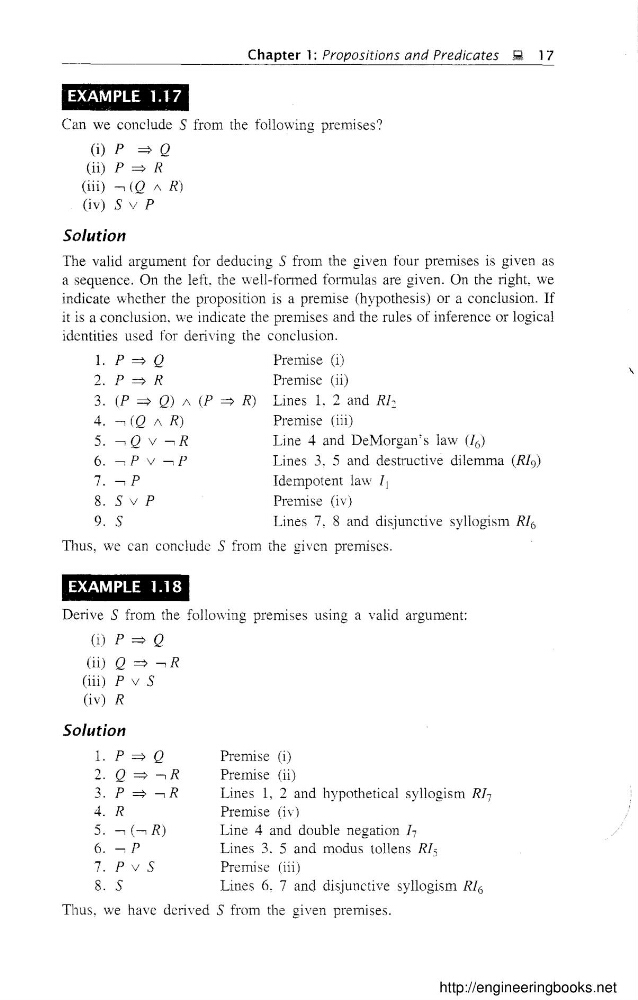
The valid argument for deducing S from the given four premises is given as
a sequence. On the left. the well-formed fOlmulas are given. On the right, we
indicate whether the proposition is a premise (hypothesis) or a conclusion. If
it is a conclusion. we indicate the premises and the rules of inference or logical
identities used for deriving the conclusion.
1. P =} Q
Premise (i)
2. P =} R
Premise (ii)
3. (P =} Q) /\ (P => R) Lines 1. 2 and RI 2
4. ---, (Q /\ R)
Premise (iii)
5. ---, Q \j ---, R
Line 4 and DeMorgan's law (h)
6. ---, P v ---, P
Lines 3. 5 and destructive dilemma (RI 9 )
7. ---, P
Idempotent law I]
8. S v P
Premise (iv)
9. S
Lines 7, 8 and disjunctive syllogism Rh
Thus, we can conclude 5 from the given premises.
EXAMPLE 1.18
Derive 5 from the following premises using a valid argument:
(i) P => Q
(ii) Q => ---, R
(iii) P v 5
(iv) R
Solution
1. P =} Q
Premise (i)
2. Q => ---, R
Premise (ii)
3. P => ---, R
Lines 1, 2 and hypothetical syllogism RI 7
4. R
Premise (iv)
5. ---, (---, R)
Line 4 and double negation h
6. ---, P
Lines 3. 5 and modus tollens RI s
7. P \j 5
Premise (iii)
8. 5
Lines 6, 7 and disjunctive syllogism RI 6
Thus, we have derived S from the given premises.
\
http://engineeringbooks.net
EXAMPLE 1.17
Can we conclude S from the following premises?
(i) P =} Q
(ii) P =} R
(iii) -,( Q /\ R)
(iv) S \j P
Solution
The valid argument for deducing S from the given four premises is given as
a sequence. On the left. the well-formed fOlmulas are given. On the right, we
indicate whether the proposition is a premise (hypothesis) or a conclusion. If
it is a conclusion. we indicate the premises and the rules of inference or logical
identities used for deriving the conclusion.
1. P =} Q
Premise (i)
2. P =} R
Premise (ii)
3. (P =} Q) /\ (P => R) Lines 1. 2 and RI 2
4. ---, (Q /\ R)
Premise (iii)
5. ---, Q \j ---, R
Line 4 and DeMorgan's law (h)
6. ---, P v ---, P
Lines 3. 5 and destructive dilemma (RI 9 )
7. ---, P
Idempotent law I]
8. S v P
Premise (iv)
9. S
Lines 7, 8 and disjunctive syllogism Rh
Thus, we can conclude 5 from the given premises.
EXAMPLE 1.18
Derive 5 from the following premises using a valid argument:
(i) P => Q
(ii) Q => ---, R
(iii) P v 5
(iv) R
Solution
1. P =} Q
Premise (i)
2. Q => ---, R
Premise (ii)
3. P => ---, R
Lines 1, 2 and hypothetical syllogism RI 7
4. R
Premise (iv)
5. ---, (---, R)
Line 4 and double negation h
6. ---, P
Lines 3. 5 and modus tollens RI s
7. P \j 5
Premise (iii)
8. 5
Lines 6, 7 and disjunctive syllogism RI 6
Thus, we have derived S from the given premises.
\
http://engineeringbooks.net