

Chapter 1: Propositions and Predicates ~ 7
Notes: (1) A wff is not a proposition, but if we substitute a proposition in
place of a propositional variable, we get a proposition. For example:
(i) -, (P v Q) 1\ (-, Q 1\ R) ~ Q is a wff.
(ii) (-, P 1\ Q) ¢:::> Q is a wff.
(2) We can drop parentheses when there is no ambiguity. For example, in
propositions we can remove the outermost parentheses. We can also specify the
hierarchy of connectives and avoid parentheses.
For the sake of convenience, we can refer to a wff as a formula.
1.1.3 TRUTH TABLE FOR A WELL-FORMED FORMULA
If we replace the propositional variables in a formula ex by propositions, we
get a proposition involving connectives. The table giving the truth values of
such a proposition obtained by replacing the propositional variables by
arbitrary propositions is called the truth table of ex.
If ex involves n propositional constants, then we have 2" possible
combinations of truth values of propositions replacing the variables.
EXAMPLE 1.5
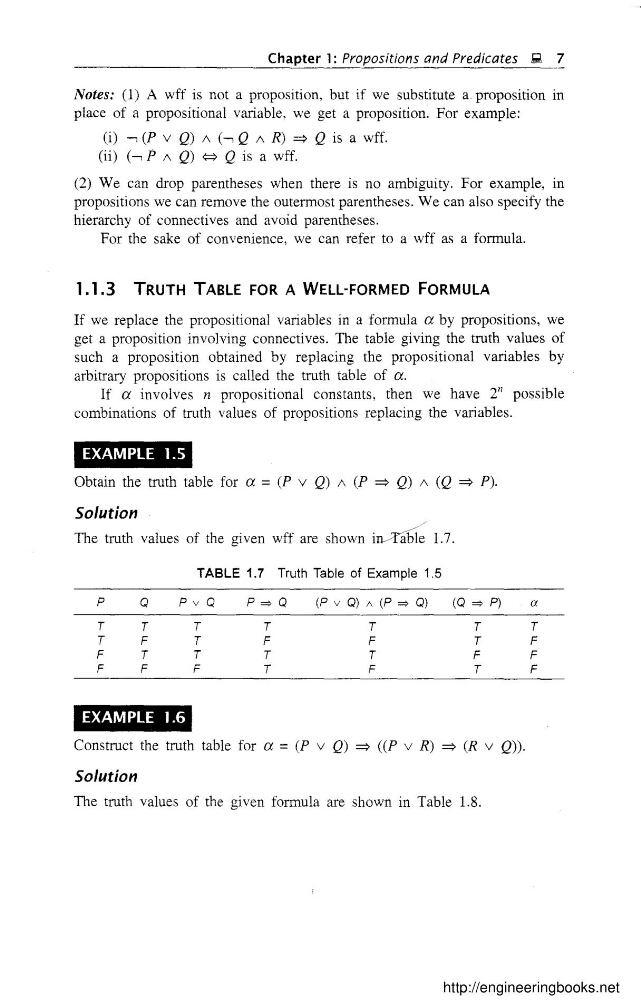
Obtain the truth table for ex = (P v Q) 1\ (P ~ Q) 1\ (Q ~ P).
Solution
The truth values of the given wff are shown i~; 1.7.
TABLE 1.7 Truth Table of Example 1.5
P
Q
PvQ
P=:oQ
(P v Q) /\ (P =:0 Q)
(Q =:0 P)
ex
T
T
T
T
T
T
T
T
F
T
F
F
T
F
F
T
T
T
T
F
F
F
F
F
T
F
T
F
EXAMPLE 1.6
Construct the truth table for ex = (P v Q) ~ ((P v R) ~ (R v Q».
Solution
The truth values of the given formula are shown in Table 1.8.
http://engineeringbooks.net
Notes: (1) A wff is not a proposition, but if we substitute a proposition in
place of a propositional variable, we get a proposition. For example:
(i) -, (P v Q) 1\ (-, Q 1\ R) ~ Q is a wff.
(ii) (-, P 1\ Q) ¢:::> Q is a wff.
(2) We can drop parentheses when there is no ambiguity. For example, in
propositions we can remove the outermost parentheses. We can also specify the
hierarchy of connectives and avoid parentheses.
For the sake of convenience, we can refer to a wff as a formula.
1.1.3 TRUTH TABLE FOR A WELL-FORMED FORMULA
If we replace the propositional variables in a formula ex by propositions, we
get a proposition involving connectives. The table giving the truth values of
such a proposition obtained by replacing the propositional variables by
arbitrary propositions is called the truth table of ex.
If ex involves n propositional constants, then we have 2" possible
combinations of truth values of propositions replacing the variables.
EXAMPLE 1.5
Obtain the truth table for ex = (P v Q) 1\ (P ~ Q) 1\ (Q ~ P).
Solution
The truth values of the given wff are shown i~; 1.7.
TABLE 1.7 Truth Table of Example 1.5
P
Q
PvQ
P=:oQ
(P v Q) /\ (P =:0 Q)
(Q =:0 P)
ex
T
T
T
T
T
T
T
T
F
T
F
F
T
F
F
T
T
T
T
F
F
F
F
F
T
F
T
F
EXAMPLE 1.6
Construct the truth table for ex = (P v Q) ~ ((P v R) ~ (R v Q».
Solution
The truth values of the given formula are shown in Table 1.8.
http://engineeringbooks.net