

3.2 Tonnage Tax Versus Income Tax in the UK Regime
In a typical tonnage tax regime, the shipowner’s “profit” for each day of operation is
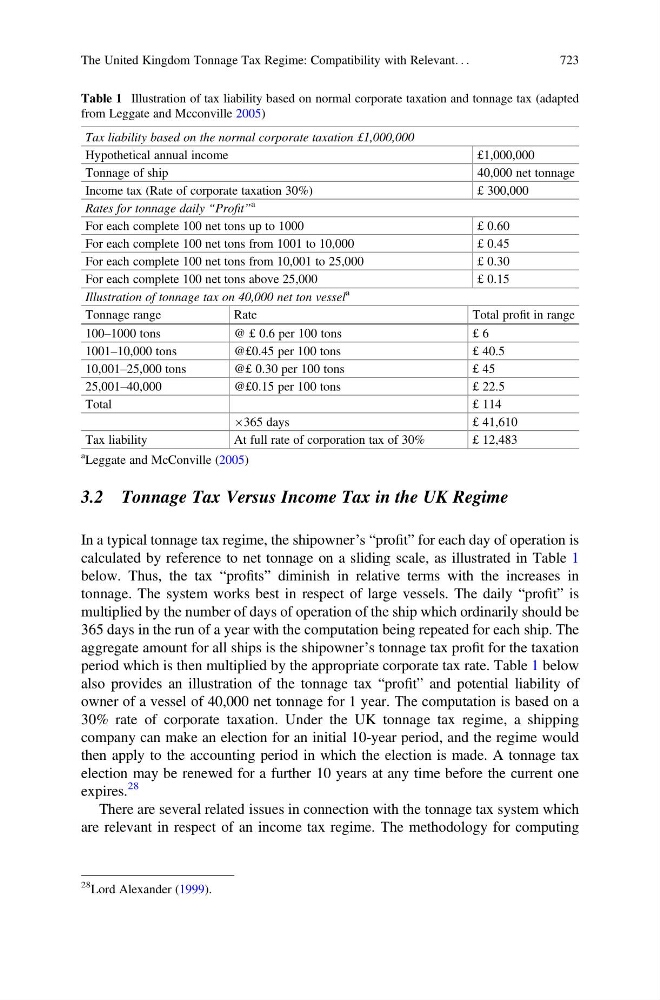
calculated by reference to net tonnage on a sliding scale, as illustrated in Table 1
below. Thus, the tax “profits” diminish in relative terms with the increases in
tonnage. The system works best in respect of large vessels. The daily “profit” is
multiplied by the number of days of operation of the ship which ordinarily should be
365 days in the run of a year with the computation being repeated for each ship. The
aggregate amount for all ships is the shipowner’s tonnage tax profit for the taxation
period which is then multiplied by the appropriate corporate tax rate. Table 1 below
also provides an illustration of the tonnage tax “profit” and potential liability of
owner of a vessel of 40,000 net tonnage for 1 year. The computation is based on a
30% rate of corporate taxation. Under the UK tonnage tax regime, a shipping
company can make an election for an initial 10-year period, and the regime would
then apply to the accounting period in which the election is made. A tonnage tax
election may be renewed for a further 10 years at any time before the current one
expires.
28
There are several related issues in connection with the tonnage tax system which
are relevant in respect of an income tax regime. The methodology for computing
Table 1 Illustration of tax liability based on normal corporate taxation and tonnage tax (adapted
from Leggate and Mcconville 2005)
Tax liability based on the normal corporate taxation £1,000,000
Hypothetical annual income
£1,000,000
Tonnage of ship
40,000 net tonnage
Income tax (Rate of corporate taxation 30%)
£ 300,000
Rates for tonnage daily “Profit”
a
For each complete 100 net tons up to 1000
£ 0.60
For each complete 100 net tons from 1001 to 10,000
£ 0.45
For each complete 100 net tons from 10,001 to 25,000
£ 0.30
For each complete 100 net tons above 25,000
£ 0.15
Illustration of tonnage tax on 40,000 net ton vessel
a
Tonnage range
Rate
Total profit in range
100–1000 tons
@ £ 0.6 per 100 tons
£ 6
1001–10,000 tons
@£0.45 per 100 tons
£ 40.5
10,001–25,000 tons
@£ 0.30 per 100 tons
£ 45
25,001–40,000
@£0.15 per 100 tons
£ 22.5
Total
£ 114
Â365 days
£ 41,610
Tax liability
At full rate of corporation tax of 30%
£ 12,483
a Leggate and McConville (2005)
28 Lord Alexander (1999).
The United Kingdom Tonnage Tax Regime: Compatibility with Relevant. . .
723