

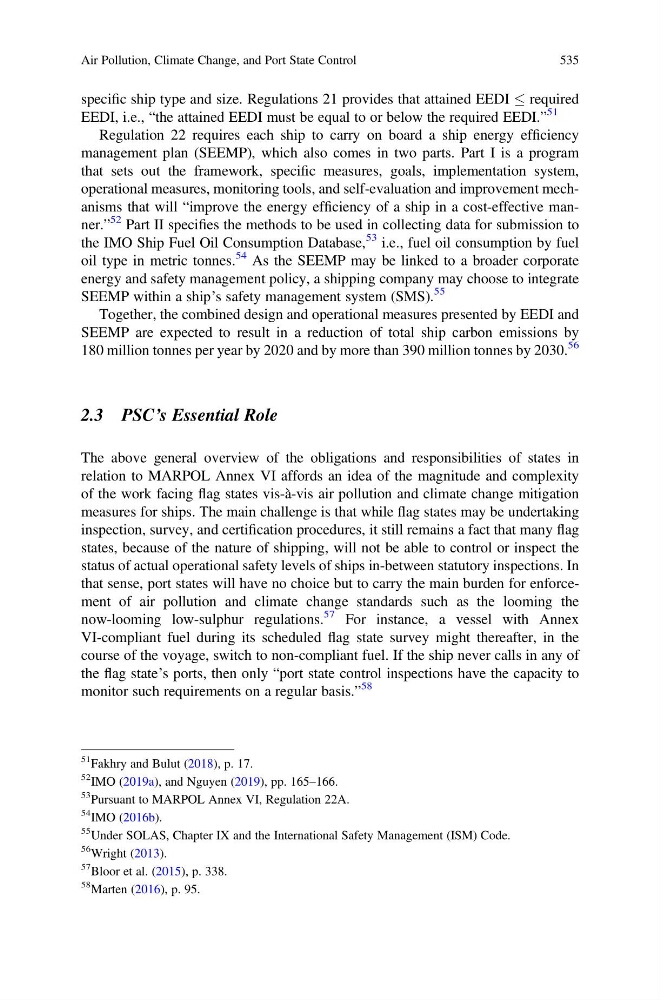
specific ship type and size. Regulations 21 provides that attained EEDI required
EEDI, i.e., “the attained EEDI must be equal to or below the required EEDI.”
51
Regulation 22 requires each ship to carry on board a ship energy efficiency
management plan (SEEMP), which also comes in two parts. Part I is a program
that sets out the framework, specific measures, goals, implementation system,
operational measures, monitoring tools, and self-evaluation and improvement mechanisms that will “improve the energy efficiency of a ship in a cost-effective manner.”
52 Part II specifies the methods to be used in collecting data for submission to
the IMO Ship Fuel Oil Consumption Database,
53 i.e., fuel oil consumption by fuel
oil type in metric tonnes.
54 As the SEEMP may be linked to a broader corporate
energy and safety management policy, a shipping company may choose to integrate
SEEMP within a ship’s safety management system (SMS).
55
Together, the combined design and operational measures presented by EEDI and
SEEMP are expected to result in a reduction of total ship carbon emissions by
180 million tonnes per year by 2020 and by more than 390 million tonnes by 2030.
56
2.3 PSC’s Essential Role
The above general overview of the obligations and responsibilities of states in
relation to MARPOL Annex VI affords an idea of the magnitude and complexity
of the work facing flag states vis-à-vis air pollution and climate change mitigation
measures for ships. The main challenge is that while flag states may be undertaking
inspection, survey, and certification procedures, it still remains a fact that many flag
states, because of the nature of shipping, will not be able to control or inspect the
status of actual operational safety levels of ships in-between statutory inspections. In
that sense, port states will have no choice but to carry the main burden for enforcement of air pollution and climate change standards such as the looming the
now-looming low-sulphur regulations.
57 For instance, a vessel with Annex
VI-compliant fuel during its scheduled flag state survey might thereafter, in the
course of the voyage, switch to non-compliant fuel. If the ship never calls in any of
the flag state’s ports, then only “port state control inspections have the capacity to
monitor such requirements on a regular basis.”
58
51 Fakhry and Bulut (2018), p. 17.
52 IMO (2019a), and Nguyen (2019), pp. 165–166.
53 Pursuant to MARPOL Annex VI, Regulation 22A.
54 IMO (2016b).
55 Under SOLAS, Chapter IX and the International Safety Management (ISM) Code.
56 Wright (2013).
57 Bloor et al. (2015), p. 338.
58 Marten (2016), p. 95.
Air Pollution, Climate Change, and Port State Control
535
EEDI, i.e., “the attained EEDI must be equal to or below the required EEDI.”
51
Regulation 22 requires each ship to carry on board a ship energy efficiency
management plan (SEEMP), which also comes in two parts. Part I is a program
that sets out the framework, specific measures, goals, implementation system,
operational measures, monitoring tools, and self-evaluation and improvement mechanisms that will “improve the energy efficiency of a ship in a cost-effective manner.”
52 Part II specifies the methods to be used in collecting data for submission to
the IMO Ship Fuel Oil Consumption Database,
53 i.e., fuel oil consumption by fuel
oil type in metric tonnes.
54 As the SEEMP may be linked to a broader corporate
energy and safety management policy, a shipping company may choose to integrate
SEEMP within a ship’s safety management system (SMS).
55
Together, the combined design and operational measures presented by EEDI and
SEEMP are expected to result in a reduction of total ship carbon emissions by
180 million tonnes per year by 2020 and by more than 390 million tonnes by 2030.
56
2.3 PSC’s Essential Role
The above general overview of the obligations and responsibilities of states in
relation to MARPOL Annex VI affords an idea of the magnitude and complexity
of the work facing flag states vis-à-vis air pollution and climate change mitigation
measures for ships. The main challenge is that while flag states may be undertaking
inspection, survey, and certification procedures, it still remains a fact that many flag
states, because of the nature of shipping, will not be able to control or inspect the
status of actual operational safety levels of ships in-between statutory inspections. In
that sense, port states will have no choice but to carry the main burden for enforcement of air pollution and climate change standards such as the looming the
now-looming low-sulphur regulations.
57 For instance, a vessel with Annex
VI-compliant fuel during its scheduled flag state survey might thereafter, in the
course of the voyage, switch to non-compliant fuel. If the ship never calls in any of
the flag state’s ports, then only “port state control inspections have the capacity to
monitor such requirements on a regular basis.”
58
51 Fakhry and Bulut (2018), p. 17.
52 IMO (2019a), and Nguyen (2019), pp. 165–166.
53 Pursuant to MARPOL Annex VI, Regulation 22A.
54 IMO (2016b).
55 Under SOLAS, Chapter IX and the International Safety Management (ISM) Code.
56 Wright (2013).
57 Bloor et al. (2015), p. 338.
58 Marten (2016), p. 95.
Air Pollution, Climate Change, and Port State Control
535