

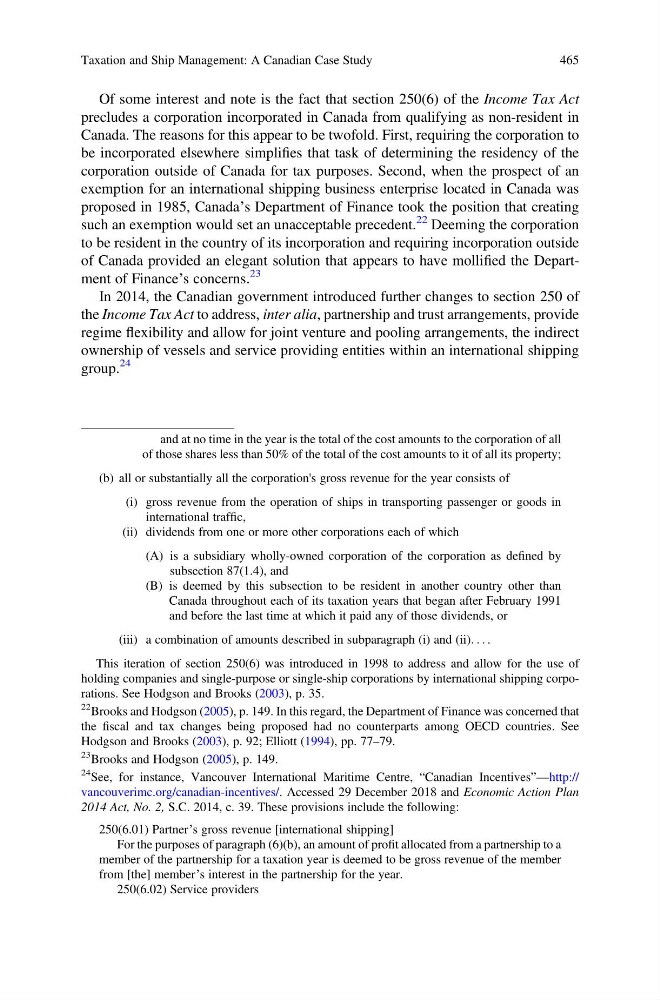
Of some interest and note is the fact that section 250(6) of the Income Tax Act
precludes a corporation incorporated in Canada from qualifying as non-resident in
Canada. The reasons for this appear to be twofold. First, requiring the corporation to
be incorporated elsewhere simplifies that task of determining the residency of the
corporation outside of Canada for tax purposes. Second, when the prospect of an
exemption for an international shipping business enterprise located in Canada was
proposed in 1985, Canada’s Department of Finance took the position that creating
such an exemption would set an unacceptable precedent.
22 Deeming the corporation
to be resident in the country of its incorporation and requiring incorporation outside
of Canada provided an elegant solution that appears to have mollified the Department of Finance’s concerns.
23
In 2014, the Canadian government introduced further changes to section 250 of
the Income Tax Act to address, inter alia, partnership and trust arrangements, provide
regime flexibility and allow for joint venture and pooling arrangements, the indirect
ownership of vessels and service providing entities within an international shipping
group.
24
and at no time in the year is the total of the cost amounts to the corporation of all
of those shares less than 50% of the total of the cost amounts to it of all its property;
(b) all or substantially all the corporation's gross revenue for the year consists of
(i) gross revenue from the operation of ships in transporting passenger or goods in
international traffic,
(ii) dividends from one or more other corporations each of which
(A) is a subsidiary wholly-owned corporation of the corporation as defined by
subsection 87(1.4), and
(B) is deemed by this subsection to be resident in another country other than
Canada throughout each of its taxation years that began after February 1991
and before the last time at which it paid any of those dividends, or
(iii) a combination of amounts described in subparagraph (i) and (ii). . . .
This iteration of section 250(6) was introduced in 1998 to address and allow for the use of
holding companies and single-purpose or single-ship corporations by international shipping corporations. See Hodgson and Brooks (2003), p. 35.
22 Brooks and Hodgson (2005), p. 149. In this regard, the Department of Finance was concerned that
the fiscal and tax changes being proposed had no counterparts among OECD countries. See
Hodgson and Brooks (2003), p. 92; Elliott (1994), pp. 77–79.
23 Brooks and Hodgson (2005), p. 149.
24 See, for instance, Vancouver International Maritime Centre, “Canadian Incentives”—http://
vancouverimc.org/canadian-incentives/. Accessed 29 December 2018 and Economic Action Plan
2014 Act, No. 2, S.C. 2014, c. 39. These provisions include the following:
250(6.01) Partner’s gross revenue [international shipping]
For the purposes of paragraph (6)(b), an amount of profit allocated from a partnership to a
member of the partnership for a taxation year is deemed to be gross revenue of the member
from [the] member’s interest in the partnership for the year.
250(6.02) Service providers
Taxation and Ship Management: A Canadian Case Study
465
precludes a corporation incorporated in Canada from qualifying as non-resident in
Canada. The reasons for this appear to be twofold. First, requiring the corporation to
be incorporated elsewhere simplifies that task of determining the residency of the
corporation outside of Canada for tax purposes. Second, when the prospect of an
exemption for an international shipping business enterprise located in Canada was
proposed in 1985, Canada’s Department of Finance took the position that creating
such an exemption would set an unacceptable precedent.
22 Deeming the corporation
to be resident in the country of its incorporation and requiring incorporation outside
of Canada provided an elegant solution that appears to have mollified the Department of Finance’s concerns.
23
In 2014, the Canadian government introduced further changes to section 250 of
the Income Tax Act to address, inter alia, partnership and trust arrangements, provide
regime flexibility and allow for joint venture and pooling arrangements, the indirect
ownership of vessels and service providing entities within an international shipping
group.
24
and at no time in the year is the total of the cost amounts to the corporation of all
of those shares less than 50% of the total of the cost amounts to it of all its property;
(b) all or substantially all the corporation's gross revenue for the year consists of
(i) gross revenue from the operation of ships in transporting passenger or goods in
international traffic,
(ii) dividends from one or more other corporations each of which
(A) is a subsidiary wholly-owned corporation of the corporation as defined by
subsection 87(1.4), and
(B) is deemed by this subsection to be resident in another country other than
Canada throughout each of its taxation years that began after February 1991
and before the last time at which it paid any of those dividends, or
(iii) a combination of amounts described in subparagraph (i) and (ii). . . .
This iteration of section 250(6) was introduced in 1998 to address and allow for the use of
holding companies and single-purpose or single-ship corporations by international shipping corporations. See Hodgson and Brooks (2003), p. 35.
22 Brooks and Hodgson (2005), p. 149. In this regard, the Department of Finance was concerned that
the fiscal and tax changes being proposed had no counterparts among OECD countries. See
Hodgson and Brooks (2003), p. 92; Elliott (1994), pp. 77–79.
23 Brooks and Hodgson (2005), p. 149.
24 See, for instance, Vancouver International Maritime Centre, “Canadian Incentives”—http://
vancouverimc.org/canadian-incentives/. Accessed 29 December 2018 and Economic Action Plan
2014 Act, No. 2, S.C. 2014, c. 39. These provisions include the following:
250(6.01) Partner’s gross revenue [international shipping]
For the purposes of paragraph (6)(b), an amount of profit allocated from a partnership to a
member of the partnership for a taxation year is deemed to be gross revenue of the member
from [the] member’s interest in the partnership for the year.
250(6.02) Service providers
Taxation and Ship Management: A Canadian Case Study
465