

solutions to avoid the borderline problem between tax and fee. In both Stockholm
and Gothenburg a congestion tax has been introduced; the decision regarding it has
been taken by the Parliament and provided for in an Act. In the same manner, several
infrastructure projects have been supported by infrastructure fees, but to avoid any
debate over whether or not this is a tax, the legality of the fee is handled through the
adoption of an Act by the Parliament. A more thorough discussion regarding the
question of tax or fee is presented below.
3 Research on Environmental Differentiated Port Dues
From the perspective of reduction of emissions regarding port operations there must
be a split between maritime operations and land operations. As stated above, traffic is
increasing in both areas, even on a global scale. This also means that different ports
around the world would construct different ways to combat emissions, not only as air
pollution but also particles from the exhaust fumes and the road surface. Another
problem to be addressed is noise from both traffic and vessels.
The first area of interest is with regard to vessels calling at ports. In the
VINNOVA project, a number of Swedish ports participated as reference groups.
13
These ports were selected from criteria based on the number of vessel calls made to
the port and the significance of their impact on the environment in the port city.
Gothenburg was chosen for hosting a large port in a relatively large city. The port of
Trelleborg, in the south of Sweden, was invited to participate for having a large port
in a small city. The ports of Stockholm and Karlskrona are more or less the same, the
difference between them being the size of the city hosting the port.
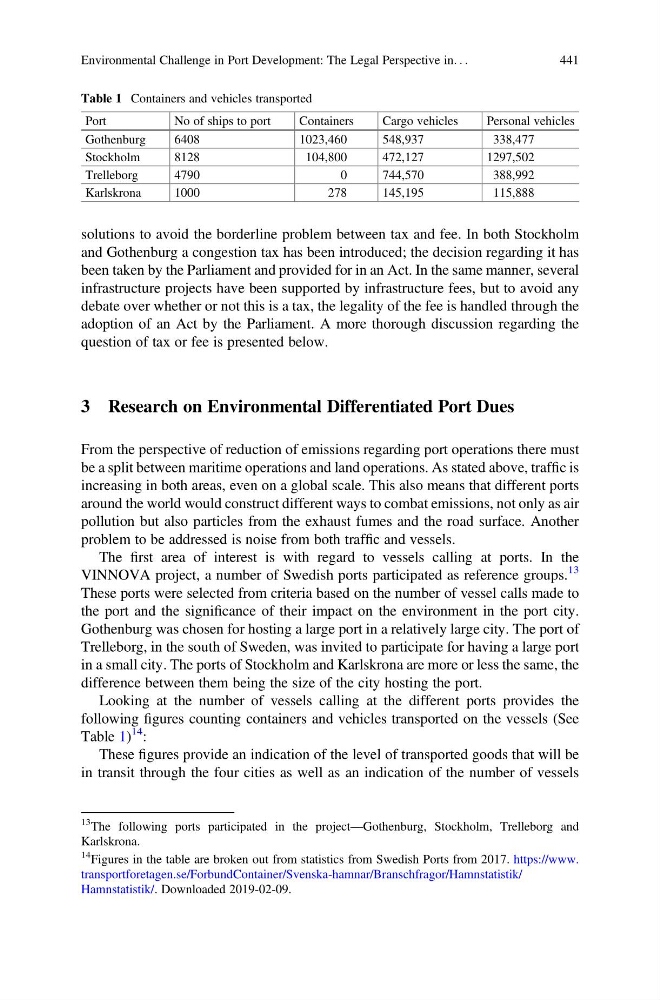
Looking at the number of vessels calling at the different ports provides the
following figures counting containers and vehicles transported on the vessels (See
Table 1)
14 :
These figures provide an indication of the level of transported goods that will be
in transit through the four cities as well as an indication of the number of vessels
Table 1 Containers and vehicles transported
Port
No of ships to port
Containers
Cargo vehicles
Personal vehicles
Gothenburg
6408
1023,460
548,937
338,477
Stockholm
8128
104,800
472,127
1297,502
Trelleborg
4790
0
744,570
388,992
Karlskrona
1000
278
145,195
115,888
13 The following ports participated in the project—Gothenburg, Stockholm, Trelleborg and
Karlskrona.
14 Figures in the table are broken out from statistics from Swedish Ports from 2017. https://www.
transportforetagen.se/ForbundContainer/Svenska-hamnar/Branschfragor/Hamnstatistik/
Hamnstatistik/. Downloaded 2019-02-09.
Environmental Challenge in Port Development: The Legal Perspective in. . .
441
and Gothenburg a congestion tax has been introduced; the decision regarding it has
been taken by the Parliament and provided for in an Act. In the same manner, several
infrastructure projects have been supported by infrastructure fees, but to avoid any
debate over whether or not this is a tax, the legality of the fee is handled through the
adoption of an Act by the Parliament. A more thorough discussion regarding the
question of tax or fee is presented below.
3 Research on Environmental Differentiated Port Dues
From the perspective of reduction of emissions regarding port operations there must
be a split between maritime operations and land operations. As stated above, traffic is
increasing in both areas, even on a global scale. This also means that different ports
around the world would construct different ways to combat emissions, not only as air
pollution but also particles from the exhaust fumes and the road surface. Another
problem to be addressed is noise from both traffic and vessels.
The first area of interest is with regard to vessels calling at ports. In the
VINNOVA project, a number of Swedish ports participated as reference groups.
13
These ports were selected from criteria based on the number of vessel calls made to
the port and the significance of their impact on the environment in the port city.
Gothenburg was chosen for hosting a large port in a relatively large city. The port of
Trelleborg, in the south of Sweden, was invited to participate for having a large port
in a small city. The ports of Stockholm and Karlskrona are more or less the same, the
difference between them being the size of the city hosting the port.
Looking at the number of vessels calling at the different ports provides the
following figures counting containers and vehicles transported on the vessels (See
Table 1)
14 :
These figures provide an indication of the level of transported goods that will be
in transit through the four cities as well as an indication of the number of vessels
Table 1 Containers and vehicles transported
Port
No of ships to port
Containers
Cargo vehicles
Personal vehicles
Gothenburg
6408
1023,460
548,937
338,477
Stockholm
8128
104,800
472,127
1297,502
Trelleborg
4790
0
744,570
388,992
Karlskrona
1000
278
145,195
115,888
13 The following ports participated in the project—Gothenburg, Stockholm, Trelleborg and
Karlskrona.
14 Figures in the table are broken out from statistics from Swedish Ports from 2017. https://www.
transportforetagen.se/ForbundContainer/Svenska-hamnar/Branschfragor/Hamnstatistik/
Hamnstatistik/. Downloaded 2019-02-09.
Environmental Challenge in Port Development: The Legal Perspective in. . .
441