

substances or effluents containing such substances.”
1 Harmful substances under
MARPOL are polluting materials of any kind, i.e., liquid, gas or solid, whose
introduction into the environment is detrimental to both human health and the
environment. The substances regulated by MARPOL comprise a wider category
than waste, since the concept of “harmful substances” includes, for instance, bunkers
and hazardous cargoes, such as oil or chemicals, as well as the residues of such
cargo. Article 1 (1) of MARPOL defines harmful substances in relation to their
deleterious effects if released into the marine environment, i.e., “any substance . . .
liable to create hazards to human health, to harm living resources and marine life, to
damage amenities or to interfere with other legitimate uses of the sea.”
2 This
Convention has six annexes, which deal with, respectively: oil; noxious substances
carried in bulk, i.e., chemicals; harmful substances carried in packaged form;
sewage; garbage; and air pollution. The day-to-day operations of ships will generate
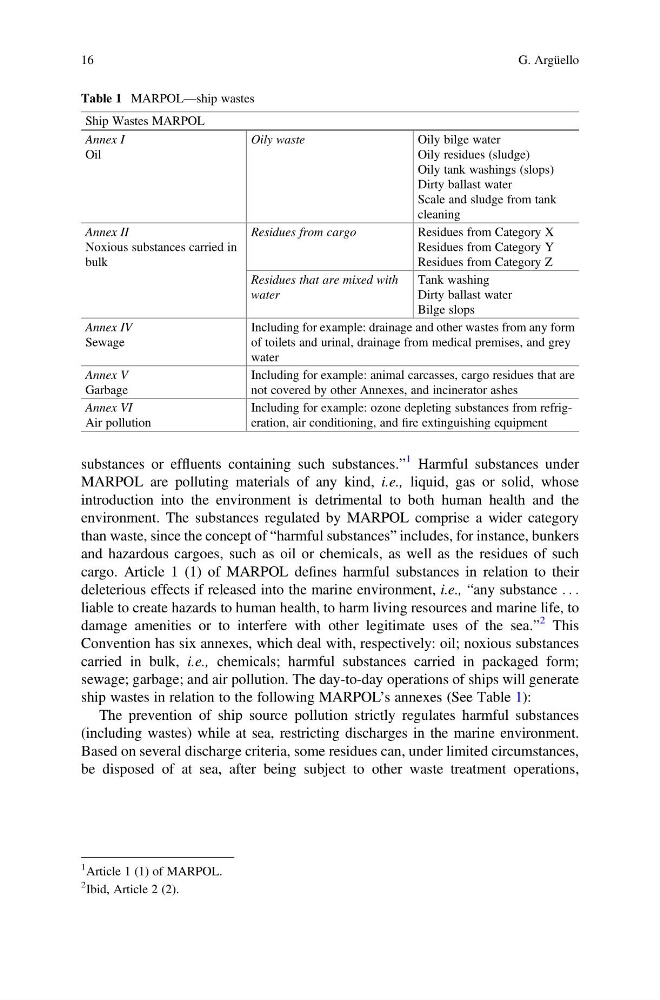
ship wastes in relation to the following MARPOL’s annexes (See Table 1):
The prevention of ship source pollution strictly regulates harmful substances
(including wastes) while at sea, restricting discharges in the marine environment.
Based on several discharge criteria, some residues can, under limited circumstances,
be disposed of at sea, after being subject to other waste treatment operations,
Table 1 MARPOL—ship wastes
Ship Wastes MARPOL
Annex I
Oil
Oily waste
Oily bilge water
Oily residues (sludge)
Oily tank washings (slops)
Dirty ballast water
Scale and sludge from tank
cleaning
Annex II
Noxious substances carried in
bulk
Residues from cargo
Residues from Category X
Residues from Category Y
Residues from Category Z
Residues that are mixed with
water
Tank washing
Dirty ballast water
Bilge slops
Annex IV
Sewage
Including for example: drainage and other wastes from any form
of toilets and urinal, drainage from medical premises, and grey
water
Annex V
Garbage
Including for example: animal carcasses, cargo residues that are
not covered by other Annexes, and incinerator ashes
Annex VI
Air pollution
Including for example: ozone depleting substances from refrigeration, air conditioning, and fire extinguishing equipment
1 Article 1 (1) of MARPOL.
2 Ibid, Article 2 (2).
16
G. Argüello
1 Harmful substances under
MARPOL are polluting materials of any kind, i.e., liquid, gas or solid, whose
introduction into the environment is detrimental to both human health and the
environment. The substances regulated by MARPOL comprise a wider category
than waste, since the concept of “harmful substances” includes, for instance, bunkers
and hazardous cargoes, such as oil or chemicals, as well as the residues of such
cargo. Article 1 (1) of MARPOL defines harmful substances in relation to their
deleterious effects if released into the marine environment, i.e., “any substance . . .
liable to create hazards to human health, to harm living resources and marine life, to
damage amenities or to interfere with other legitimate uses of the sea.”
2 This
Convention has six annexes, which deal with, respectively: oil; noxious substances
carried in bulk, i.e., chemicals; harmful substances carried in packaged form;
sewage; garbage; and air pollution. The day-to-day operations of ships will generate
ship wastes in relation to the following MARPOL’s annexes (See Table 1):
The prevention of ship source pollution strictly regulates harmful substances
(including wastes) while at sea, restricting discharges in the marine environment.
Based on several discharge criteria, some residues can, under limited circumstances,
be disposed of at sea, after being subject to other waste treatment operations,
Table 1 MARPOL—ship wastes
Ship Wastes MARPOL
Annex I
Oil
Oily waste
Oily bilge water
Oily residues (sludge)
Oily tank washings (slops)
Dirty ballast water
Scale and sludge from tank
cleaning
Annex II
Noxious substances carried in
bulk
Residues from cargo
Residues from Category X
Residues from Category Y
Residues from Category Z
Residues that are mixed with
water
Tank washing
Dirty ballast water
Bilge slops
Annex IV
Sewage
Including for example: drainage and other wastes from any form
of toilets and urinal, drainage from medical premises, and grey
water
Annex V
Garbage
Including for example: animal carcasses, cargo residues that are
not covered by other Annexes, and incinerator ashes
Annex VI
Air pollution
Including for example: ozone depleting substances from refrigeration, air conditioning, and fire extinguishing equipment
1 Article 1 (1) of MARPOL.
2 Ibid, Article 2 (2).
16
G. Argüello