

In a paper bill of lading, the right to possess it enables the person identified on the
face of the bill of lading to take delivery of the goods by surrendering it to the carrier.
In other words, as mentioned earlier, the person in possession of the bill of lading is
effectively in possession of the goods because he is entitled to the have access to
them whether they are located on board the ship or stored in a warehouse. In the case
of a blockchain bill of lading, the person in possession of it uses a symbolic key to
unlock the door of the warehouse to take physical possession of the goods.
35
In terms of transfer of possession and exercise of contractual rights, the transfer of
possession of the bill of lading transfers the right to possess as well as the right to
control the goods. In the instance of a paper bill of lading, the right to bring suit is a
contractual right provided for in the bill which can be transferred typically through
assignment or subrogation clauses. However, any act of delivery, or act of indorsement and delivery, can also transfer contractual rights of suit, subject to satisfaction
of the statutory requirements for lawful possession of the bill of lading. Through the
mentioned provision, transfer of possession is perfected and it enable the transferee
or indorsee to become a party to the carriage contract which he was not originally,
when the parties entered into it.
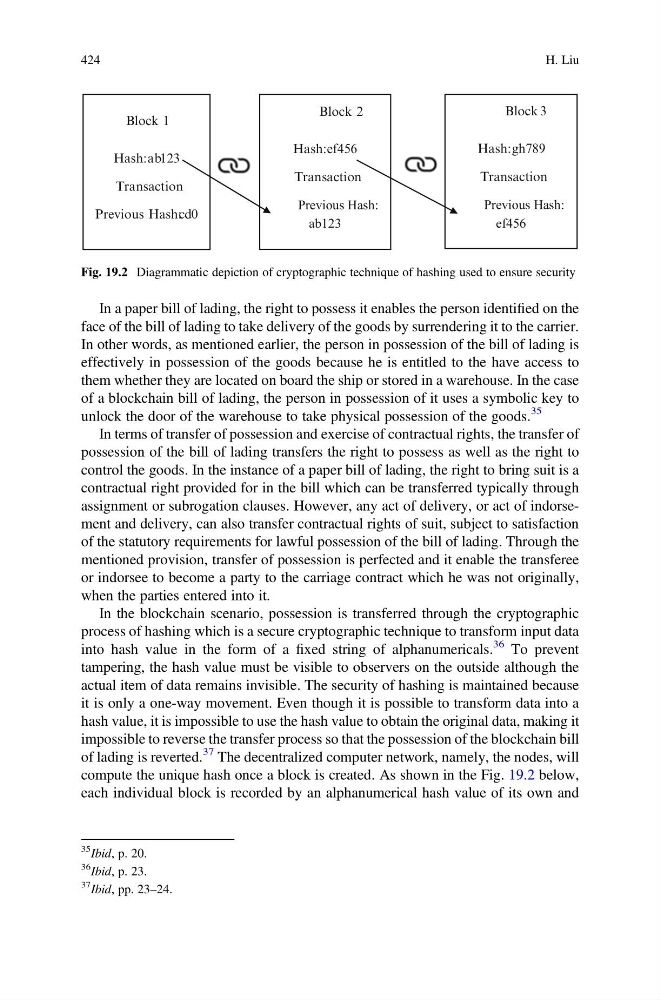
In the blockchain scenario, possession is transferred through the cryptographic
process of hashing which is a secure cryptographic technique to transform input data
into hash value in the form of a fixed string of alphanumericals.
36 To prevent
tampering, the hash value must be visible to observers on the outside although the
actual item of data remains invisible. The security of hashing is maintained because
it is only a one-way movement. Even though it is possible to transform data into a
hash value, it is impossible to use the hash value to obtain the original data, making it
impossible to reverse the transfer process so that the possession of the blockchain bill
of lading is reverted.
37 The decentralized computer network, namely, the nodes, will
compute the unique hash once a block is created. As shown in the Fig. 19.2 below,
each individual block is recorded by an alphanumerical hash value of its own and
Block 1
Hash: ab123
Transaction
Previous Hash: cd0
Block 2
Hash: ef456
Transaction
Previous Hash:
ab123
Block 3
Hash: gh789
Transaction
Previous Hash:
ef456
Fig. 19.2 Diagrammatic depiction of cryptographic technique of hashing used to ensure security
35 Ibid, p. 20.
36 Ibid, p. 23.
37 Ibid, pp. 23–24.
424
H. Liu
face of the bill of lading to take delivery of the goods by surrendering it to the carrier.
In other words, as mentioned earlier, the person in possession of the bill of lading is
effectively in possession of the goods because he is entitled to the have access to
them whether they are located on board the ship or stored in a warehouse. In the case
of a blockchain bill of lading, the person in possession of it uses a symbolic key to
unlock the door of the warehouse to take physical possession of the goods.
35
In terms of transfer of possession and exercise of contractual rights, the transfer of
possession of the bill of lading transfers the right to possess as well as the right to
control the goods. In the instance of a paper bill of lading, the right to bring suit is a
contractual right provided for in the bill which can be transferred typically through
assignment or subrogation clauses. However, any act of delivery, or act of indorsement and delivery, can also transfer contractual rights of suit, subject to satisfaction
of the statutory requirements for lawful possession of the bill of lading. Through the
mentioned provision, transfer of possession is perfected and it enable the transferee
or indorsee to become a party to the carriage contract which he was not originally,
when the parties entered into it.
In the blockchain scenario, possession is transferred through the cryptographic
process of hashing which is a secure cryptographic technique to transform input data
into hash value in the form of a fixed string of alphanumericals.
36 To prevent
tampering, the hash value must be visible to observers on the outside although the
actual item of data remains invisible. The security of hashing is maintained because
it is only a one-way movement. Even though it is possible to transform data into a
hash value, it is impossible to use the hash value to obtain the original data, making it
impossible to reverse the transfer process so that the possession of the blockchain bill
of lading is reverted.
37 The decentralized computer network, namely, the nodes, will
compute the unique hash once a block is created. As shown in the Fig. 19.2 below,
each individual block is recorded by an alphanumerical hash value of its own and
Block 1
Hash: ab123
Transaction
Previous Hash: cd0
Block 2
Hash: ef456
Transaction
Previous Hash:
ab123
Block 3
Hash: gh789
Transaction
Previous Hash:
ef456
Fig. 19.2 Diagrammatic depiction of cryptographic technique of hashing used to ensure security
35 Ibid, p. 20.
36 Ibid, p. 23.
37 Ibid, pp. 23–24.
424
H. Liu