

will reach the consignee before the goods arrive at the port of destination. To address
this anomaly, electronic bills of lading came into vogue some decades ago
spearheaded by private entities and organizations in the shipping industry. However,
they are not in widespread use due to difficulties in replicating the “document of
title” or negotiability function of paper bills of lading. Indeed, there is no existing
electronic device ensuring flawless delivery of goods to an authorized receiver. The
new blockchain technology-based bill of lading is believed to be the solution.
23
It is therefore apt to enquire whether blockchain technology and its extended
application to smart contracts may well resolve these deficiencies, if the bill of lading
can be considered as possessing the traits of a smart contract. In that context, it must
be recognized that there are serious downsides to the concept of the smart contract
itself, which in the case of the bill of lading, may be magnified several-fold. This is
discussed later in this chapter.
The first application of blockchain was in the financial field, the object being to
circulate monetary value in the forms of coins. A prime example of this is the
Bitcoin. It is also possible to exploit such technology to exchange non-monetary
tokens, be it tangible or intangible proprietary interests such as ownership, security
rights, copyrights or a transferable document such as a smart contract. In the context
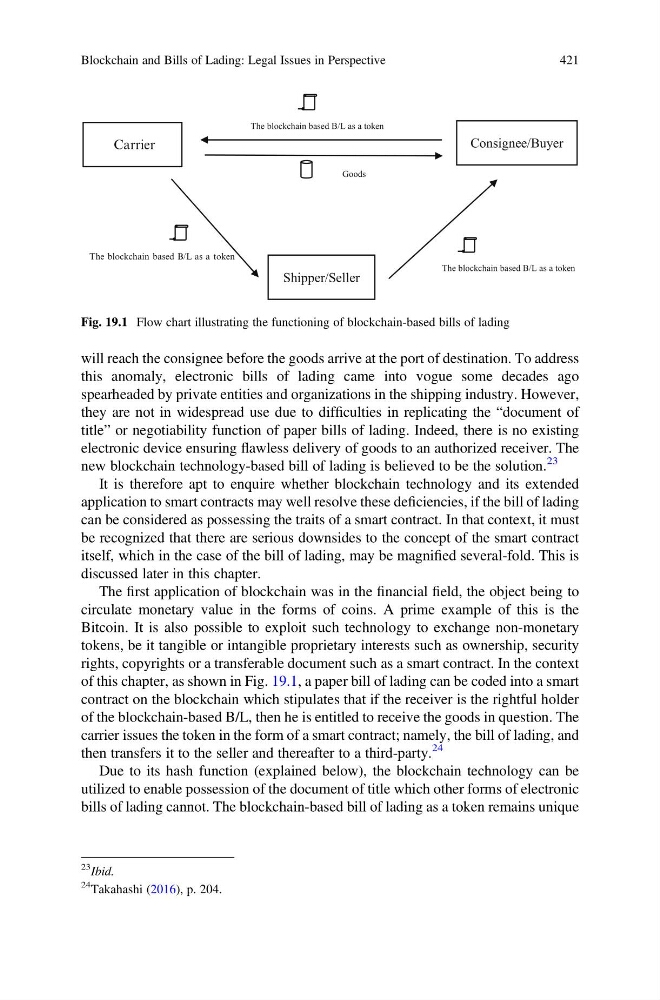
of this chapter, as shown in Fig. 19.1, a paper bill of lading can be coded into a smart
contract on the blockchain which stipulates that if the receiver is the rightful holder
of the blockchain-based B/L, then he is entitled to receive the goods in question. The
carrier issues the token in the form of a smart contract; namely, the bill of lading, and
then transfers it to the seller and thereafter to a third-party.
24
Due to its hash function (explained below), the blockchain technology can be
utilized to enable possession of the document of title which other forms of electronic
bills of lading cannot. The blockchain-based bill of lading as a token remains unique
Carrier
Shipper/Seller
Consignee/Buyer
The blockchain based B/L as a token
The blockchain based B/L as a token
The blockchain based B/L as a token
Goods
Fig. 19.1 Flow chart illustrating the functioning of blockchain-based bills of lading
23 Ibid.
24 Takahashi (2016), p. 204.
Blockchain and Bills of Lading: Legal Issues in Perspective
421
this anomaly, electronic bills of lading came into vogue some decades ago
spearheaded by private entities and organizations in the shipping industry. However,
they are not in widespread use due to difficulties in replicating the “document of
title” or negotiability function of paper bills of lading. Indeed, there is no existing
electronic device ensuring flawless delivery of goods to an authorized receiver. The
new blockchain technology-based bill of lading is believed to be the solution.
23
It is therefore apt to enquire whether blockchain technology and its extended
application to smart contracts may well resolve these deficiencies, if the bill of lading
can be considered as possessing the traits of a smart contract. In that context, it must
be recognized that there are serious downsides to the concept of the smart contract
itself, which in the case of the bill of lading, may be magnified several-fold. This is
discussed later in this chapter.
The first application of blockchain was in the financial field, the object being to
circulate monetary value in the forms of coins. A prime example of this is the
Bitcoin. It is also possible to exploit such technology to exchange non-monetary
tokens, be it tangible or intangible proprietary interests such as ownership, security
rights, copyrights or a transferable document such as a smart contract. In the context
of this chapter, as shown in Fig. 19.1, a paper bill of lading can be coded into a smart
contract on the blockchain which stipulates that if the receiver is the rightful holder
of the blockchain-based B/L, then he is entitled to receive the goods in question. The
carrier issues the token in the form of a smart contract; namely, the bill of lading, and
then transfers it to the seller and thereafter to a third-party.
24
Due to its hash function (explained below), the blockchain technology can be
utilized to enable possession of the document of title which other forms of electronic
bills of lading cannot. The blockchain-based bill of lading as a token remains unique
Carrier
Shipper/Seller
Consignee/Buyer
The blockchain based B/L as a token
The blockchain based B/L as a token
The blockchain based B/L as a token
Goods
Fig. 19.1 Flow chart illustrating the functioning of blockchain-based bills of lading
23 Ibid.
24 Takahashi (2016), p. 204.
Blockchain and Bills of Lading: Legal Issues in Perspective
421