

What happens if the territorial seas encompass international straits? It is believed
that the judgement of the International Court of Justice in the Corfu Channel case has
had positive implications for right of innocent passage of warships in international
straits within territorial seas. The case relates to the assertion by the government of
Albania that warships and even foreign merchant vessels had no right to pass
through the international straits in its territorial seas without prior permission
which was struck down by the International Court in 1949 stating that it was contrary
to both, what is generally recognized and international custom, although the International Court of Justice did refer to the international straits.
102
The maritime claims of several coastal States exceed the provisions of the Law of
the Sea Convention. State practices and procedures relating to warships that commonly go beyond the Convention include excessive straight baselines, requiring
prior notification for foreign military or government vessels to enter the territorial
sea, requiring consent for military exercises in the EEZ, and requiring prior permission for overflight of the EEZ and Flight Identification Region, et cetera. According
to a study, at one point of time there were about forty-five states
103 requiring prior
notification of passage of warships. Albania, China, Croatia, Indonesia, Malta,
Oman, South Korea, Sri Lanka, and Vietnam are amongst countries that require
prior permission or authorisation for innocent passage of foreign warships through
their territorial seas and are routinely challenged by the United States Navy operational assertions and activities, in order to preserve the rights, freedoms, and uses of
the sea and airspace guaranteed to all nations under international law.
104 Additionally, Indonesia restricts stopping, dropping anchor, or cruising without legitimate
reason in the seas adjoining the territorial seas and Taiwan requires prior notification
of innocent passage by government vessels too.
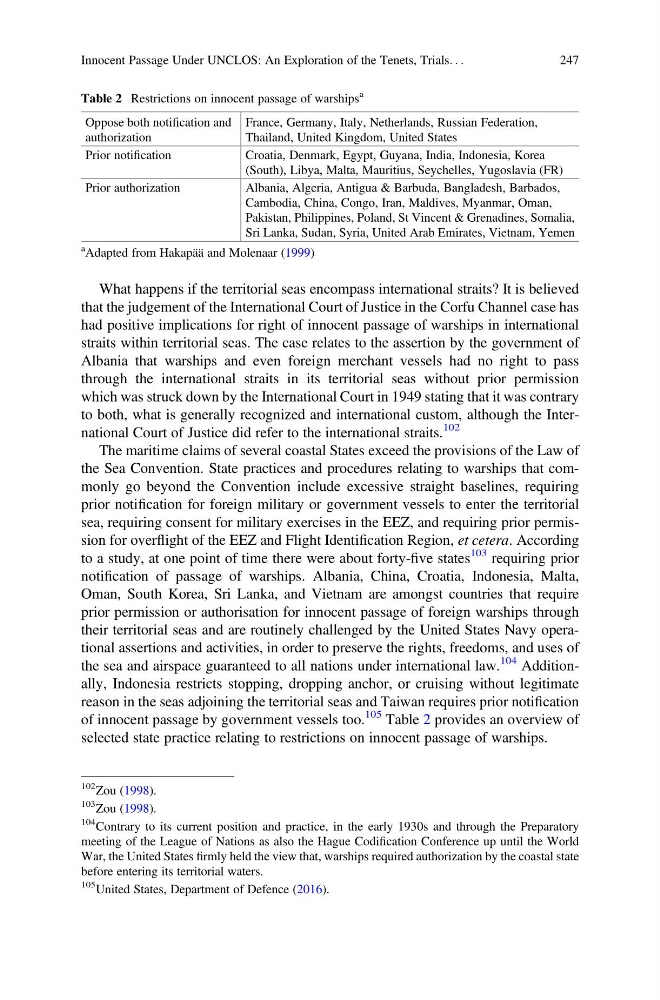
105 Table 2 provides an overview of
selected state practice relating to restrictions on innocent passage of warships.
Table 2 Restrictions on innocent passage of warships
a
Oppose both notification and
authorization
France, Germany, Italy, Netherlands, Russian Federation,
Thailand, United Kingdom, United States
Prior notification
Croatia, Denmark, Egypt, Guyana, India, Indonesia, Korea
(South), Libya, Malta, Mauritius, Seychelles, Yugoslavia (FR)
Prior authorization
Albania, Algeria, Antigua & Barbuda, Bangladesh, Barbados,
Cambodia, China, Congo, Iran, Maldives, Myanmar, Oman,
Pakistan, Philippines, Poland, St Vincent & Grenadines, Somalia,
Sri Lanka, Sudan, Syria, United Arab Emirates, Vietnam, Yemen
a Adapted from Hakapää and Molenaar (1999)
102 Zou (1998).
103 Zou (1998).
104 Contrary to its current position and practice, in the early 1930s and through the Preparatory
meeting of the League of Nations as also the Hague Codification Conference up until the World
War, the United States firmly held the view that, warships required authorization by the coastal state
before entering its territorial waters.
105 United States, Department of Defence (2016).
Innocent Passage Under UNCLOS: An Exploration of the Tenets, Trials. . .
247
that the judgement of the International Court of Justice in the Corfu Channel case has
had positive implications for right of innocent passage of warships in international
straits within territorial seas. The case relates to the assertion by the government of
Albania that warships and even foreign merchant vessels had no right to pass
through the international straits in its territorial seas without prior permission
which was struck down by the International Court in 1949 stating that it was contrary
to both, what is generally recognized and international custom, although the International Court of Justice did refer to the international straits.
102
The maritime claims of several coastal States exceed the provisions of the Law of
the Sea Convention. State practices and procedures relating to warships that commonly go beyond the Convention include excessive straight baselines, requiring
prior notification for foreign military or government vessels to enter the territorial
sea, requiring consent for military exercises in the EEZ, and requiring prior permission for overflight of the EEZ and Flight Identification Region, et cetera. According
to a study, at one point of time there were about forty-five states
103 requiring prior
notification of passage of warships. Albania, China, Croatia, Indonesia, Malta,
Oman, South Korea, Sri Lanka, and Vietnam are amongst countries that require
prior permission or authorisation for innocent passage of foreign warships through
their territorial seas and are routinely challenged by the United States Navy operational assertions and activities, in order to preserve the rights, freedoms, and uses of
the sea and airspace guaranteed to all nations under international law.
104 Additionally, Indonesia restricts stopping, dropping anchor, or cruising without legitimate
reason in the seas adjoining the territorial seas and Taiwan requires prior notification
of innocent passage by government vessels too.
105 Table 2 provides an overview of
selected state practice relating to restrictions on innocent passage of warships.
Table 2 Restrictions on innocent passage of warships
a
Oppose both notification and
authorization
France, Germany, Italy, Netherlands, Russian Federation,
Thailand, United Kingdom, United States
Prior notification
Croatia, Denmark, Egypt, Guyana, India, Indonesia, Korea
(South), Libya, Malta, Mauritius, Seychelles, Yugoslavia (FR)
Prior authorization
Albania, Algeria, Antigua & Barbuda, Bangladesh, Barbados,
Cambodia, China, Congo, Iran, Maldives, Myanmar, Oman,
Pakistan, Philippines, Poland, St Vincent & Grenadines, Somalia,
Sri Lanka, Sudan, Syria, United Arab Emirates, Vietnam, Yemen
a Adapted from Hakapää and Molenaar (1999)
102 Zou (1998).
103 Zou (1998).
104 Contrary to its current position and practice, in the early 1930s and through the Preparatory
meeting of the League of Nations as also the Hague Codification Conference up until the World
War, the United States firmly held the view that, warships required authorization by the coastal state
before entering its territorial waters.
105 United States, Department of Defence (2016).
Innocent Passage Under UNCLOS: An Exploration of the Tenets, Trials. . .
247