

5.1 Hazardous and Noxious Substances
Coastal States have for long recognized the importance of safe maritime transportation of hazardous goods through waters under jurisdiction, and the attendant socioeconomic impacts from environmental damage in the event of any casualty, with
some having reacted strongly when ships carrying hazardous cargo attempted to take
innocent passage through their territorial waters and others having refused to grant
innocent passage without permission.
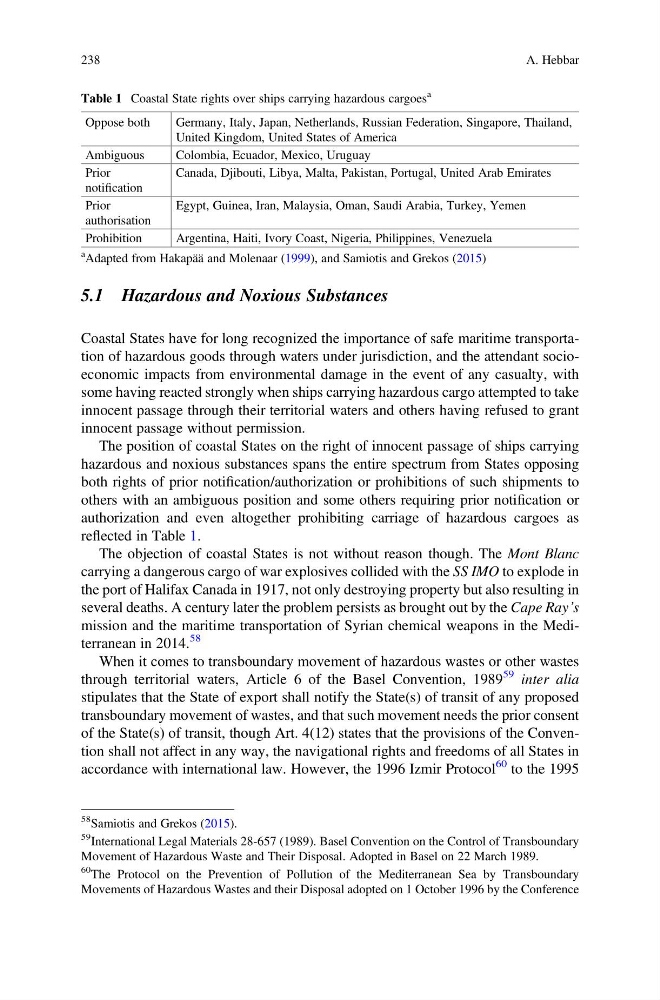
The position of coastal States on the right of innocent passage of ships carrying
hazardous and noxious substances spans the entire spectrum from States opposing
both rights of prior notification/authorization or prohibitions of such shipments to
others with an ambiguous position and some others requiring prior notification or
authorization and even altogether prohibiting carriage of hazardous cargoes as
reflected in Table 1.
The objection of coastal States is not without reason though. The Mont Blanc
carrying a dangerous cargo of war explosives collided with the SS IMO to explode in
the port of Halifax Canada in 1917, not only destroying property but also resulting in
several deaths. A century later the problem persists as brought out by the Cape Ray’s
mission and the maritime transportation of Syrian chemical weapons in the Mediterranean in 2014.
58
When it comes to transboundary movement of hazardous wastes or other wastes
through territorial waters, Article 6 of the Basel Convention, 1989
59 inter alia
stipulates that the State of export shall notify the State(s) of transit of any proposed
transboundary movement of wastes, and that such movement needs the prior consent
of the State(s) of transit, though Art. 4(12) states that the provisions of the Convention shall not affect in any way, the navigational rights and freedoms of all States in
accordance with international law. However, the 1996 Izmir Protocol
60 to the 1995
Table 1 Coastal State rights over ships carrying hazardous cargoes
a
Oppose both
Germany, Italy, Japan, Netherlands, Russian Federation, Singapore, Thailand,
United Kingdom, United States of America
Ambiguous
Colombia, Ecuador, Mexico, Uruguay
Prior
notification
Canada, Djibouti, Libya, Malta, Pakistan, Portugal, United Arab Emirates
Prior
authorisation
Egypt, Guinea, Iran, Malaysia, Oman, Saudi Arabia, Turkey, Yemen
Prohibition
Argentina, Haiti, Ivory Coast, Nigeria, Philippines, Venezuela
a Adapted from Hakapää and Molenaar (1999), and Samiotis and Grekos (2015)
58 Samiotis and Grekos (2015).
59 International Legal Materials 28-657 (1989). Basel Convention on the Control of Transboundary
Movement of Hazardous Waste and Their Disposal. Adopted in Basel on 22 March 1989.
60 The Protocol on the Prevention of Pollution of the Mediterranean Sea by Transboundary
Movements of Hazardous Wastes and their Disposal adopted on 1 October 1996 by the Conference
238
A. Hebbar
Coastal States have for long recognized the importance of safe maritime transportation of hazardous goods through waters under jurisdiction, and the attendant socioeconomic impacts from environmental damage in the event of any casualty, with
some having reacted strongly when ships carrying hazardous cargo attempted to take
innocent passage through their territorial waters and others having refused to grant
innocent passage without permission.
The position of coastal States on the right of innocent passage of ships carrying
hazardous and noxious substances spans the entire spectrum from States opposing
both rights of prior notification/authorization or prohibitions of such shipments to
others with an ambiguous position and some others requiring prior notification or
authorization and even altogether prohibiting carriage of hazardous cargoes as
reflected in Table 1.
The objection of coastal States is not without reason though. The Mont Blanc
carrying a dangerous cargo of war explosives collided with the SS IMO to explode in
the port of Halifax Canada in 1917, not only destroying property but also resulting in
several deaths. A century later the problem persists as brought out by the Cape Ray’s
mission and the maritime transportation of Syrian chemical weapons in the Mediterranean in 2014.
58
When it comes to transboundary movement of hazardous wastes or other wastes
through territorial waters, Article 6 of the Basel Convention, 1989
59 inter alia
stipulates that the State of export shall notify the State(s) of transit of any proposed
transboundary movement of wastes, and that such movement needs the prior consent
of the State(s) of transit, though Art. 4(12) states that the provisions of the Convention shall not affect in any way, the navigational rights and freedoms of all States in
accordance with international law. However, the 1996 Izmir Protocol
60 to the 1995
Table 1 Coastal State rights over ships carrying hazardous cargoes
a
Oppose both
Germany, Italy, Japan, Netherlands, Russian Federation, Singapore, Thailand,
United Kingdom, United States of America
Ambiguous
Colombia, Ecuador, Mexico, Uruguay
Prior
notification
Canada, Djibouti, Libya, Malta, Pakistan, Portugal, United Arab Emirates
Prior
authorisation
Egypt, Guinea, Iran, Malaysia, Oman, Saudi Arabia, Turkey, Yemen
Prohibition
Argentina, Haiti, Ivory Coast, Nigeria, Philippines, Venezuela
a Adapted from Hakapää and Molenaar (1999), and Samiotis and Grekos (2015)
58 Samiotis and Grekos (2015).
59 International Legal Materials 28-657 (1989). Basel Convention on the Control of Transboundary
Movement of Hazardous Waste and Their Disposal. Adopted in Basel on 22 March 1989.
60 The Protocol on the Prevention of Pollution of the Mediterranean Sea by Transboundary
Movements of Hazardous Wastes and their Disposal adopted on 1 October 1996 by the Conference
238
A. Hebbar