

significance to address regulatory gaps in engaging private security services.
113
There is substantial debate as to the applicability of these documents to activities
of private security companies within the maritime domain because they address
more specifically private security companies providing military-like services in
armed conflict situations.
114 In spite of the seemingly unsuitable nature of these
initiatives, their provisions maintain some relevance to the maritime context because
several of its underlying obligations, practices and concepts are transposable to the
maritime setting.
115
Another prominent multi stakeholder initiative is the International Organization
for Standardization’s Ship and Marine Technology-Guidelines for Private Maritime
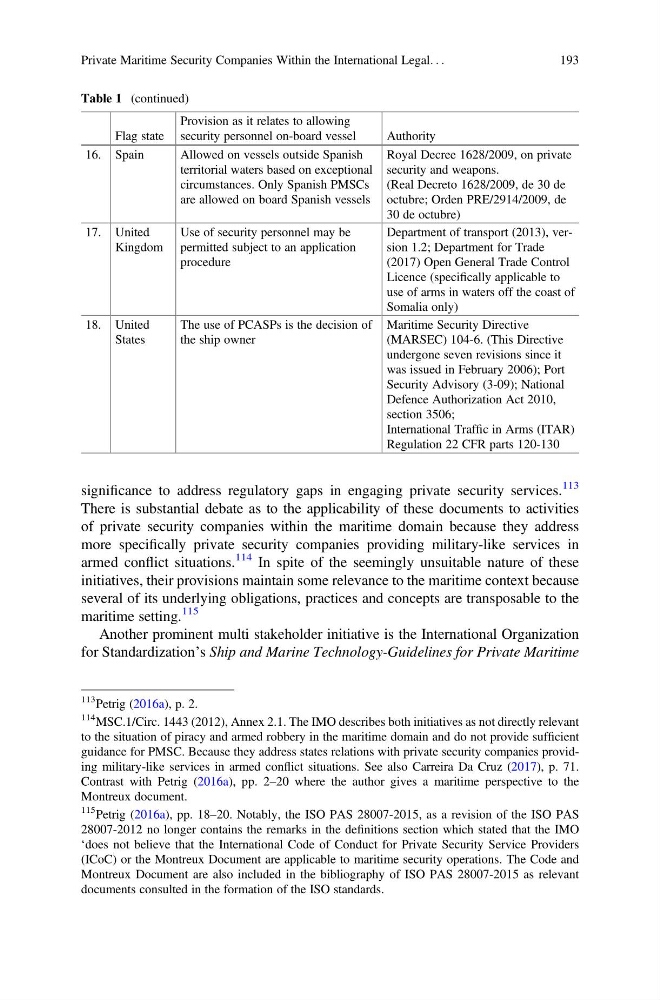
Table 1 (continued)
Flag state
Provision as it relates to allowing
security personnel on-board vessel
Authority
16. Spain
Allowed on vessels outside Spanish
territorial waters based on exceptional
circumstances. Only Spanish PMSCs
are allowed on board Spanish vessels
Royal Decree 1628/2009, on private
security and weapons.
(Real Decreto 1628/2009, de 30 de
octubre; Orden PRE/2914/2009, de
30 de octubre)
17. United
Kingdom
Use of security personnel may be
permitted subject to an application
procedure
Department of transport (2013), version 1.2; Department for Trade
(2017) Open General Trade Control
Licence (specifically applicable to
use of arms in waters off the coast of
Somalia only)
18. United
States
The use of PCASPs is the decision of
the ship owner
Maritime Security Directive
(MARSEC) 104-6. (This Directive
undergone seven revisions since it
was issued in February 2006); Port
Security Advisory (3-09); National
Defence Authorization Act 2010,
section 3506;
International Traffic in Arms (ITAR)
Regulation 22 CFR parts 120-130
113 Petrig (2016a), p. 2.
114 MSC.1/Circ. 1443 (2012), Annex 2.1. The IMO describes both initiatives as not directly relevant
to the situation of piracy and armed robbery in the maritime domain and do not provide sufficient
guidance for PMSC. Because they address states relations with private security companies providing military-like services in armed conflict situations. See also Carreira Da Cruz (2017), p. 71.
Contrast with Petrig (2016a), pp. 2–20 where the author gives a maritime perspective to the
Montreux document.
115 Petrig (2016a), pp. 18–20. Notably, the ISO PAS 28007-2015, as a revision of the ISO PAS
28007-2012 no longer contains the remarks in the definitions section which stated that the IMO
‘does not believe that the International Code of Conduct for Private Security Service Providers
(ICoC) or the Montreux Document are applicable to maritime security operations. The Code and
Montreux Document are also included in the bibliography of ISO PAS 28007-2015 as relevant
documents consulted in the formation of the ISO standards.
Private Maritime Security Companies Within the International Legal. . .
193
113
There is substantial debate as to the applicability of these documents to activities
of private security companies within the maritime domain because they address
more specifically private security companies providing military-like services in
armed conflict situations.
114 In spite of the seemingly unsuitable nature of these
initiatives, their provisions maintain some relevance to the maritime context because
several of its underlying obligations, practices and concepts are transposable to the
maritime setting.
115
Another prominent multi stakeholder initiative is the International Organization
for Standardization’s Ship and Marine Technology-Guidelines for Private Maritime
Table 1 (continued)
Flag state
Provision as it relates to allowing
security personnel on-board vessel
Authority
16. Spain
Allowed on vessels outside Spanish
territorial waters based on exceptional
circumstances. Only Spanish PMSCs
are allowed on board Spanish vessels
Royal Decree 1628/2009, on private
security and weapons.
(Real Decreto 1628/2009, de 30 de
octubre; Orden PRE/2914/2009, de
30 de octubre)
17. United
Kingdom
Use of security personnel may be
permitted subject to an application
procedure
Department of transport (2013), version 1.2; Department for Trade
(2017) Open General Trade Control
Licence (specifically applicable to
use of arms in waters off the coast of
Somalia only)
18. United
States
The use of PCASPs is the decision of
the ship owner
Maritime Security Directive
(MARSEC) 104-6. (This Directive
undergone seven revisions since it
was issued in February 2006); Port
Security Advisory (3-09); National
Defence Authorization Act 2010,
section 3506;
International Traffic in Arms (ITAR)
Regulation 22 CFR parts 120-130
113 Petrig (2016a), p. 2.
114 MSC.1/Circ. 1443 (2012), Annex 2.1. The IMO describes both initiatives as not directly relevant
to the situation of piracy and armed robbery in the maritime domain and do not provide sufficient
guidance for PMSC. Because they address states relations with private security companies providing military-like services in armed conflict situations. See also Carreira Da Cruz (2017), p. 71.
Contrast with Petrig (2016a), pp. 2–20 where the author gives a maritime perspective to the
Montreux document.
115 Petrig (2016a), pp. 18–20. Notably, the ISO PAS 28007-2015, as a revision of the ISO PAS
28007-2012 no longer contains the remarks in the definitions section which stated that the IMO
‘does not believe that the International Code of Conduct for Private Security Service Providers
(ICoC) or the Montreux Document are applicable to maritime security operations. The Code and
Montreux Document are also included in the bibliography of ISO PAS 28007-2015 as relevant
documents consulted in the formation of the ISO standards.
Private Maritime Security Companies Within the International Legal. . .
193