

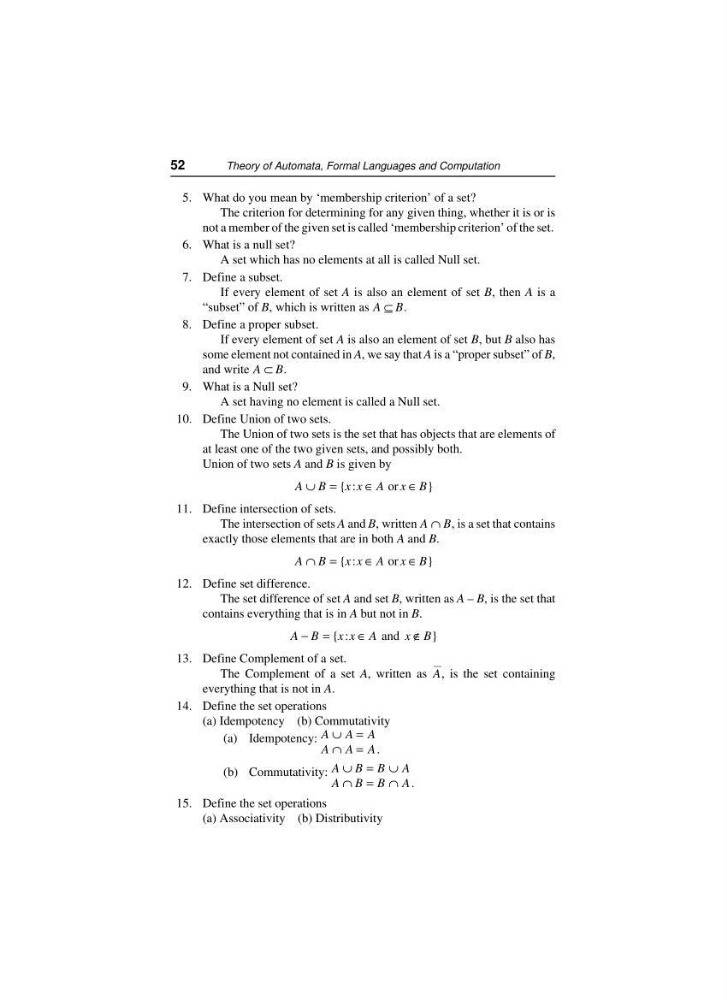
5. What do you mean by ‘membership criterion’ of a set?
The criterion for determining for any given thing, whether it is or is
not a member of the given set is called ‘membership criterion’ of the set.
6. What is a null set?
A set which has no elements at all is called Null set.
7. Define a subset.
If every element of set A is also an element of set B, then A is a
“subset” of B, which is written as A B
⊆ .
8. Define a proper subset.
If every element of set A is also an element of set B, but B also has
some element not contained in A, we say that A is a “proper subset” of B,
and write A B
⊂ .
9. What is a Null set?
A set having no element is called a Null set.
10. Define Union of two sets.
The Union of two sets is the set that has objects that are elements of
at least one of the two given sets, and possibly both.
Union of two sets A and B is given by
A B
x x A x B
∪ =
∈
∈
{ :
}
or
11. Define intersection of sets.
The intersection of sets A and B, written A B
∩ , is a set that contains
exactly those elements that are in both A and B.
A B
x x A x B
∩ =
∈
∈
{ :
}
or
12. Define set difference.
The set difference of set A and set B, written as A – B, is the set that
contains everything that is in A but not in B.
A B
x x A
x B
− =
∈
∉
{ :
}
and
13. Define Complement of a set.
The Complement of a set A, written as A, is the set containing
everything that is not in A.
14. Define the set operations
(a) Idempotency (b) Commutativity
(a) Idempotency: A A A
A A A
∪ =
∩ = .
(b) Commutativity: A B B A
A B B A
∪ = ∪
∩ = ∩ .
15. Define the set operations
(a) Associativity (b) Distributivity
52
Theory of Automata, Formal Languages and Computation
The criterion for determining for any given thing, whether it is or is
not a member of the given set is called ‘membership criterion’ of the set.
6. What is a null set?
A set which has no elements at all is called Null set.
7. Define a subset.
If every element of set A is also an element of set B, then A is a
“subset” of B, which is written as A B
⊆ .
8. Define a proper subset.
If every element of set A is also an element of set B, but B also has
some element not contained in A, we say that A is a “proper subset” of B,
and write A B
⊂ .
9. What is a Null set?
A set having no element is called a Null set.
10. Define Union of two sets.
The Union of two sets is the set that has objects that are elements of
at least one of the two given sets, and possibly both.
Union of two sets A and B is given by
A B
x x A x B
∪ =
∈
∈
{ :
}
or
11. Define intersection of sets.
The intersection of sets A and B, written A B
∩ , is a set that contains
exactly those elements that are in both A and B.
A B
x x A x B
∩ =
∈
∈
{ :
}
or
12. Define set difference.
The set difference of set A and set B, written as A – B, is the set that
contains everything that is in A but not in B.
A B
x x A
x B
− =
∈
∉
{ :
}
and
13. Define Complement of a set.
The Complement of a set A, written as A, is the set containing
everything that is not in A.
14. Define the set operations
(a) Idempotency (b) Commutativity
(a) Idempotency: A A A
A A A
∪ =
∩ = .
(b) Commutativity: A B B A
A B B A
∪ = ∪
∩ = ∩ .
15. Define the set operations
(a) Associativity (b) Distributivity
52
Theory of Automata, Formal Languages and Computation