

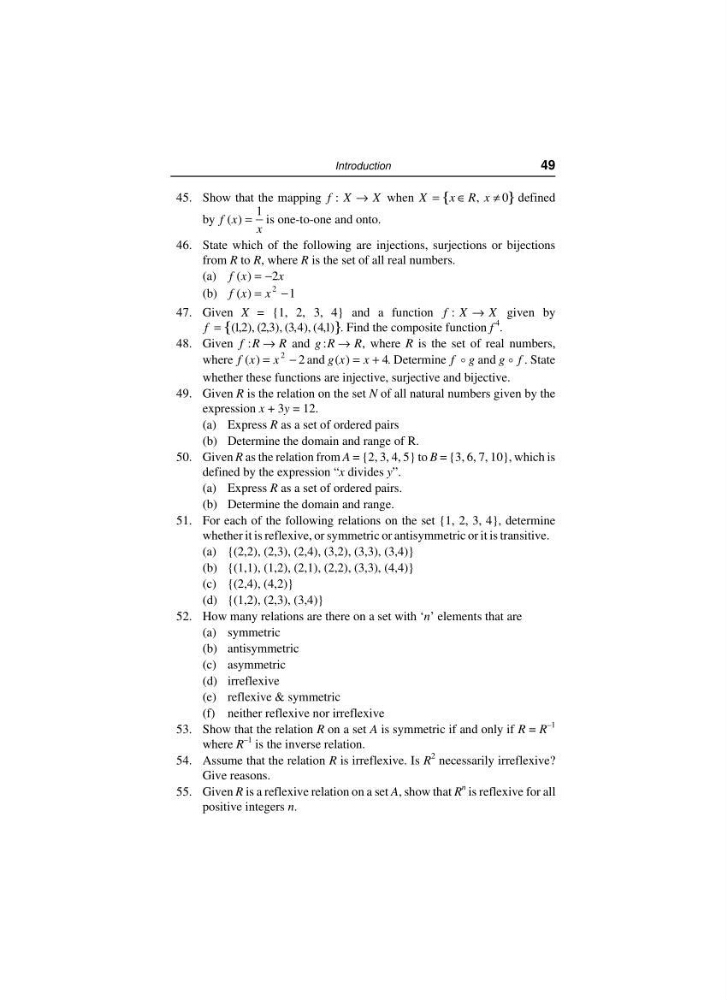
45. Show that the mapping f X
X
: → when
{
}
X
x R x
= ∈
≠
,
0 defined
by f x
x
( ) =
1 is one-to-one and onto.
46. State which of the following are injections, surjections or bijections
from R to R, where R is the set of all real numbers.
(a) f x
x
( ) = −2
(b) f x x
( ) =
−
2
1
47. Given X = {1, 2, 3, 4} and a function f X
X
: →
given by
{
}
f = ( , ), ( , ), ( , ), ( , )
12 2 3 3 4 41 . Find the composite function f
4 .
48. Given f R
R
: → and g R
R
: → , where R is the set of real numbers,
where f x x
( ) =
−
2
2 and g x x
( ) = + 4. Determine f g
o and g f
o . State
whether these functions are injective, surjective and bijective.
49. Given R is the relation on the set N of all natural numbers given by the
expression x + 3y = 12.
(a) Express R as a set of ordered pairs
(b) Determine the domain and range of R.
50. Given R as the relation from A = {2, 3, 4, 5} to B = {3, 6, 7, 10}, which is
defined by the expression “x divides y”.
(a) Express R as a set of ordered pairs.
(b) Determine the domain and range.
51. For each of the following relations on the set {1, 2, 3, 4}, determine
whether it is reflexive, or symmetric or antisymmetric or it is transitive.
(a) {(2,2), (2,3), (2,4), (3,2), (3,3), (3,4)}
(b) {(1,1), (1,2), (2,1), (2,2), (3,3), (4,4)}
(c) {(2,4), (4,2)}
(d) {(1,2), (2,3), (3,4)}
52. How many relations are there on a set with ‘n’ elements that are
(a) symmetric
(b) antisymmetric
(c) asymmetric
(d) irreflexive
(e) reflexive & symmetric
(f) neither reflexive nor irreflexive
53. Show that the relation R on a set A is symmetric if and only if R = R
–1
where R
–1 is the inverse relation.
54. Assume that the relation R is irreflexive. Is R
2 necessarily irreflexive?
Give reasons.
55. Given R is a reflexive relation on a set A, show that R
n is reflexive for all
positive integers n.
Introduction
49
X
: → when
{
}
X
x R x
= ∈
≠
,
0 defined
by f x
x
( ) =
1 is one-to-one and onto.
46. State which of the following are injections, surjections or bijections
from R to R, where R is the set of all real numbers.
(a) f x
x
( ) = −2
(b) f x x
( ) =
−
2
1
47. Given X = {1, 2, 3, 4} and a function f X
X
: →
given by
{
}
f = ( , ), ( , ), ( , ), ( , )
12 2 3 3 4 41 . Find the composite function f
4 .
48. Given f R
R
: → and g R
R
: → , where R is the set of real numbers,
where f x x
( ) =
−
2
2 and g x x
( ) = + 4. Determine f g
o and g f
o . State
whether these functions are injective, surjective and bijective.
49. Given R is the relation on the set N of all natural numbers given by the
expression x + 3y = 12.
(a) Express R as a set of ordered pairs
(b) Determine the domain and range of R.
50. Given R as the relation from A = {2, 3, 4, 5} to B = {3, 6, 7, 10}, which is
defined by the expression “x divides y”.
(a) Express R as a set of ordered pairs.
(b) Determine the domain and range.
51. For each of the following relations on the set {1, 2, 3, 4}, determine
whether it is reflexive, or symmetric or antisymmetric or it is transitive.
(a) {(2,2), (2,3), (2,4), (3,2), (3,3), (3,4)}
(b) {(1,1), (1,2), (2,1), (2,2), (3,3), (4,4)}
(c) {(2,4), (4,2)}
(d) {(1,2), (2,3), (3,4)}
52. How many relations are there on a set with ‘n’ elements that are
(a) symmetric
(b) antisymmetric
(c) asymmetric
(d) irreflexive
(e) reflexive & symmetric
(f) neither reflexive nor irreflexive
53. Show that the relation R on a set A is symmetric if and only if R = R
–1
where R
–1 is the inverse relation.
54. Assume that the relation R is irreflexive. Is R
2 necessarily irreflexive?
Give reasons.
55. Given R is a reflexive relation on a set A, show that R
n is reflexive for all
positive integers n.
Introduction
49