

Hence we conclude the following
(a) True (b) False (c) True (d) True (e) True (f) False
(g) True (h) False (i) False (j) True (k) True (l) False
(m) True (n) True (o) True.
0.1.5 Boolean Logic
“Boolean logic” is a system built with two values TRUE and FALSE.
“Boolean values” are represented by values 0 and 1. There are many Boolean
operations.
(a) Negation: It means the NOT operation, represents by ¬.
Example: ¬ 0 = 1 and ¬ 1 = 0.
(b) Conjunction: It means the AND operation, represented by ∧.
(c) Disjunction: It means the OR operation, represented by ∨
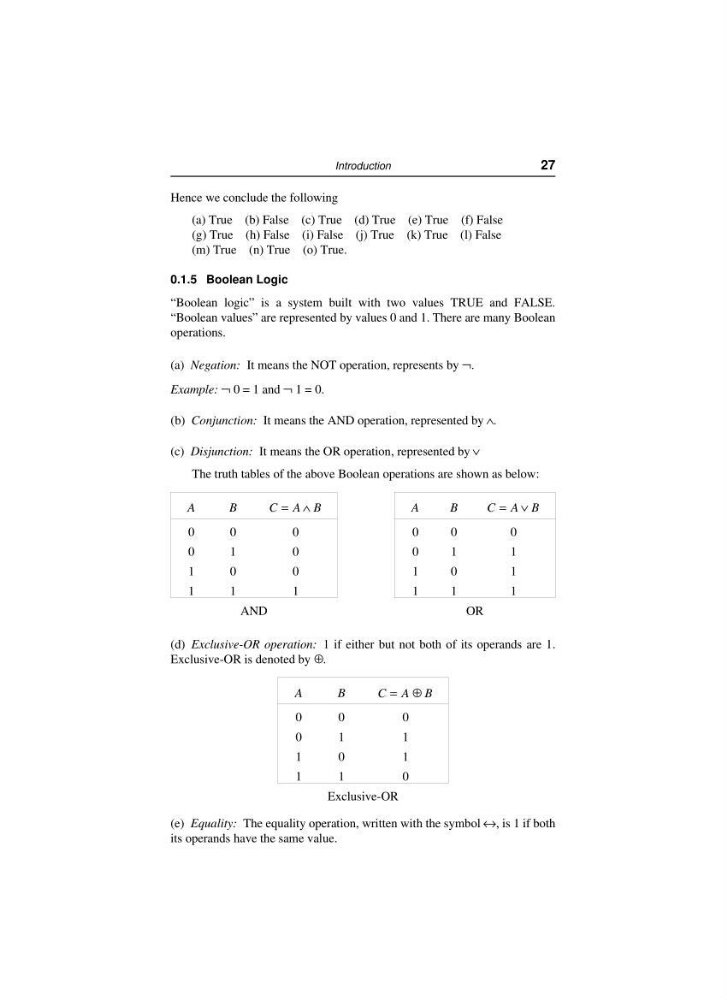
The truth tables of the above Boolean operations are shown as below:
A
B
C A B
= ∧
A
B
C A B
= ∨
0
0
0
0
0
0
0
1
0
0
1
1
1
0
0
1
0
1
1
1
1
1
1
1
AND
OR
(d) Exclusive-OR operation: 1 if either but not both of its operands are 1.
Exclusive-OR is denoted by ⊕.
A
B
C A B
= ⊕
0
0
0
0
1
1
1
0
1
1
1
0
Exclu sive-OR
(e) Equality: The equality operation, written with the symbol ↔, is 1 if both
its operands have the same value.
Introduction
27
(a) True (b) False (c) True (d) True (e) True (f) False
(g) True (h) False (i) False (j) True (k) True (l) False
(m) True (n) True (o) True.
0.1.5 Boolean Logic
“Boolean logic” is a system built with two values TRUE and FALSE.
“Boolean values” are represented by values 0 and 1. There are many Boolean
operations.
(a) Negation: It means the NOT operation, represents by ¬.
Example: ¬ 0 = 1 and ¬ 1 = 0.
(b) Conjunction: It means the AND operation, represented by ∧.
(c) Disjunction: It means the OR operation, represented by ∨
The truth tables of the above Boolean operations are shown as below:
A
B
C A B
= ∧
A
B
C A B
= ∨
0
0
0
0
0
0
0
1
0
0
1
1
1
0
0
1
0
1
1
1
1
1
1
1
AND
OR
(d) Exclusive-OR operation: 1 if either but not both of its operands are 1.
Exclusive-OR is denoted by ⊕.
A
B
C A B
= ⊕
0
0
0
0
1
1
1
0
1
1
1
0
Exclu sive-OR
(e) Equality: The equality operation, written with the symbol ↔, is 1 if both
its operands have the same value.
Introduction
27