

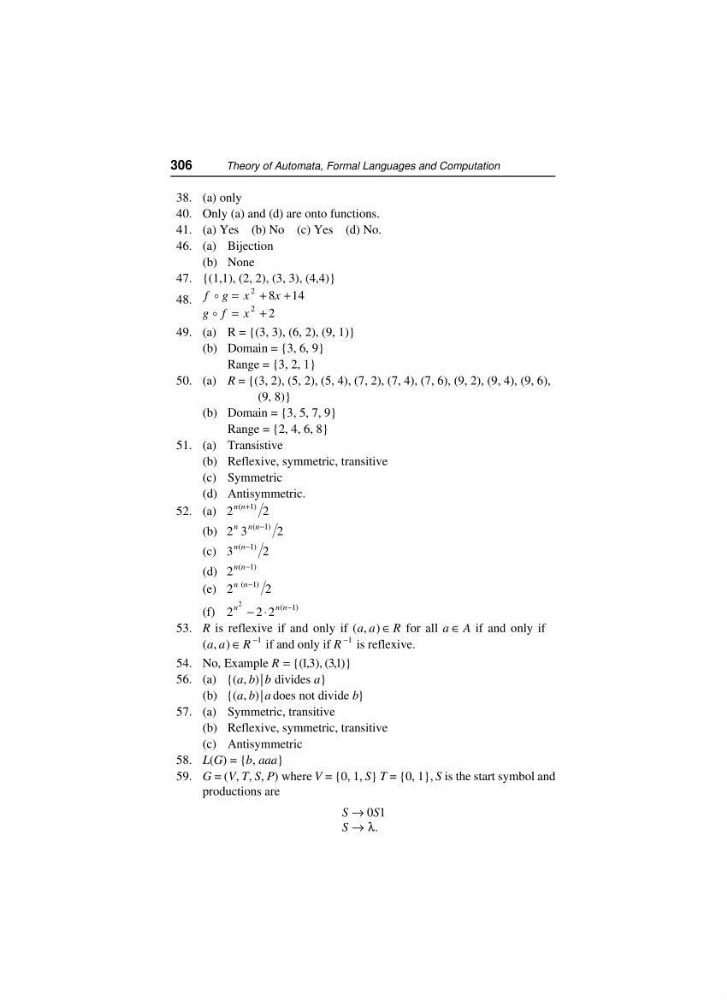
38. (a) only
40. Only (a) and (d) are onto functions.
41. (a) Yes (b) No (c) Yes (d) No.
46. (a) Bijection
(b) None
47. {(1,1), (2, 2), (3, 3), (4,4)}
48. f g x
x
g f x
o
o
=
+ +
=
+
2
2
8 14
2
49. (a) R = {(3, 3), (6, 2), (9, 1)}
(b) Domain = {3, 6, 9}
Range = {3, 2, 1}
50. (a) R = {(3, 2), (5, 2), (5, 4), (7, 2), (7, 4), (7, 6), (9, 2), (9, 4), (9, 6),
(9, 8)}
(b) Domain = {3, 5, 7, 9}
Range = {2, 4, 6, 8}
51. (a) Transistive
(b) Reflexive, symmetric, transitive
(c) Symmetric
(d) Antisymmetric.
52. (a) 2
2
1
n n
(
)
+
(b) 2 3
2
1
n n n
(
)
−
(c) 3
2
1
n n
(
)
−
(d) 2
1
n n
(
)
−
(e) 2
2
1
n n
(
)
−
(f) 2
2 2
2
1
n
n n
− ⋅
−
(
)
53. R is reflexive if and only if ( , )
a a R
∈ for all a A
∈ if and only if
( , )
a a R
∈
−1 if and only if R
−1 is reflexive.
54. No, Example R = {( , ), ( , )}
13 31
56. (a) {( , ) |
a b b
a
divides }
(b) {( , ) |
a b a
b
does not divide }
57. (a) Symmetric, transitive
(b) Reflexive, symmetric, transitive
(c) Antisymmetric
58. L(G) = {b, aaa}
59. G = (V, T, S, P) where V = {0, 1, S} T = {0, 1}, S is the start symbol and
productions are
S
S
S
→
→
0 1
λ.
306
Theory of Automata, Formal Languages and Computation
40. Only (a) and (d) are onto functions.
41. (a) Yes (b) No (c) Yes (d) No.
46. (a) Bijection
(b) None
47. {(1,1), (2, 2), (3, 3), (4,4)}
48. f g x
x
g f x
o
o
=
+ +
=
+
2
2
8 14
2
49. (a) R = {(3, 3), (6, 2), (9, 1)}
(b) Domain = {3, 6, 9}
Range = {3, 2, 1}
50. (a) R = {(3, 2), (5, 2), (5, 4), (7, 2), (7, 4), (7, 6), (9, 2), (9, 4), (9, 6),
(9, 8)}
(b) Domain = {3, 5, 7, 9}
Range = {2, 4, 6, 8}
51. (a) Transistive
(b) Reflexive, symmetric, transitive
(c) Symmetric
(d) Antisymmetric.
52. (a) 2
2
1
n n
(
)
+
(b) 2 3
2
1
n n n
(
)
−
(c) 3
2
1
n n
(
)
−
(d) 2
1
n n
(
)
−
(e) 2
2
1
n n
(
)
−
(f) 2
2 2
2
1
n
n n
− ⋅
−
(
)
53. R is reflexive if and only if ( , )
a a R
∈ for all a A
∈ if and only if
( , )
a a R
∈
−1 if and only if R
−1 is reflexive.
54. No, Example R = {( , ), ( , )}
13 31
56. (a) {( , ) |
a b b
a
divides }
(b) {( , ) |
a b a
b
does not divide }
57. (a) Symmetric, transitive
(b) Reflexive, symmetric, transitive
(c) Antisymmetric
58. L(G) = {b, aaa}
59. G = (V, T, S, P) where V = {0, 1, S} T = {0, 1}, S is the start symbol and
productions are
S
S
S
→
→
0 1
λ.
306
Theory of Automata, Formal Languages and Computation