

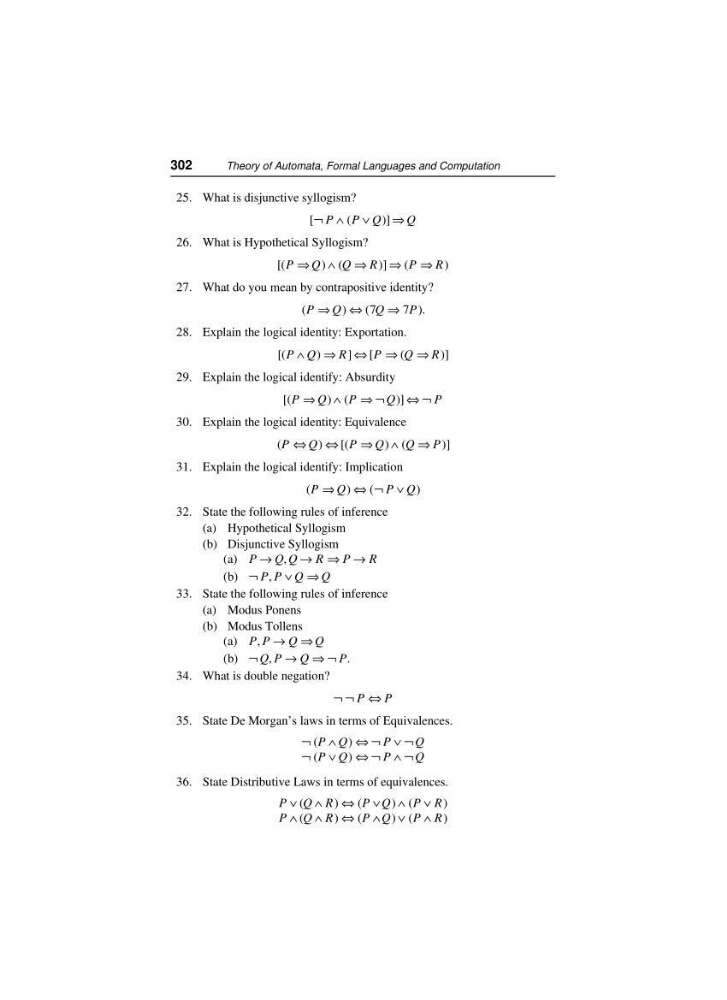
25. What is disjunctive syllogism?
[
(
)]
¬ ∧ ∨
⇒
P P Q
Q
26. What is Hypothetical Syllogism?
[(
) (
)] (
)
P Q
Q R
P
R
⇒ ∧
⇒
⇒
⇒
27. What do you mean by contrapositive identity?
(
)
(
).
P Q
Q
P
⇒
⇔
⇒
7
7
28. Explain the logical identity: Exportation.
[(
)
] [
(
)]
P Q
R
P
Q R
∧
⇒ ⇔ ⇒
⇒
29. Explain the logical identify: Absurdity
[(
) (
)]
P Q
P
Q
P
⇒ ∧
⇒ ¬
⇔ ¬
30. Explain the logical identity: Equivalence
(
) [(
) (
)]
P
Q
P Q
Q P
⇔
⇔
⇒ ∧
⇒
31. Explain the logical identify: Implication
(
)
(
)
P Q
P Q
⇒
⇔ ¬ ∨
32. State the following rules of inference
(a) Hypothetical Syllogism
(b) Disjunctive Syllogism
(a) P Q Q R
P
R
→
→ ⇒ →
,
(b) ¬
∨ ⇒
P P Q Q
,
33. State the following rules of inference
(a) Modus Ponens
(b) Modus Tollens
(a) P P Q Q
, → ⇒
(b) ¬
→ ⇒ ¬
Q P Q
P
,
.
34. What is double negation?
¬ ¬ ⇔
P
P
35. State De Morgan’s laws in terms of Equivalences.
¬ ∧
⇔ ¬ ∨ ¬
¬ ∨
⇔ ¬ ∧ ¬
(
)
(
)
P Q
P
Q
P Q
P
Q
36. State Distributive Laws in terms of equivalences.
P Q R
P Q
P R
P Q R
P Q
P R
∨ ∧
⇔ ∨ ∧ ∨
∧ ∧
⇔ ∧ ∨ ∧
(
)
(
) (
)
(
)
(
) (
)
302
Theory of Automata, Formal Languages and Computation
[
(
)]
¬ ∧ ∨
⇒
P P Q
Q
26. What is Hypothetical Syllogism?
[(
) (
)] (
)
P Q
Q R
P
R
⇒ ∧
⇒
⇒
⇒
27. What do you mean by contrapositive identity?
(
)
(
).
P Q
Q
P
⇒
⇔
⇒
7
7
28. Explain the logical identity: Exportation.
[(
)
] [
(
)]
P Q
R
P
Q R
∧
⇒ ⇔ ⇒
⇒
29. Explain the logical identify: Absurdity
[(
) (
)]
P Q
P
Q
P
⇒ ∧
⇒ ¬
⇔ ¬
30. Explain the logical identity: Equivalence
(
) [(
) (
)]
P
Q
P Q
Q P
⇔
⇔
⇒ ∧
⇒
31. Explain the logical identify: Implication
(
)
(
)
P Q
P Q
⇒
⇔ ¬ ∨
32. State the following rules of inference
(a) Hypothetical Syllogism
(b) Disjunctive Syllogism
(a) P Q Q R
P
R
→
→ ⇒ →
,
(b) ¬
∨ ⇒
P P Q Q
,
33. State the following rules of inference
(a) Modus Ponens
(b) Modus Tollens
(a) P P Q Q
, → ⇒
(b) ¬
→ ⇒ ¬
Q P Q
P
,
.
34. What is double negation?
¬ ¬ ⇔
P
P
35. State De Morgan’s laws in terms of Equivalences.
¬ ∧
⇔ ¬ ∨ ¬
¬ ∨
⇔ ¬ ∧ ¬
(
)
(
)
P Q
P
Q
P Q
P
Q
36. State Distributive Laws in terms of equivalences.
P Q R
P Q
P R
P Q R
P Q
P R
∨ ∧
⇔ ∨ ∧ ∨
∧ ∧
⇔ ∧ ∨ ∧
(
)
(
) (
)
(
)
(
) (
)
302
Theory of Automata, Formal Languages and Computation