

SHORT QUESTIONS AND ANSWERS
1. Define a mathematical structure.
It is defined as a set of axioms.
2. What is an axiom?
An oxiom is a true statement about the properties of the structure.
3. What is logic?
Logic is the discipline that deals with the method of reasoning. It
gives a set of rules and techniques to determine whether a given
argument is valid or not.
4. What are Theorems?
True assertions which can be inferred from the truth of axioms are
called ‘Theorems’.
5. What is meant by ‘proof’ of a Theorem?
Proof of a theorem is an argument that establishes that the theorem is
true for a specified mathematical structure.
6. What is a proposition or a statement?
Any declarative sentence which is true (T) or false (F) is called a
proposition or a statement.
7. What do you mean by truth value of a statement?
We refer to T (True) or F (False) as the truth value of the statement.
8. Give examples for statements (propositions).
(a) 3 + 3 = 6
(b) It will rain tomorrow.
9. What is Liar’s paradox?
(a) “This statement is false”.
(b) “I am lying”.
Statement (b) is a pseudostatement equivalent to (a).
Such a self-referential sentence is a Liar’s Paradox.
10. Give examples of sentential connectives
And, or, not.
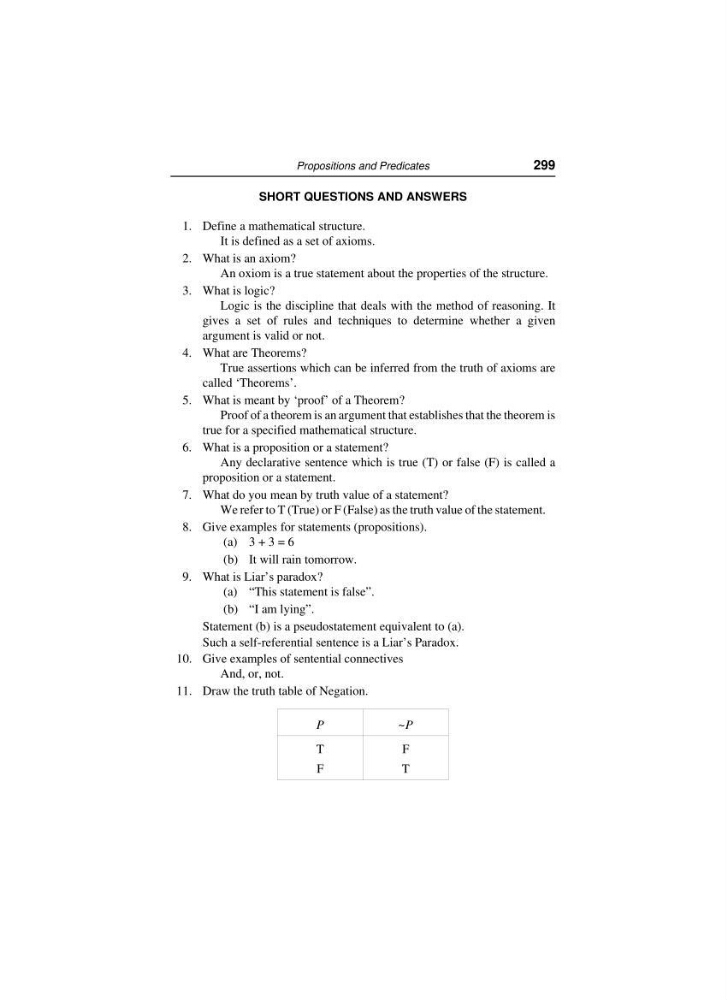
11. Draw the truth table of Negation.
P
~P
T
F
F
T
Prop o si tions and Pred i cates
299
1. Define a mathematical structure.
It is defined as a set of axioms.
2. What is an axiom?
An oxiom is a true statement about the properties of the structure.
3. What is logic?
Logic is the discipline that deals with the method of reasoning. It
gives a set of rules and techniques to determine whether a given
argument is valid or not.
4. What are Theorems?
True assertions which can be inferred from the truth of axioms are
called ‘Theorems’.
5. What is meant by ‘proof’ of a Theorem?
Proof of a theorem is an argument that establishes that the theorem is
true for a specified mathematical structure.
6. What is a proposition or a statement?
Any declarative sentence which is true (T) or false (F) is called a
proposition or a statement.
7. What do you mean by truth value of a statement?
We refer to T (True) or F (False) as the truth value of the statement.
8. Give examples for statements (propositions).
(a) 3 + 3 = 6
(b) It will rain tomorrow.
9. What is Liar’s paradox?
(a) “This statement is false”.
(b) “I am lying”.
Statement (b) is a pseudostatement equivalent to (a).
Such a self-referential sentence is a Liar’s Paradox.
10. Give examples of sentential connectives
And, or, not.
11. Draw the truth table of Negation.
P
~P
T
F
F
T
Prop o si tions and Pred i cates
299