

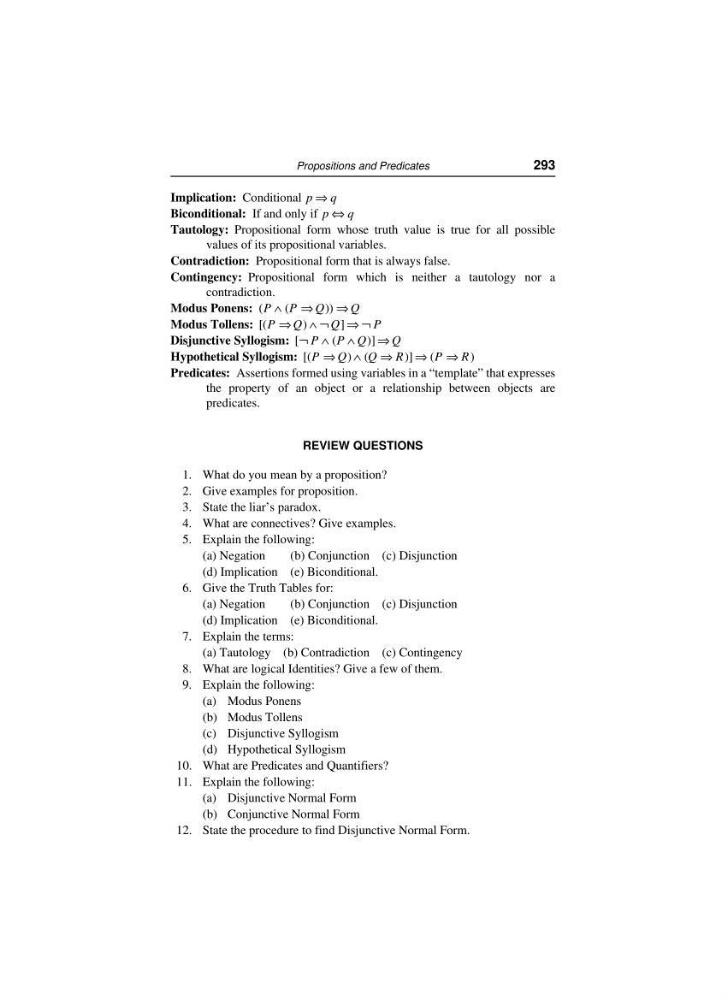
Implication: Conditional p q
⇒
Biconditional: If and only if p q
⇔
Tautology: Propositional form whose truth value is true for all possible
values of its propositional variables.
Contradiction: Propositional form that is always false.
Contingency: Propositional form which is neither a tautology nor a
contradiction.
Modus Ponens: (
(
))
P P Q
Q
∧
⇒
⇒
Modus Tollens: [(
)
]
P Q
Q
P
⇒ ∧ ¬ ⇒ ¬
Disjunctive Syllogism: [
(
)]
¬ ∧ ∧
⇒
P P Q
Q
Hypothetical Syllogism: [(
) (
)] (
)
P Q
Q R
P
R
⇒ ∧
⇒
⇒
⇒
Predicates: Assertions formed using variables in a “template” that expresses
the property of an object or a relationship between objects are
predicates.
REVIEW QUESTIONS
1. What do you mean by a proposition?
2. Give examples for proposition.
3. State the liar’s paradox.
4. What are connectives? Give examples.
5. Explain the following:
(a) Negation
(b) Conjunction (c) Disjunction
(d) Implication (e) Biconditional.
6. Give the Truth Tables for:
(a) Negation
(b) Conjunction (c) Disjunction
(d) Implication (e) Biconditional.
7. Explain the terms:
(a) Tautology (b) Contradiction (c) Contingency
8. What are logical Identities? Give a few of them.
9. Explain the following:
(a) Modus Ponens
(b) Modus Tollens
(c) Disjunctive Syllogism
(d) Hypothetical Syllogism
10. What are Predicates and Quantifiers?
11. Explain the following:
(a) Disjunctive Normal Form
(b) Conjunctive Normal Form
12. State the procedure to find Disjunctive Normal Form.
Prop o si tions and Pred i cates
293
⇒
Biconditional: If and only if p q
⇔
Tautology: Propositional form whose truth value is true for all possible
values of its propositional variables.
Contradiction: Propositional form that is always false.
Contingency: Propositional form which is neither a tautology nor a
contradiction.
Modus Ponens: (
(
))
P P Q
Q
∧
⇒
⇒
Modus Tollens: [(
)
]
P Q
Q
P
⇒ ∧ ¬ ⇒ ¬
Disjunctive Syllogism: [
(
)]
¬ ∧ ∧
⇒
P P Q
Q
Hypothetical Syllogism: [(
) (
)] (
)
P Q
Q R
P
R
⇒ ∧
⇒
⇒
⇒
Predicates: Assertions formed using variables in a “template” that expresses
the property of an object or a relationship between objects are
predicates.
REVIEW QUESTIONS
1. What do you mean by a proposition?
2. Give examples for proposition.
3. State the liar’s paradox.
4. What are connectives? Give examples.
5. Explain the following:
(a) Negation
(b) Conjunction (c) Disjunction
(d) Implication (e) Biconditional.
6. Give the Truth Tables for:
(a) Negation
(b) Conjunction (c) Disjunction
(d) Implication (e) Biconditional.
7. Explain the terms:
(a) Tautology (b) Contradiction (c) Contingency
8. What are logical Identities? Give a few of them.
9. Explain the following:
(a) Modus Ponens
(b) Modus Tollens
(c) Disjunctive Syllogism
(d) Hypothetical Syllogism
10. What are Predicates and Quantifiers?
11. Explain the following:
(a) Disjunctive Normal Form
(b) Conjunctive Normal Form
12. State the procedure to find Disjunctive Normal Form.
Prop o si tions and Pred i cates
293