

f P Q R
P Q R
P
Q R
P
Q
r
P
Q R
( , , ) (
) (
) (
)
(
)
=
∧ ∧
∨ ∧ ¬ ∧ ∨ ∧ ¬ ∧
∨ ¬ ∧ ¬ ∧
7
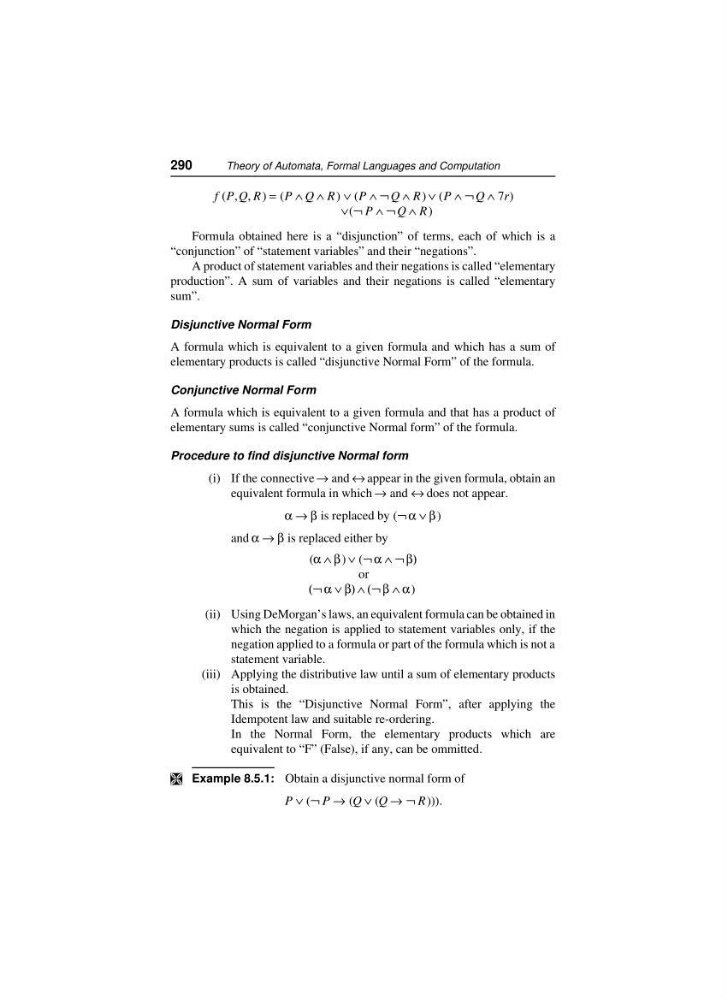
Formula obtained here is a “disjunction” of terms, each of which is a
“conjunction” of “statement variables” and their “negations”.
A product of statement variables and their negations is called “elementary
production”. A sum of variables and their negations is called “elementary
sum”.
Dis junc tive Nor mal Form
A formula which is equivalent to a given formula and which has a sum of
elementary products is called “disjunctive Normal Form” of the formula.
Con junc tive Nor mal Form
A formula which is equivalent to a given formula and that has a product of
elementary sums is called “conjunctive Normal form” of the formula.
Pro ce dure to find dis junc tive Nor mal form
(i) If the connective → and ↔ appear in the given formula, obtain an
equivalent formula in which → and ↔ does not appear.
α β
→ is replaced by (
)
¬ ∨
α β
and α β
→ is replaced either by
(
) (
)
α β
α
β)
( α β) ∧ ( β α
∧ ∨ ¬ ∧ ¬
¬ ∨
¬ ∧
or
(ii) Using DeMorgan’s laws, an equivalent formula can be obtained in
which the negation is applied to statement variables only, if the
negation applied to a formula or part of the formula which is not a
statement variable.
(iii) Applying the distributive law until a sum of elementary products
is obtained.
This is the “Disjunctive Normal Form”, after applying the
Idempotent law and suitable re-ordering.
In the Normal Form, the elementary products which are
equivalent to “F” (False), if any, can be ommitted.
Ì Exam ple 8.5.1: Obtain a disjunctive normal form of
P
P
Q Q
R
∨ ¬ →
∨ → ¬
(
(
(
))).
290
Theory of Automata, Formal Languages and Computation
P Q R
P
Q R
P
Q
r
P
Q R
( , , ) (
) (
) (
)
(
)
=
∧ ∧
∨ ∧ ¬ ∧ ∨ ∧ ¬ ∧
∨ ¬ ∧ ¬ ∧
7
Formula obtained here is a “disjunction” of terms, each of which is a
“conjunction” of “statement variables” and their “negations”.
A product of statement variables and their negations is called “elementary
production”. A sum of variables and their negations is called “elementary
sum”.
Dis junc tive Nor mal Form
A formula which is equivalent to a given formula and which has a sum of
elementary products is called “disjunctive Normal Form” of the formula.
Con junc tive Nor mal Form
A formula which is equivalent to a given formula and that has a product of
elementary sums is called “conjunctive Normal form” of the formula.
Pro ce dure to find dis junc tive Nor mal form
(i) If the connective → and ↔ appear in the given formula, obtain an
equivalent formula in which → and ↔ does not appear.
α β
→ is replaced by (
)
¬ ∨
α β
and α β
→ is replaced either by
(
) (
)
α β
α
β)
( α β) ∧ ( β α
∧ ∨ ¬ ∧ ¬
¬ ∨
¬ ∧
or
(ii) Using DeMorgan’s laws, an equivalent formula can be obtained in
which the negation is applied to statement variables only, if the
negation applied to a formula or part of the formula which is not a
statement variable.
(iii) Applying the distributive law until a sum of elementary products
is obtained.
This is the “Disjunctive Normal Form”, after applying the
Idempotent law and suitable re-ordering.
In the Normal Form, the elementary products which are
equivalent to “F” (False), if any, can be ommitted.
Ì Exam ple 8.5.1: Obtain a disjunctive normal form of
P
P
Q Q
R
∨ ¬ →
∨ → ¬
(
(
(
))).
290
Theory of Automata, Formal Languages and Computation