

For every non-zero real number x X
∈ there exists a non-zero real number
1
x
X
∈ such that
f
x
x
x
1
1
1
=
= .
Hence every element x X
∈ is an image of
1
x
. Therefore f is onto.
Therefore f is one-to-one and onto.
0.1.3 Graphs and Trees
Graphs
A graph G consists of a finite set V of objects called “Vertices”, a finite set E of
objects called “Edges”, and a function γ that assigns to each edge a subset {v,
w}, where v and w are vertices (and may be the same).
There fore we write
G V E
= ( , , )
γ .
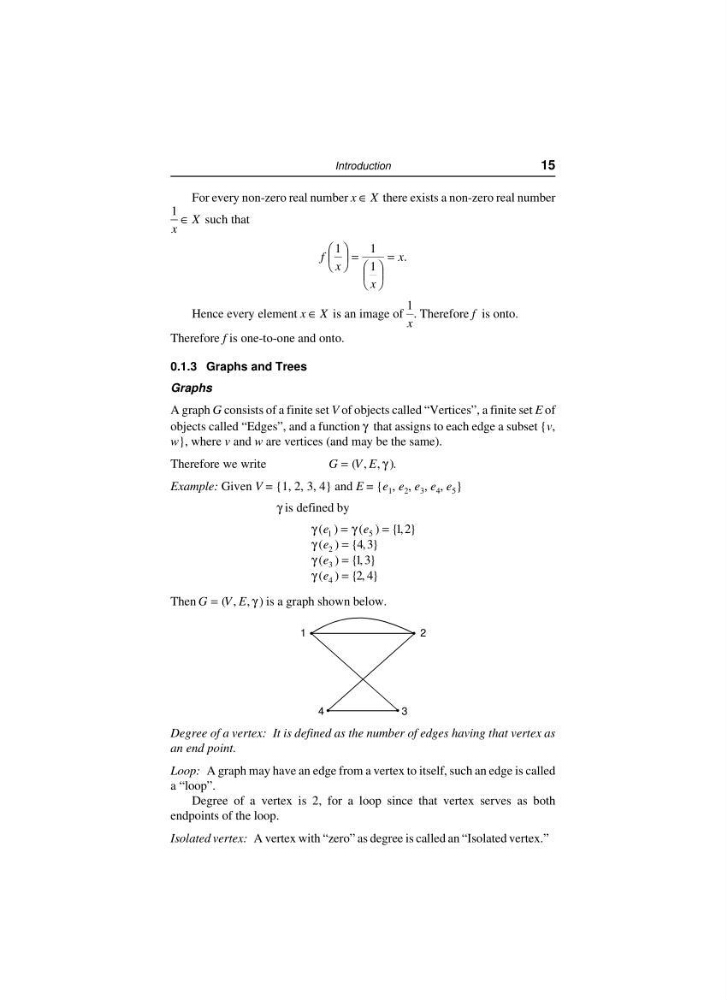
Example: Given V = {1, 2, 3, 4} and E = {e 1 , e 2 , e 3 , e 4 , e 5 }
γ is defined by
γ
γ
γ
γ
γ
( )
( ) { , }
( ) { , }
( ) { , }
( ) { , }
e
e
e
e
e
1
5
2
3
4
1 2
4 3
1 3
2 4
=
=
=
=
=
Then G V E
= ( , , )
γ is a graph shown below.
Degree of a vertex: It is defined as the number of edges having that vertex as
an end point.
Loop: A graph may have an edge from a vertex to itself, such an edge is called
a “loop”.
Degree of a vertex is 2, for a loop since that vertex serves as both
endpoints of the loop.
Isolated vertex: A vertex with “zero” as degree is called an “Isolated vertex.”
Introduction
15
1
2
3
4
∈ there exists a non-zero real number
1
x
X
∈ such that
f
x
x
x
1
1
1
=
= .
Hence every element x X
∈ is an image of
1
x
. Therefore f is onto.
Therefore f is one-to-one and onto.
0.1.3 Graphs and Trees
Graphs
A graph G consists of a finite set V of objects called “Vertices”, a finite set E of
objects called “Edges”, and a function γ that assigns to each edge a subset {v,
w}, where v and w are vertices (and may be the same).
There fore we write
G V E
= ( , , )
γ .
Example: Given V = {1, 2, 3, 4} and E = {e 1 , e 2 , e 3 , e 4 , e 5 }
γ is defined by
γ
γ
γ
γ
γ
( )
( ) { , }
( ) { , }
( ) { , }
( ) { , }
e
e
e
e
e
1
5
2
3
4
1 2
4 3
1 3
2 4
=
=
=
=
=
Then G V E
= ( , , )
γ is a graph shown below.
Degree of a vertex: It is defined as the number of edges having that vertex as
an end point.
Loop: A graph may have an edge from a vertex to itself, such an edge is called
a “loop”.
Degree of a vertex is 2, for a loop since that vertex serves as both
endpoints of the loop.
Isolated vertex: A vertex with “zero” as degree is called an “Isolated vertex.”
Introduction
15
1
2
3
4