

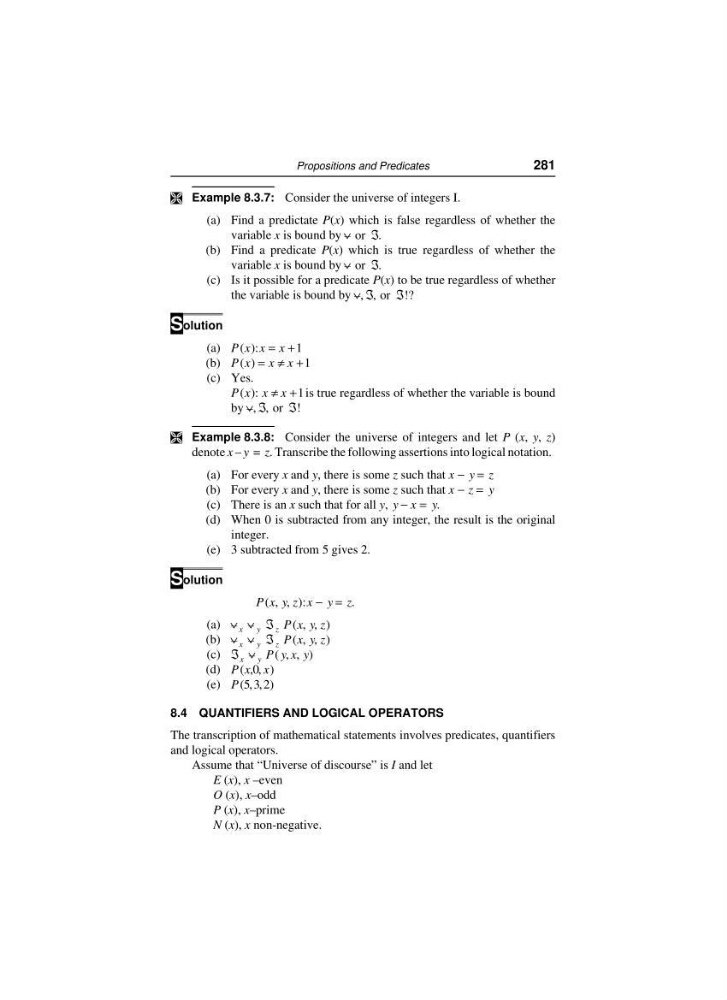
Ì Exam ple 8.3.7: Consider the universe of integers I.
(a) Find a predictate P(x) which is false regardless of whether the
variable x is bound by ∨
ℑ
or .
(b) Find a predicate P(x) which is true regardless of whether the
variable x is bound by ∨
ℑ
or .
(c) Is it possible for a predicate P(x) to be true regardless of whether
the variable is bound by ∨ ℑ
ℑ
, ,
!?
or
Solu tion
(a) P x x x
( ): = + 1
(b) P x x x
( ) = ≠ +1
(c) Yes.
P x x x
( ): ≠ +1 is true regardless of whether the variable is bound
by ∨ ℑ
ℑ
, ,
!
or
Ì Exam ple 8.3.8: Consider the universe of integers and let P (x, y, z)
denote x – y = z. Transcribe the following assertions into logical notation.
(a) For every x and y, there is some z such that x y z
− =
(b) For every x and y, there is some z such that x z y
− =
(c) There is an x such that for all y, y x y
− = .
(d) When 0 is subtracted from any integer, the result is the original
integer.
(e) 3 subtracted from 5 gives 2.
Solu tion
P x y z x y z
( , , ):
.
− =
(a) ∨ ∨ ℑ
x
y
z P x y z
( , , )
(b) ∨ ∨ ℑ
x
y
z P x y z
( , , )
(c) ℑ ∨
x
y P y x y
( , , )
(d) P x x
( , , )
0
(e) P ( , , )
5 3 2
8.4 QUANTIFIERS AND LOGICAL OPERATORS
The transcription of mathematical statements involves predicates, quantifiers
and logical operators.
Assume that “Universe of discourse” is I and let
E (x), x –even
O (x), x–odd
P (x), x–prime
N (x), x non-negative.
Prop o si tions and Pred i cates
281
(a) Find a predictate P(x) which is false regardless of whether the
variable x is bound by ∨
ℑ
or .
(b) Find a predicate P(x) which is true regardless of whether the
variable x is bound by ∨
ℑ
or .
(c) Is it possible for a predicate P(x) to be true regardless of whether
the variable is bound by ∨ ℑ
ℑ
, ,
!?
or
Solu tion
(a) P x x x
( ): = + 1
(b) P x x x
( ) = ≠ +1
(c) Yes.
P x x x
( ): ≠ +1 is true regardless of whether the variable is bound
by ∨ ℑ
ℑ
, ,
!
or
Ì Exam ple 8.3.8: Consider the universe of integers and let P (x, y, z)
denote x – y = z. Transcribe the following assertions into logical notation.
(a) For every x and y, there is some z such that x y z
− =
(b) For every x and y, there is some z such that x z y
− =
(c) There is an x such that for all y, y x y
− = .
(d) When 0 is subtracted from any integer, the result is the original
integer.
(e) 3 subtracted from 5 gives 2.
Solu tion
P x y z x y z
( , , ):
.
− =
(a) ∨ ∨ ℑ
x
y
z P x y z
( , , )
(b) ∨ ∨ ℑ
x
y
z P x y z
( , , )
(c) ℑ ∨
x
y P y x y
( , , )
(d) P x x
( , , )
0
(e) P ( , , )
5 3 2
8.4 QUANTIFIERS AND LOGICAL OPERATORS
The transcription of mathematical statements involves predicates, quantifiers
and logical operators.
Assume that “Universe of discourse” is I and let
E (x), x –even
O (x), x–odd
P (x), x–prime
N (x), x non-negative.
Prop o si tions and Pred i cates
281