

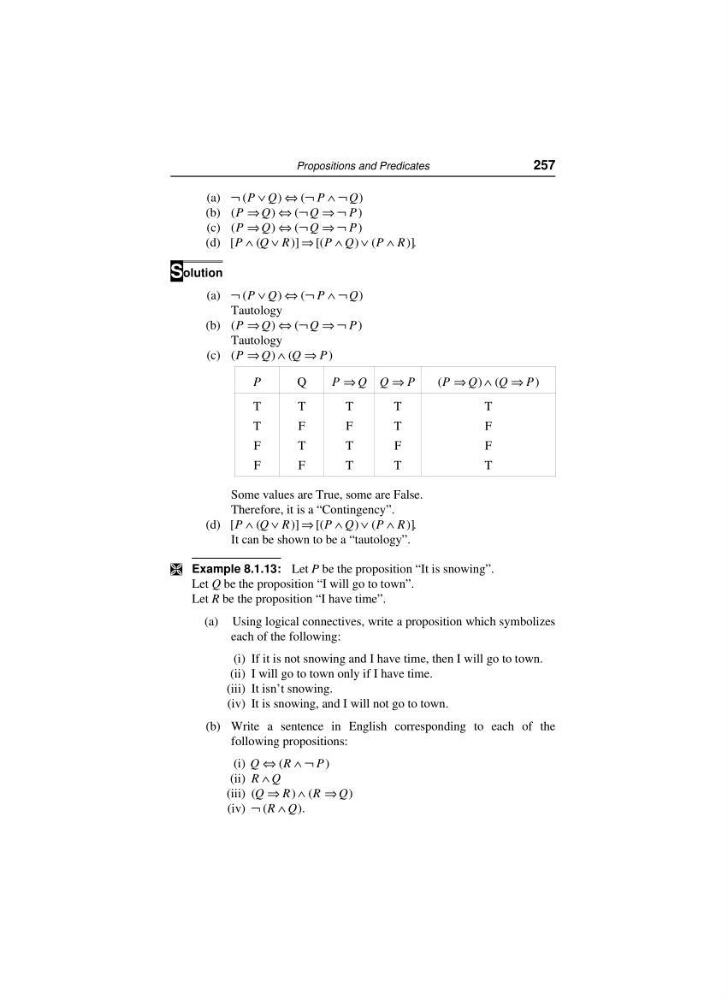
(a) ¬ ∨
⇔ ¬ ∧ ¬
(
)
(
)
P Q
P
Q
(b) (
)
(
)
P Q
Q
P
⇒
⇔ ¬ ⇒ ¬
(c) (
)
(
)
P Q
Q
P
⇒
⇔ ¬ ⇒ ¬
(d) [
(
)] [(
) (
)]
P Q R
P Q
P R
∧ ∨
⇒
∧ ∨ ∧
.
Solu tion
(a) ¬ ∨
⇔ ¬ ∧ ¬
(
)
(
)
P Q
P
Q
Tautology
(b) (
)
(
)
P Q
Q
P
⇒
⇔ ¬ ⇒ ¬
Tautology
(c) (
) (
)
P Q
Q P
⇒ ∧
⇒
P
Q
P Q
⇒
Q P
⇒
(
) (
)
P Q
Q P
⇒ ∧
⇒
T
T
T
T
T
T
F
F
T
F
F
T
T
F
F
F
F
T
T
T
Some values are True, some are False.
Therefore, it is a “Contingency”.
(d) [
(
)] [(
) (
)]
P Q R
P Q
P R
∧ ∨
⇒
∧ ∨ ∧
.
It can be shown to be a “tautology”.
Ì Exam ple 8.1.13: Let P be the proposition “It is snowing”.
Let Q be the proposition “I will go to town”.
Let R be the proposition “I have time”.
(a) Using logical connectives, write a proposition which symbolizes
each of the following:
(i) If it is not snow ing and I have time, then I will go to town.
(ii) I will go to town only if I have time.
(iii) It isn’t snowing.
(iv) It is snowing, and I will not go to town.
(b) Write a sentence in English corresponding to each of the
following propositions:
(i) Q
R
P
⇔ ∧ ¬
(
)
(ii) R Q
∧
(iii) (
) (
)
Q R
R Q
⇒ ∧
⇒
(iv) ¬ ∧
(
).
R Q
Prop o si tions and Pred i cates
257
⇔ ¬ ∧ ¬
(
)
(
)
P Q
P
Q
(b) (
)
(
)
P Q
Q
P
⇒
⇔ ¬ ⇒ ¬
(c) (
)
(
)
P Q
Q
P
⇒
⇔ ¬ ⇒ ¬
(d) [
(
)] [(
) (
)]
P Q R
P Q
P R
∧ ∨
⇒
∧ ∨ ∧
.
Solu tion
(a) ¬ ∨
⇔ ¬ ∧ ¬
(
)
(
)
P Q
P
Q
Tautology
(b) (
)
(
)
P Q
Q
P
⇒
⇔ ¬ ⇒ ¬
Tautology
(c) (
) (
)
P Q
Q P
⇒ ∧
⇒
P
Q
P Q
⇒
Q P
⇒
(
) (
)
P Q
Q P
⇒ ∧
⇒
T
T
T
T
T
T
F
F
T
F
F
T
T
F
F
F
F
T
T
T
Some values are True, some are False.
Therefore, it is a “Contingency”.
(d) [
(
)] [(
) (
)]
P Q R
P Q
P R
∧ ∨
⇒
∧ ∨ ∧
.
It can be shown to be a “tautology”.
Ì Exam ple 8.1.13: Let P be the proposition “It is snowing”.
Let Q be the proposition “I will go to town”.
Let R be the proposition “I have time”.
(a) Using logical connectives, write a proposition which symbolizes
each of the following:
(i) If it is not snow ing and I have time, then I will go to town.
(ii) I will go to town only if I have time.
(iii) It isn’t snowing.
(iv) It is snowing, and I will not go to town.
(b) Write a sentence in English corresponding to each of the
following propositions:
(i) Q
R
P
⇔ ∧ ¬
(
)
(ii) R Q
∧
(iii) (
) (
)
Q R
R Q
⇒ ∧
⇒
(iv) ¬ ∧
(
).
R Q
Prop o si tions and Pred i cates
257