

From ¬ and -, it is obvious that if P
Q
⇔ is true, then P Q
⇒ and Q P
⇒
is true.
From the above truth table, from ¬ & -, it is seen that if P Q
⇒ and
Q P
⇒ are true also P
Q
⇔ is true.
8.1.2 Tau tol ogy, Con tra dic tion and Con tin gency
(a) Tautology: A Tautology is a propositional form whose truth value is true
for all possible values of its propositional variables.
Example: p
p
∨ ¬ .
(b) Contradiction: A contradiction or absurdity is a propositional form which
is always false.
Example: p
p
∧ ¬ .
(c) Contingency: A propositional form which is neither a tautology nor a
contradiction is called a contingency.
Ì Exam ple 8.1.10: Show that P Q
⇒ has the same truth value as ¬ ∨
P Q
for all truth values of P and Q, i.e., show that (
)
(
)
P Q
P Q
⇒
⇔ ¬ ∨
is a
tautology.
Solu tion
P
Q
¬ P
P Q
⇒
¬ ∨
P Q
(
)
(
)
P Q
P Q
⇒
⇔ ¬ ∨
T
T
F
F
T
T
T
F
F
F
F
T
F
T
T
T
T
T
F
F
T
T
T
T
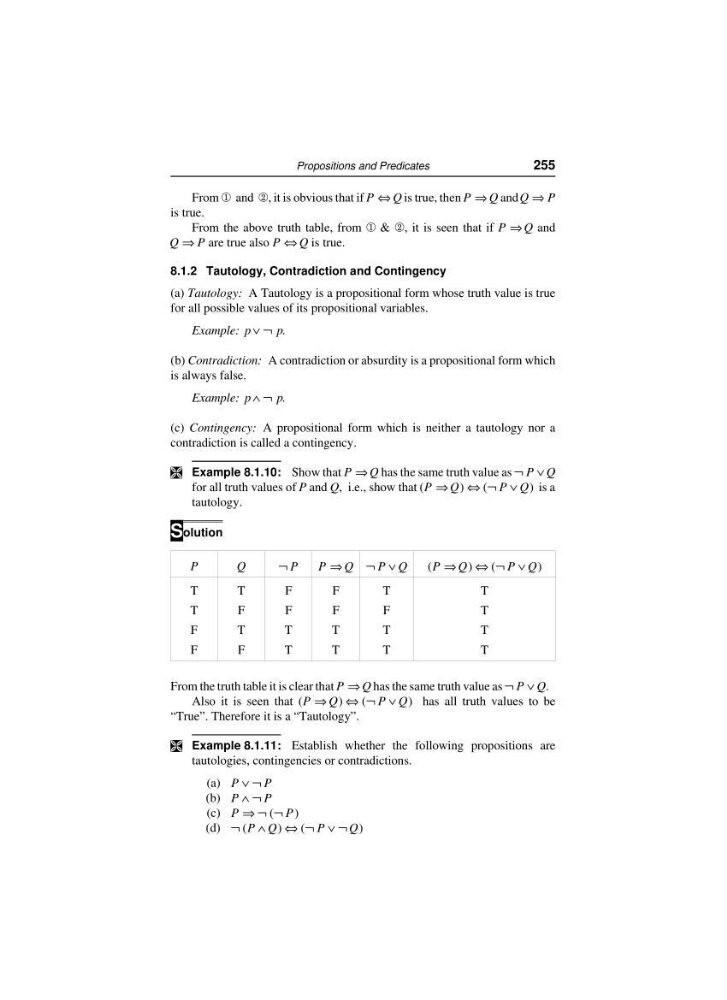
From the truth table it is clear that P Q
⇒ has the same truth value as ¬ ∨
P Q.
Also it is seen that (
)
(
)
P Q
P Q
⇒
⇔ ¬ ∨
has all truth values to be
“True”. Therefore it is a “Tautology”.
Ì Exam ple 8.1.11: Establish whether the following propositions are
tautologies, contingencies or contradictions.
(a) P
P
∨ ¬
(b) P
P
∧ ¬
(c) P
P
⇒ ¬ ¬
(
)
(d) ¬ ∧
⇔ ¬ ∨ ¬
(
)
(
)
P Q
P
Q
Prop o si tions and Pred i cates
255
Q
⇔ is true, then P Q
⇒ and Q P
⇒
is true.
From the above truth table, from ¬ & -, it is seen that if P Q
⇒ and
Q P
⇒ are true also P
Q
⇔ is true.
8.1.2 Tau tol ogy, Con tra dic tion and Con tin gency
(a) Tautology: A Tautology is a propositional form whose truth value is true
for all possible values of its propositional variables.
Example: p
p
∨ ¬ .
(b) Contradiction: A contradiction or absurdity is a propositional form which
is always false.
Example: p
p
∧ ¬ .
(c) Contingency: A propositional form which is neither a tautology nor a
contradiction is called a contingency.
Ì Exam ple 8.1.10: Show that P Q
⇒ has the same truth value as ¬ ∨
P Q
for all truth values of P and Q, i.e., show that (
)
(
)
P Q
P Q
⇒
⇔ ¬ ∨
is a
tautology.
Solu tion
P
Q
¬ P
P Q
⇒
¬ ∨
P Q
(
)
(
)
P Q
P Q
⇒
⇔ ¬ ∨
T
T
F
F
T
T
T
F
F
F
F
T
F
T
T
T
T
T
F
F
T
T
T
T
From the truth table it is clear that P Q
⇒ has the same truth value as ¬ ∨
P Q.
Also it is seen that (
)
(
)
P Q
P Q
⇒
⇔ ¬ ∨
has all truth values to be
“True”. Therefore it is a “Tautology”.
Ì Exam ple 8.1.11: Establish whether the following propositions are
tautologies, contingencies or contradictions.
(a) P
P
∨ ¬
(b) P
P
∧ ¬
(c) P
P
⇒ ¬ ¬
(
)
(d) ¬ ∧
⇔ ¬ ∨ ¬
(
)
(
)
P Q
P
Q
Prop o si tions and Pred i cates
255